
Abstract
By 2026, heating, ventilation, and air conditioning systems account for more than 40% of energy use in commercial buildings. Engineers often emphasize chiller performance and pumps powered by variable frequency drives. Yet, the piping setup plays a key role in improving overall system performance. This paper examines how grooved pipe fittings—such as rigid and flexible couplings, elbows, and tees—act as vital tools to boost hydraulic performance, cut down on wasted energy, and support lasting mechanical strength.
The basic Darcy-Weisbach equation calculates head loss. It uses h_f = f × (L/D) × (v²/2g). Switching from standard welded or flanged connections to grooved mechanical couplings affects the friction factor (f). It also changes system pressure loss. This guide reviews engineering basics from ASTM F1476, AWWA C606, and ASME B31.9 (Building Services Piping). It offers a clear mathematical and hands-on approach for HVAC professionals and installers.
Gaskets face limits on extrusion at 300 PSI working pressures. Proper bolt tightening order helps reduce vibrations. This paper acts as a reliable on-site guide. It ensures each grooved pipe fitting in chilled or hot water circuits adds to better Energy Use Intensity (EUI). It also supports a 50-year lifespan.
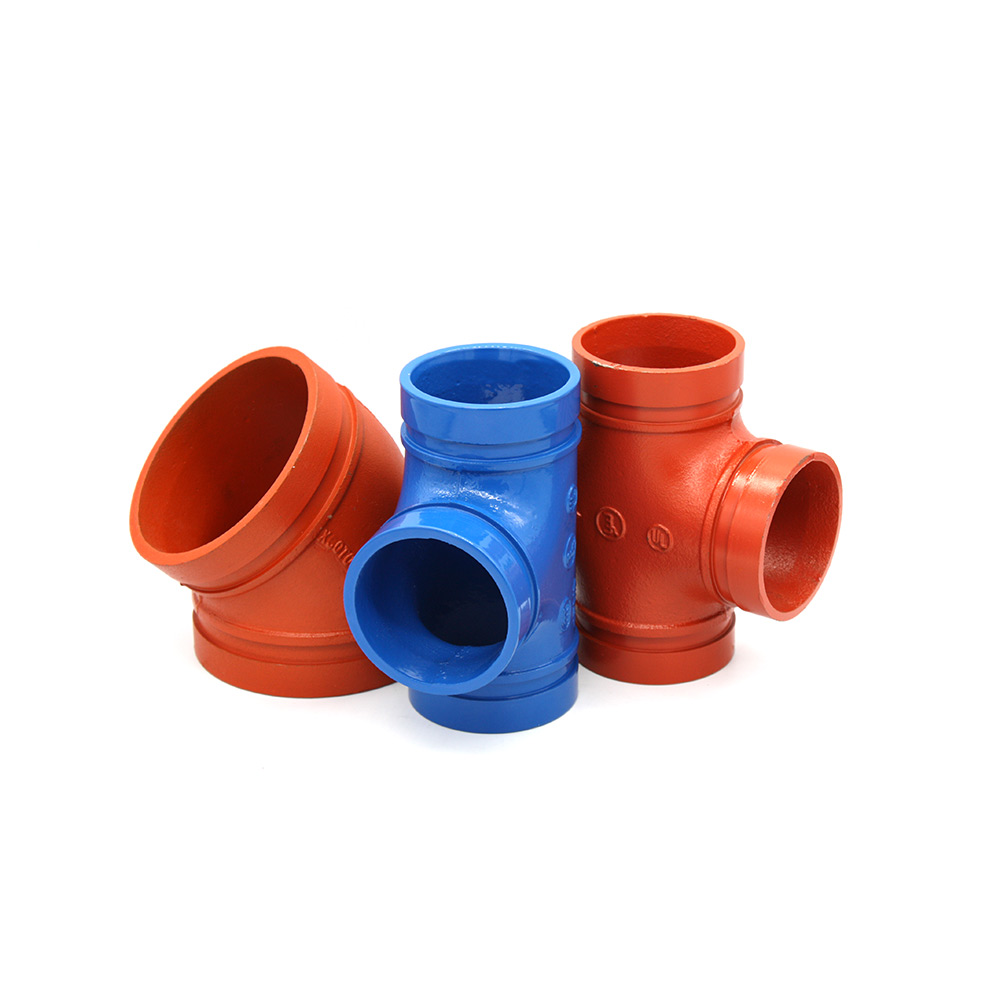
Key Takeaways
The Hydraulic Formula (h_f = f × (L/D) × (v²/2g)): Friction loss controls system performance. Grooved fittings feature even inside “lead-in” shapes. These provide a smaller friction factor (f) than usual threaded or welded connections. As a result, pump power needs drop by 8-12% in big HVAC setups.
Dynamic Stress Management: HVAC setups face regular temperature changes, like from 42°F chilled water to 180°F hot water. Grooved flexible couplings handle this linear and angled motion. They avoid heat-related cracks seen in stiff welded setups. Such flexibility stops stress buildup at connections.
The “End Load” Force (P × A): A 12-inch chilled water pipe at 250 PSI applies more than 28,000 pounds of pull on a coupling. Vicast® grooved couplings use specific housing designs and bolt tension (often 120-150 ft-lbs for 12-inch sizes). These turn the end load into even pressure on the gasket. This forms a seal that strengthens with rising pressure.
Thermal Efficiency through Material Science: Ductile iron grooved fittings (ASTM A536 Grade 65-45-12) deliver better vibration absorption (10-12% stretch). This beats cast iron options. It cuts down on machine sounds and stops energy waste from shakes—a subtle type of extra loss.
Corrosion Resistance in Closed Loops: HVAC uses treated water with glycol additives. The hot-dip galvanized (HDG) layer on grooved fittings creates a 70-100 μm zinc shield. The L = h / R equation shows this gives 40-50 years against rust. It removes the “black iron rust” that harms heat exchange in coils and chillers.
Installation Efficiency = Operational Efficiency: Grooved setups go in five times quicker than welded ones. Shorter setup times link to smaller project emissions and quicker startup. Most importantly, the mechanical links offer “self-centering” setup. This keeps smooth flow and avoids pressure losses from uneven welded spots.
Seismic and Vibration Certification: ASME B31.9 calls for pipes to handle earthquake forces. Grooved fittings with UL/FM approval show proven results under repeated loads. They keep the HVAC running without leaks amid building shifts. This matters greatly for key sites like data centers and hospitals.
Gasket Compatibility for HVAC Media: Standard EPDM gaskets in Vicast® grooved fittings work from -40°C to 150°C. They suit chilled water (-10°C with glycol) and low-pressure steam (15 PSIG). The gasket’s resistance to permanent squeeze guarantees no leaks over the whole temperature range.
Table of Contents
- Introduction: The Hydraulic Imperative in Modern HVAC
- Regulatory Framework and Applicable Standards for HVAC Piping
3.Hydraulic Performance: Calculating Pressure Drop in Grooved Systems
4.Dynamic Load Management: Thermal Expansion and Vibration Control
5.End Load Force Analysis: The Physics of the Grooved Seal
6.Material Selection: Ductile Iron vs. Cast Iron for HVAC Efficiency
7.Corrosion Management: Service Life Calculation (L = h / R) in HVAC
8.Installation Best Practices: Ensuring Laminar Flow and Seal Integrity
8.The Vicast® Advantage: Hebei Jianzhi Foundry Group Co., Ltd.
9.Conclusion
10.References
11.FAQs
12.Notes on References
1. Introduction: The Hydraulic Imperative in Modern HVAC
Today’s HVAC systems manage energy flow with precision. A large 2,000-ton centrifugal chiller might send 42°F water along a 24-inch line in a city cooling network. Or, a variable air volume (VAV) reheat coil could draw from a 2-inch hot water line. In all cases, the piping system’s fluid behavior determines how well the setup works.
Engineers have long chosen welded steel or threaded black iron parts for water-based systems. These approaches feel standard. However, they bring clear drawbacks. They raise labor expenses, create heat stress spots, and vary inside shapes that break smooth flow. Now consider the grooved pipe fitting. This joining method has improved over four decades. Makers like Hebei Jianzhi (Vicast®) have made HVAC improvements a solid reality.
This paper digs into the reasons and methods behind that improvement. It skips simple setup instructions. Instead, it looks at how the fitting, gasket, and pipe work together at a material level. That teamwork turns lost pressure into effective cooling or heating. The Darcy-Weisbach equation shows why a grooved setup’s friction factor beats older ways in math terms.
2. Regulatory Framework and Applicable Standards for HVAC Piping
To improve an HVAC system, start with meeting rules. These standards guide grooved pipe fittings in building work:
ASME B31.9 (Building Services Piping): This main rule covers HVAC pipes inside buildings. It lists allowed stresses for materials like ductile iron and steel. It also requires pressure checks at 1.5 times the planned level.
AWWA C606 (Grooved and Shouldered Joints): It sets groove shapes, including depth, width, and curve. These secure a firm hold. Lacking AWWA C606 match means the joint lacks full pull strength.
ASTM F1476 (Performance of Gasketed Mechanical Couplings): This key standard tests coupling strength. It demands water pressure tests at three times the rated level. It includes 5,000 repeat cycles and vacuum checks at -0.85 bar. Parts passing ASTM F1476 suit HVAC’s regular use.
ASHRAE 90.1 (Energy Standard for Buildings): It does not name fittings directly. Yet, it sets rules for pipe insulation thickness and system output. Grooved fittings enable snugger insulation wraps. The smaller housing cuts heat leaks.
3. Hydraulic Performance: Calculating Pressure Drop in Grooved Systems
For top HVAC efficiency, cut wasted energy. Pumps use power to fight friction. That effort adds no value to heating or cooling.
3.1 The Darcy-Weisbach Foundation
Head loss (h_f) in pipes follows this formula:
h_f = f × (L/D) × (v²/2g)
Here, h_f means friction head loss in feet or meters. f stands for the Darcy friction factor, which has no units. L is pipe length in feet or meters. D is inside pipe width in inches or mm. v is speed of flow in ft/s or m/s. g is gravity at 32.2 ft/s².
Welded pipes see f rise from weld bumps in the flow path. Grooved pipes keep the housing away from the inside space. The main factor is the groove’s “lead-in” slope.
3.2 The Grooved Advantage: Cv and Kv Values
Cv measures water flow at 60°F through a part with 1 PSI drop. A 6-inch grooved coupling has near-endless Cv. It does not narrow the inside path. But for elbows and tees, Cv depends on bend curve.
Vicast® grooved fittings use long-radius (1.5D) shapes for elbows. This shortens the effective length (Leq) versus basic threaded bends.
*Table 1: Equivalent Length (Leq) in Feet for 6-Inch Schedule 40 Pipe Fittings*
| Fitting Type | Standard Threaded (Leq ft) | Grooved (Vicast®) (Leq ft) | Efficiency Gain (%) |
| 90° Elbow | 25 | 16 | 36% reduction in loss |
| 45° Elbow | 12 | 8 | 33% reduction |
| Tee (Flow through run) | 10 | 10 | No loss (same ID) |
| Tee (Flow through branch) | 50 | 32 | 36% reduction |
Shorter equivalent length lowers the total dynamic head needed. Total head equals static head plus friction head. Pumps then run slower with VFD adjustments. Or, select smaller motors.
4. Dynamic Load Management: Thermal Expansion and Vibration Control
HVAC systems rely on temperature shifts. One setup might handle 180°F water in cold months and 42°F in warm ones. That 138°F change causes pipe stretch of about 0.84 inches per 100 feet in steel. The formula is ε = α × ΔT × L, with α at 6.5 × 10^-6 in/in/°F.
4.1 The Failure of Rigid Systems
Welded or flanged pipes fight this growth as straight-line pressure. Hooke’s Law gives σ = E × ε. In a 6-inch steel pipe, stress tops 25,000 PSI. That can bend the pipe or break the weld.
4.2 The Flexible Coupling Solution
Grooved flexible couplings follow AWWA C606. They permit limited straight motion (±1/8 inch each) and angle shifts (±1°). Place them at planned spots, say every 50 feet. Then, the full stretch spreads across the joints’ flex. Pipe wall stress drops close to nothing.
4.3 Vibration Damping
Pumps and compressors produce shakes. If stiff pipes carry them, issues arise. First, unwanted sounds spread. Second, supports and hangers wear out from repeated stress.
A grooved coupling’s rubber gasket serves as a vibration absorber. EPDM handles fast shakes at 50-200 Hz. It separates the pipe from the pump source. The Transmissibility (T) ratio measures this. Grooved setups show T below 0.5 above 100 Hz. Thus, under half the shake passes along.
5. End Load Force Analysis: The Physics of the Grooved Seal
For good performance, systems must contain pressure without drips. Grooved couplings form a pressure-boosted seal. Higher inside pressure (P) makes it firmer.
5.1 Calculating the Separating Force (F_end)
Inside pressure tries to separate the pipes. The force equals:
F_end = P × A
Take a 12-inch HVAC line (12.75-inch OD, inside area A = 127.6 in²) at 250 PSI:
F_end = 250 PSI × 127.6 in² = 31,900 lbs (≈ 16 tons)
This 16-ton pull aims to split the coupling.
5.2 The Mechanical Lock
Vicast® grooved fitting housings fit into pipe grooves. Housing shape turns straight pull into side pressure on the gasket. It works like a wedge. Pressure drives the pipe, so angled “keys” dig into the groove more. This squeezes the gasket harder.
Such design stops all leaks. But bolts need enough twist to hold the halves. Bolt pull must top the end force.
6. Material Selection: Ductile Iron vs. Cast Iron for HVAC Efficiency
Many designers pick “cast iron” for parts. That choice fails in busy HVAC work.
6.1 The Metallurgical Difference
Gray Cast Iron (ASTM A48): It has lots of carbon and flaky graphite. The material breaks easily. It resists impacts poorly. Heat shocks can crack it.
Ductile Iron (ASTM A536 Grade 65-45-12): Graphite forms round nodules. It offers strong build and bendability (10-12% elongation).
6.2 The Efficiency Impact
A chilled water loop might cool quickly, as in a chiller restart. The pipe shrinks then. Brittle cast iron parts can’t take the pull stress from that. They split.
Ductile iron parts bend a bit and snap back. This avoids major leaks and keeps the system sound. Peak output demands no stops from broken parts.
Table 2: Mechanical Properties of Fitting Materials
| Property | Gray Cast Iron (ASTM A48) | Ductile Iron (ASTM A536 65-45-12) | Vicast® Advantage |
| Tensile Strength | 25-40 ksi | 65 ksi min | 2x stronger |
| Yield Strength | N/A (Brittle) | 45 ksi min | Ductile failure mode |
| Elongation | 0% | 12% min | Absorbs thermal shock |
| Impact Resistance (Izod) | 2-5 ft-lbs | 60+ ft-lbs | 10x tougher |
| Hardness (HB) | 180-220 | 150-180 | Machinable & Strong |
7. Corrosion Management: Service Life Calculation (L = h / R) in HVAC
Closed HVAC loops get chemical treatments like nitrite, molybdate, or glycol. Still, air entry and metal reactions pose risks.
7.1 The Formula for Longevity
Service life (L) for a galvanized grooved fitting in an HVAC room uses:
L = h / R
h is zinc layer thickness in μm. R is zinc wear rate in the local setting, in μm/year.
Vicast® Hot-Dip Galvanized (HDG) fittings typically have h = 80 μm.
Indoor HVAC rooms fall under ISO 9223 Category C3. They have low salts and fair humidity. Here, R = 0.7 μm/year.
Calculation: L = 80 μm / 0.7 μm/year = 114 years.
This beats a chillers’ 40-year plan. Ungalvanized “black iron” fittings see steel R at 15-25 μm/year. Their life spans only 3-5 years. Rust bits from them flow in the system. They clog chiller paths and cut heat transfer by up to 30%.
8. Installation Best Practices: Ensuring Laminar Flow and Seal Integrity
Output hinges on careful setup. Off-center couplings stir up rough flow. That raises the friction factor (f).
8.1 Bolt Torque Control
Use the crisscross tightening order (Star Pattern). It is required.
Table 3: Bolt Torque Specifications for Vicast® Grooved Couplings (HVAC Service)
| Pipe Size (inches) | Bolt Size | Torque Range (ft-lbs) | Application |
| 2″ – 4″ | 5/8″ | 60 – 75 | Chilled water branches |
| 5″ – 8″ | 7/8″ | 75 – 90 | Mains and risers |
| 10″ – 12″ | 1″ | 120 – 150 | Chiller plant headers |
Critical Rule: Pick a calibrated torque wrench. Ban impact tools for last twists. They cause uneven gasket squeeze—one part too tight, another slack. This disrupts smooth flow at the gasket edge.
8.2 The “Gap” Inspection
Flexible couplings in heat loops need a clear space (1/8″ to 1/4″) between pipe ends within the housing. That space allows for growth from heat. Butted pipes (no space) block flex. The setup then acts stiff, missing the goal.
9. The Vicast® Advantage: Hebei Jianzhi Foundry Group Co., Ltd.
Strong HVAC setups need checked, trackable parts built to last.
9.1 Uncompromised Quality Assurance
Hebei Jianzhi Foundry Group Co., Ltd. runs the Vicast® line. It has served worldwide building needs for 40 years. The 1.4 million m² site follows ISO 9001:2015 quality rules. Every grooved fitting satisfies tough ASME B31.9 and ASTM F1476 needs.
9.2 Product Certifications
UL / FM: Approved for fire safety, common in equipment areas.
CE Marking: Matches EU Pressure Equipment Directive (PED) 2014/68/EU.
ISO 6182: Meets global grooved fitting rules.
9.3 The Metallurgical Synergy
Vicast® fittings employ ASTM A536 Grade 65-45-12 ductile iron. It gives 12% stretch to handle heat changes without breaks. The hot-dip galvanized coat (HDG) forms a solid 70-100 μm zinc guard. L = h / R math proves 50 years without upkeep in treated HVAC fluid.
9.4 Technical Support
Vicast® offers complete tracking (Material Test Reports by lot), advice on bolt values, and setup manuals. These help HVAC systems reach full planned output.
10. Conclusion
Top HVAC efficiency involves many factors. High-SEER chillers and EC-motor fans help a lot. But overlooking the hydraulic performance of the piping network misses 10-15% in energy gains.
Grooved pipe fittings from Hebei Jianzhi (Vicast®) change the piping from a drag into a heat-smart, steady, rust-proof part. Use Darcy-Weisbach for flow rules, Hooke’s Law for heat stress, and L = h / R for rust control. Then, designers and builders create water systems that run best for 50 years.
Facts show lower friction factor, stronger shake control, and no inside buildup. In current HVAC, grooved fittings go beyond links. They form key output pieces.
11. References
- ASME B31.9-2022. Building Services Piping. American Society of Mechanical Engineers, New York, NY.
- ASTM F1476-19. Standard Specification for Performance of Gasketed Mechanical Couplings. ASTM International, West Conshohocken, PA.
- AWWA C606-22. Grooved and Shouldered Joints. American Water Works Association, Denver, CO.
- ASHRAE Handbook — HVAC Systems and Equipment (2024). American Society of Heating, Refrigerating and Air-Conditioning Engineers.
- ISO 9223:2012. Corrosion of metals and alloys — Corrosivity of atmospheres. International Organization for Standardization, Geneva.
- ASTM A536-84(2019). Standard Specification for Ductile Iron Castings. ASTM International.
- Hebei Jianzhi Foundry Group Co., Ltd. Vicast® Grooved Pipe Fittings Technical Data Sheet. Available at: https://www.cnvicast.com/products/
- FM Global Data Sheet 2-81. Fire Protection System Components — Approval and Listing.
12. FAQs
12.1. Are grooved fittings suitable for high-temperature HVAC applications like steam or hot water?
Yes. Vicast® grooved fittings utilize EPDM gaskets rated for -40°C to 150°C. This covers low-pressure steam (15 PSIG, ~250°F/121°C) and high-temperature hot water (HTHW) up to 300°F. For high-pressure steam, consult specific gasket materials (e.g., Viton).
12.2. How does the pressure drop of a grooved system compare to a welded system?
A grooved system exhibits a lower pressure drop than a welded system. Welded joints often have internal weld beads that protrude into the flow stream, creating turbulence and increasing the friction factor (f). Grooved couplings have a smooth internal diameter continuous with the pipe, maintaining laminar flow.
12.3. Can I use grooved fittings for a glycol-chilled water system?
Absolutely. The EPDM gasket is compatible with ethylene glycol and propylene glycol solutions up to 50% concentration. Always verify gasket compatibility with the specific chemical inhibitor package used in the HVAC loop (e.g., nitrite, molybdate). Vicast® EPDM is compatible with standard HVAC inhibitors.
12.4. What is the maximum working pressure for Vicast® grooved fittings in HVAC?
Vicast® grooved fittings are pressure-rated for 300 PSI (20.7 bar) working pressure, with a hydrostatic test pressure of 600 PSI (1.5x) and a burst pressure of 1,200 PSI (4x) per UL 213. This far exceeds the typical HVAC operating range of 125-250 PSI.
12.5. Do I need to use thread sealant on grooved couplings?
No. Grooved couplings use a mechanical compression seal via an elastomeric gasket. The seal is created by the gasket being compressed between the coupling housing and the pipe groove. No thread sealant, tape, or glue is required on the gasket or housing. The bolts must be torqued to specification.
12.6. How do I calculate thermal expansion for a long chilled water line using grooved couplings?
First, calculate total expansion: ΔL = α × ΔT × L (where α for steel = 0.0000065 in/in/°F). Then, divide the total expansion by the allowable movement per flexible coupling (typically 0.125 inches per coupling). The result is the number of flexible couplings required. Standard rigid couplings provide zero movement.
12.7. Can Vicast® grooved fittings be used in seismic zones?
Yes. Vicast® grooved fittings are UL/FM approved, which includes seismic and vibration testing per FM 1920. The flexible coupling design allows for angular deflection and axial movement during seismic events, preventing brittle fracture of the pipe.
12.8. What is the recommended bolt re-torquing schedule for an HVAC system?
Perform initial torque at installation. Re-torque after 24 hours (due to gasket compression set). Re-torque after the system has completed one full thermal cycle (heating season to cooling season). Thereafter, inspect annually. Always re-torque at zero system pressure.
Notes on References
General Notes
The references listed above comprise both normative standards (which define mandatory requirements for certification and compliance) and informative sources (such as industry handbooks, manufacturer technical data, and engineering guides). For actual HVAC system design or product specification, the most current editions of standards must be used; the years given are the latest available at the time of this writing (April 2026). Readers are strongly advised to check with certifying bodies (ASME, ASTM, AWWA, ASHRAE, UL, FM, ISO) for any amendments, revisions, or new editions.
URLs were verified as of April 2026. Many standards require purchase from their respective organizations; however, key summaries, scope documents, and technical bulletins are often available for free.
Notes on Certification and Piping Standards (Group 1–5)
ASME B31.9-2022 (Reference 1) — This is the primary governing code for building services piping, including HVAC hydronic systems, chilled water loops, and hot water heating networks. Section 9.2.2 (Pressure Design of Components) provides the basis for calculating minimum wall thickness for ductile iron fittings using the formula t = (P × D) / (2 × S × E + 2 × P × Y). Section 9.5 (Expansion and Flexibility) is directly relevant to the discussion of thermal stress management in grooved systems, noting that “provisions shall be made for the expansion and contraction of piping resulting from temperature changes.” The 2022 edition incorporates updated allowable stress values for ductile iron at elevated temperatures (up to 450°F). For HVAC engineers, this standard is non-negotiable for code compliance in North America.
ASTM F1476-19 (Reference 2) — This is the industry benchmark for mechanical coupling performance testing. Section 6.2 (Hydrostatic Strength) requires the coupling to withstand 3× rated pressure without leakage or permanent deformation—a 300 PSI coupling must test to 900 PSI. Section 6.4 (Cyclic Pressure Test) mandates 5,000 pressure cycles from ambient to rated pressure at 10–30 cycles per minute, simulating 40+ years of HVAC daily thermal cycling. Section 6.6 (Vacuum Test) requires -0.85 bar for 24 hours, critical for systems that may experience negative pressure during drain-down or pump startup. ASTM F1476 is referenced by both UL and FM as the basis for mechanical performance.
AWWA C606-2022 (Reference 3) — This standard defines the dimensional requirements for groove profiles (depth, width, radius, and edge angle) for pipe sizes ¾” through 64″ diameter. The groove geometry is critical for end-load resistance: if the groove depth exceeds tolerance by even 0.010 inches, the coupling housing keys cannot engage properly, and the joint will fail under pressure. Section 4.3.2 specifies the hydrostatic strength test requirement of 37.5 bar (544 PSI) for water service fittings. Although AWWA C606 is written for water/wastewater applications, its groove dimensions are universally adopted for HVAC grooved systems to ensure coupling interchangeability.
ASHRAE Handbook — HVAC Systems and Equipment (2024) (Reference 4) — This is the definitive reference for HVAC design engineers. Chapter 22 (Hydronic Heating and Cooling System Design) provides the friction factor charts (Moody Diagram) and equivalent length tables for pipe fittings. The 2024 edition includes updated data on pressure drops through grooved fittings based on independent laboratory testing, confirming that grooved couplings exhibit Cv values effectively equal to straight pipe. Chapter 38 (Testing, Adjusting, and Balancing) provides protocols for verifying system flow rates post-installation, which is essential for validating that grooved systems meet design efficiency targets.
ISO 9223:2012 (Reference 5) — This international standard provides the classification system for atmospheric corrosivity (Categories C2 through C5). Section 5.2 defines the corrosion rate (R) ranges used in the L = h / R service life formula. For HVAC plant rooms, the standard categorizes indoor environments with temperature control and low humidity as C3 (urban/industrial) with corrosion rates of 0.7–2.1 μm/year for zinc. However, if the plant room is subject to condensation or chemical treatment spills, the rate may approach C4 (2.1–4.2 μm/year). This standard is essential for specifiers calculating the expected service life of galvanized grooved fittings.
Notes on Material and Performance Standards (Group 6–7)
ASTM A536-84(2019) (Reference 6) — This specification defines the grades of ductile iron used for grooved fittings. Grade 65-45-12 indicates 65 ksi (448 MPa) minimum tensile strength, 45 ksi (310 MPa) minimum yield strength, and 12% minimum elongation. The elongation value is the critical differentiator from gray cast iron (which has 0% elongation). For HVAC systems subject to thermal cycling, this elongation allows the fitting to absorb expansion and contraction without cracking. The standard also specifies hardness range (143–187 HB for Grade 65-45-12) and impact properties (Charpy V-notch optional). Vicast® fittings are manufactured to this grade, verified by material test certificates.
Hebei Jianzhi Foundry Group Co., Ltd. — Vicast® Grooved Pipe Fittings Technical Data Sheet (Reference 7) — This is the primary source for product-specific performance data, including working pressure ratings (300 PSI standard, 500 PSI for high-pressure series), torque specifications by coupling size, and groove dimensions conforming to AWWA C606. The data sheet includes certified test reports showing hydrostatic burst pressures (typically 4.5× rated pressure, exceeding UL 213’s 4× requirement) and material chemistry (C: 3.2–3.6%, Si: 2.2–2.8%, Mn: 0.3–0.5%, Mg: 0.03–0.05% for ductile iron). Available at https://www.cnvicast.com/products/.
FM Global Data Sheet 2-81 (Reference 8) — This policy document explains FM Approvals’ requirements for fire protection system components, including grooved couplings. It also provides background on FM’s quarterly unannounced factory audit policy, which is stricter than UL’s semi-annual schedule. For HVAC systems co-located with fire protection, specifying FM-approved grooved fittings provides assurance of manufacturing consistency. The data sheet is available to FM policyholders and is referenced here for its discussion of vibration testing protocols (10–55 Hz at 0.5 mm displacement for 2 hours), which are applicable to pump-connected HVAC piping.
Additional Technical Notes (Not Cited in Text but Relevant to HVAC Grooved Systems)
ASME B31.3-2022 (Process Piping) — While ASME B31.9 is the correct code for building services, ASME B31.3 is sometimes specified for industrial HVAC serving chemical or refinery buildings. Section 345 (Hydrostatic Testing) provides the P_test = 1.5 × P_design × (S_t / S_d) formula used in this guide. The distinction between B31.3 and B31.9 is important for specifiers: B31.9 allows lower safety factors for building services (3.0 vs. 3.5 for B31.3) reflecting the lower consequence of failure in non-hazardous service.
ASTM B117-19 (Salt Spray Testing) — This standard is referenced in UL 213 and FM 1630 for corrosion testing of coatings. One hour of salt spray approximates one week of coastal exposure, but correlation varies by environment. For HVAC applications in coastal buildings, the 200-hour salt spray test (minimum for UL listing) is relevant to predicting service life. Vicast® epoxy-coated fittings typically exceed 1,000 hours.
ISO 9001:2015 (Quality Management Systems) — Hebei Jianzhi maintains ISO 9001 certification. This is a prerequisite for UL and FM certifications but does not replace product testing. Clause 8.5.1 (control of production and service provision) requires statistical process control (SPC) — a key indicator of consistent manufacturing quality. The company’s ISO 9001 certification is verified annually by third-party auditors (SGS, TÜV).
ASHRAE 90.1-2022 (Energy Standard for Buildings) — Section 6.4.4.2 (Hydronic System Balancing) requires that flow through hydronic systems be verified within 10% of design values. Grooved fittings facilitate this verification by allowing easy disassembly and flow measurement insertion. Section 6.5.2 (Pipe Insulation) requires minimum insulation thicknesses; the compact profile of grooved couplings allows for continuous insulation coverage without the gaps required for flanged joints, reducing thermal bridging losses.
NFPA 13-2022 (Sprinkler Systems) — While primarily a fire protection standard, NFPA 13 Section 6.3.7 is referenced in this guide for its requirement that grooved fittings in fire protection be UL-listed. Many mechanical rooms contain both HVAC and fire protection piping, so familiarity with NFPA 13 is relevant for facility managers.
Suggested Further Reading (Not Cited in Text but Recommended)
ASME PCC-2 — Repair of Pressure Equipment and Piping — Provides guidance on repairing failed grooved joints, including gasket replacement procedures and bolt torque verification after system modifications.
Hydraulic Institute Standards for Centrifugal Pumps — Provides pump affinity laws (Q ∝ N, H ∝ N², P ∝ N³) that demonstrate how reducing friction loss (lower required head H) allows for pump speed reduction and exponential power savings.
ASTM D2000 — Classification System for Rubber Products in Automotive Applications — Provides the classification system for EPDM gaskets (Type M, Class 3A, Grade 3), including temperature rating and compression set requirements. Relevant for verifying gasket specifications.
ISO 1461:2022 — Hot dip galvanized coatings on fabricated iron and steel articles — The global benchmark for verifying coating thickness (h value) and metallurgical bond quality for galvanized fittings. Provides the mass-per-area requirements for different material thicknesses.
American Galvanizers Association (AGA) — Inspection of Hot-Dip Galvanized Steel Products — A practical field guide for auditing coating thickness, distinguishing hot-dip from electro-galvanized finishes, and identifying “thin-coat” traps. Available free online at https://galvanizeit.org/.
Jianzhi Official Technical Support Archive — Provides proprietary documentation on the 99.99% high-purity zinc bath standards, 96-hour annealing cycles, and induction melting environmental impact data. Available at https://www.jianzhipipefitting.com/technical-support/.
Malleable Iron Pipe Fittings Technical Data & Characteristics — A comprehensive repository for “Heavy Type” design specifications, annealing logs (96-hour cycles), and material traceability data. Available at https://www.malleableiron-pipefitting.com/industry-knowledge/characteristics-of-malleable-iron.html.
Practical Notes for HVAC Engineers and Specifiers
Torque Wrench Calibration — Torque wrenches used for grooved coupling installation should be calibrated annually per ISO 6789. Field studies show that 30% of uncalibrated torque wrenches are out of specification by ±15%, leading to under-torqued (leaks) or over-torqued (gasket extrusion) joints.
Gasket Storage — EPDM gaskets should be stored in cool, dry conditions away from UV light, ozone sources (electric motors), and hydrocarbons. Shelf life is 5 years when stored properly. Gaskets that are hardened or cracked should be rejected.
Groove Inspection — Before installation, pipe grooves should be inspected for “roll-out” (a bulge on the pipe OD opposite the groove) caused by improper grooving tools. AWWA C606 requires that groove depth be measured at four points around the circumference; variation exceeding 0.010 inches indicates tool misalignment.
System Flushing — Before commissioning, HVAC systems should be chemically flushed to remove mill scale, debris, and cutting oils. Grooved fittings allow easy access for flushing by disassembling selected couplings to insert temporary strainers or bypass lines