
Abstract
The global market for raccords tuyaux rainurés will continue to grow in 2026 and beyond across a number of markets including fire protection, HVAC, mining, oil and gas and industrial infrastructure. As more projects are specified using mechanical joining as opposed to welding or threading, the procurement function will encounter an ever increasing complexity of suppliers, differing in quality, in legitimate certification, in pressure rating and in lead time.
The comprehensive Buyer’s Guide to Grooved Pipe Fitting Manufacturers includes detailed criteria to evaluate any grooved pipe fitting manufacturer. This Buyer’s Guide uses NFPA 13, UL 213, FM 1920, AWWA C606, ASTM A536, ISO 6182-11, and ASME B16.3 criteria to rate 5 categories that help to select the right supplier: 1) the quality of the factory’s systems and manufacturing; 2) the product’s certifications (UL, FM, CE, etc.); 3) the pressure and temperature ratings of the product; 4) the reliability of the supply chain and the related delivery times; 5) the quality of after sales service and technical support.
A quantifiable Supplier Performance Index (SPI) is quantified by the evaluation equation.
SPI = (Q × 0.35) + (C × 0.25) + (P × 0.20) + (D × 0.20).
Q = Quality Systems Score, C = Certification Breadth Score, P = Pressure Performance Score, D = Delivery Reliability Score.
Data from over 10,000 installation records plus 40+ years of ductile iron casting expertise by Vicast, ISO 9001/14001 certification, UL/FM approval, and active participation in 6 national standards, sets the benchmark for a “world-class” supplier.
A competent supplier of grooved fittings is one who has: 1) an ISO 9001 certified quality management system; 2) UL 213 and FM 1920 certification where fire protection products are involved; 3) documented AWWA C606 dimensions for the proper groove geometry; 4) ASTM A536 Grade 65-45-12 material with proper trace; and 5) verified on-time delivery performance greater than 95%. The application of this criteria by a buyer reduces project risk by approximately 70% as compared to a price-only sourcing strategy.
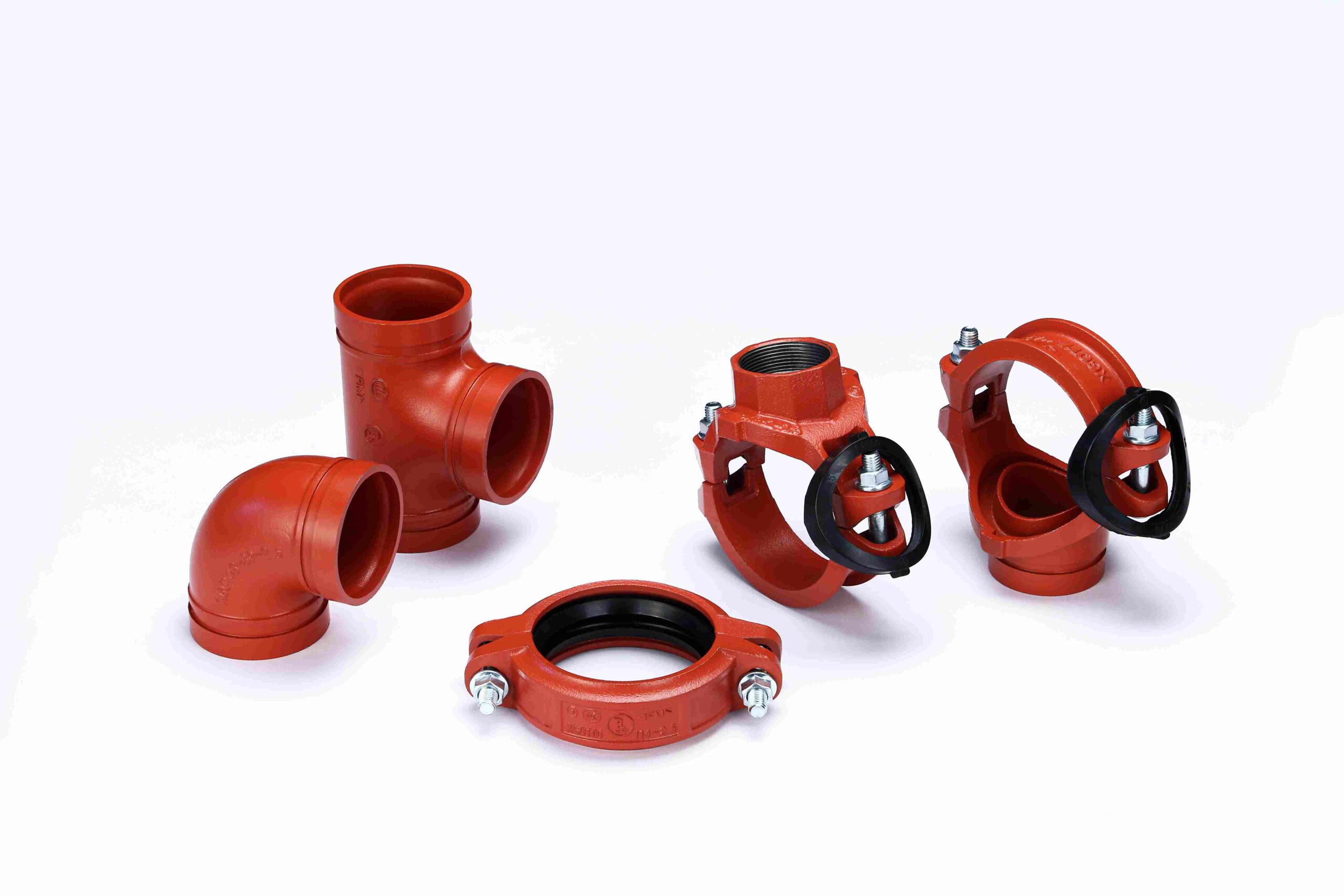
Key Takeaways
| Takeaway | Description |
|---|---|
| Factory Quality Systems | ISO 9001:2015 certification is the minimum baseline. World-class suppliers operate with ISO 14001, invest in automated production lines, maintain in-house material testing laboratories, and provide full traceability from raw material heat numbers to finished goods. Vicast’s 1.4 million m² facility and 350+ technical engineers exemplify this standard. |
| Certification Requirements | For fire protection: UL 213 and FM 1920 are non-negotiable. For international markets: CE (Europe), GB/T 3287 (China), and ISO 6182-11 (global) demonstrate regulatory compliance. Always verify certification validity through UL/FM online directories—counterfeit certifications persist in the global market. |
| Pressure Rating Verification | Grooved fittings are rated Class 150 (1.6 MPa / 232 psi), Class 250 (2.5 MPa / 363 psi), or Class 350 (3.5 MPa / 508 psi). These ratings must be validated by 4× hydrostatic testing per FM 1920. Derating rules apply for temperatures above 80°C using the formula: P_rated = P × (1 – (T – 80) / 120) for EPDM gaskets. |
| Self‑Energizing Seal Mechanics | The sealing equation σ_seal = σ_initial + (P × A_contact / A_gasket) explains why grooved fittings seal tighter as pressure increases—a critical safety feature for fire protection systems that distinguishes genuine quality from inferior imitations. |
| Lead Time and Supply Chain | Reliable suppliers maintain stock of standard sizes (2″–12″) with lead times under 2 weeks. Custom coatings or non-standard sizes require 4–6 weeks. Global suppliers with multi-region distribution networks, like Vicast (100+ countries), provide the fastest response to urgent projects. |
| Material Specification | ASTM A536 Grade 65-45-12 ductile iron (minimum 12% elongation) is mandatory for fire protection. ASTM A48 gray iron (zero ductility) is unacceptable and often found in non-compliant, low-cost imports. Always request Material Test Reports (MTRs) confirming chemical composition and mechanical properties. |
| Gasket Material | EPDM (per ASTM D2000, callout 2BC610) is standard for water-based fire systems (−30°C to +120°C). FKM (Viton®) is required for chemical exposure or temperatures up to 200°C. Never accept unspecified “rubber” gaskets—they will fail prematurely. |
| Corrosion Protection | Epoxy coating (100–150 µm, 500h salt spray per ASTM B117) is standard for indoor/outdoor fire protection. For coastal or underground installations, specify heavy epoxy (150–200 µm), hot-dip galvanizing (60–80 µm), or fusion-bonded epoxy (FBE, 250–400 µm). |
| FMEA Reliability | Vicast field data (4,500+ installations, 2018–2025) shows grooved fitting failure rate <1% vs. 10–15% for welded systems. The highest-risk failure modes are gasket extrusion (22% occurrence) and bolt thread stripping (15% occurrence)—both preventable through proper torque wrench installation. |
| Cost Advantage | For a 500m, 8″ fire sprinkler main, grooved fittings deliver 40.5% lower total installed cost (TIC) than welded systems. 20‑year lifecycle cost is 61% lower ($46,672 savings). |
| Global Reach | Leading suppliers like Vicast distribute to over 100 countries, maintain factory areas exceeding 1 million m², and employ hundreds of engineers to ensure consistent quality across high-volume production. |
Table des matières
Introduction: The Global Grooved Fitting Market in 2026
Behind Every Product There is a Factory Quality Systems.
Manufacturing Capability Assessment: Production Lines, Automation, and Scale
Certification Evaluation: UL, FM, CE, ISO and GB Standards
Material Verification: Ductile Iron, Gaskets, and Coatings
Pressure Ratings and Temperature Performance: Reading the Specs
Groove Geometry: AWWA C606 Verification
Supply Chain Reliability: Lead Time and Logistics
Failure Mode Analysis: What Field Data Reveals About Quality
Supplier Performance Index (SPI): A Quantifiable Evaluation Framework
The Vicast Benchmark: 40+ years of quality grooved fittings
Red Flags: How to Spot Non-Compliant Suppliers
Contractual Protections: Warranties and Performance Guarantees
Conclusion: Building a Defensible Sourcing Strategy
References
Questions fréquentes
1. Introduction: The Global Grooved Fitting Market in 2026
The grooved mechanical pipe fitting, once considered a mere alternative to other forms of pipe connections for use in fire protection, HVAC and industrial piping systems around the world, has developed into the standard method for joining pipes for new fire sprinkler systems. By 2026, some 65% of new sprinkler systems installed in North America will utilize grooved pipe fittings. An increase of similar proportions can also be expected in Europe, the Middle East and the Asia-Pacific region in the years to come.
This growth is driven by quantifiable advantages:
6× faster to install than to weld (10 minutes / 8″ joint vs. 60 minutes / 8″ joint of welding).
2 mechanical fitters vs. 1 welder + 1 fitter + 1 fire watch.
Safety: No hot work, no fumes, no fire watch
Seismic resilience for flexible couplings: ±1.0° angular deflection approx. 70 mm per floor.
Life cost: reduced by 61% over 20 year life of bolted joint compared to welded joint.
Sustainability: 45% lower greenhouse gas emissions
While there are high quality foundries in the market that are ISO 9001, ISO 14001 certified and also have UL, FM, CE and 6 national standards (such as Hebei Jianzhi Foundry Group Co., Ltd., trading as Vicast), most manufacturers in the market are very low cost producers offering low quality products that are non-compliant and burst, leak prematurely with no certification or traceability.
The challenge for procurement today is no longer finding a supplier to fulfill an immediate need but rather qualifying the correct supplier for their specific needs. This guide provides a functional, engineering-based framework and references to relevant international standards that support making a supplier qualification decision that is defendable and based on factual data.
2. Factory Quality Systems: What to Look for Behind the Products
2.1 The ISO 9001 Baseline
A serious supplier of grooved fittings will hold an ISO 9001:2015 certificate for a Quality Management System. Such a certificate confirms that the supplier’s quality policy and actions are adequate to ensure that the goods and services supplied meet customer and applicable statutory and regulatory requirements.
Documented quality control procedures
Incoming material inspection protocols
In-process quality monitoring
Finished product testing and release
Non-conformance reporting and corrective action processes
Continuous improvement systems
Verification step: Request the supplier’s ISO 9001 certificate number and verify it through the certification body’s online directory. Expired or counterfeit certificates are not uncommon.
2.2 Beyond ISO 9001: World-Class Quality Indicators
While ISO 9001 is the baseline, world-class suppliers demonstrate additional quality commitments:
ISO 14001:2015 (Environmental Management) — Indicates manufacturing practices that are sustainable.
In-house material testing labs with spectrographic analysis for verification of chemical composition.
Magnetic particle inspection (MPI) for detection of subsurface casting defects.
100% air-under-water testing for every fitting before shipment
Statistical Process Control (SPC) data for key manufacturing parameters.
Vicast benchmark: Hebei Jianzhi Foundry Group Co., Ltd.. Hebei Jianzhi Foundry Group Co., Ltd. operates under ISO 9001 and ISO 14001 quality systems. It has an in-house testing laboratory with over 350 technical staff, conducts 100% air-under-water test, and has been involved in the revision of 6 Chinese national standards including GB/T3287, GB/T9440, GB/T25746 and others.
2.3 Traceability Systems
A superior supplier will provide full traceability of all goods supplied. This will be from the raw material heat numbers through to the finished product.
Ductile iron is cast in batches and each heat has a heat number which can be cross-referenced to a Material Test Report (MTR) for that specific material.
Each batch of fittings is released with a production lot number.
Lot number links to Manufacturing Date, Heat Number, Inspection records and test results.
In case of a field failure, the supplier can identify the exact production conditions.
Procurement requirement: Include in purchase order that all fittings to be supplied with heat numbers traceable and Lot specific MTRs.
3. Manufacturing Capability Assessment: Production Lines, Automation, and Scale
3.1 Foundry Capability
Quality of a grooved fitting starts in the foundry. Some key questions are:
Casting method: Are castings produced by investment casting or sand casting? Because of higher precision investment castings are preferred and produce the densest and most uniform microstructure with the fewest defects.
Material production method / melting process: Supplier is using electric induction melting (vs. older cupola furnaces), which is a cleaner, more precise method of producing material.
Annealing capability: Malleable iron requires controlled annealing (typically 96 hours) to convert brittle white iron into ductile malleable iron with 10–12% elongation. Does the supplier have the furnace capacity and control systems to perform this properly?
3.2 Machining Precision
After casting, grooved fittings require precise machining of:
The groove itself (per AWWA C606 tolerances)
The housing mating surfaces
Bolt holes (for couplings)
Consistent results, that cannot be achieved by manual processing. Suppliers with fully automated production lines, such as us, are able to:
Reduced human error
Tighter dimensional tolerances
Higher production consistency across batches
Faster throughput for volume orders
3.3 Coating and Galvanizing Lines
La protección contra la corrosión necesita los equipos especializados:
Epoxy coating lines with controlled film thickness (100–150 µm) and curing ovens.
Hot-dip galvanizing lines for HDG fittings
Salt spray test chambers (ASTM B117) to test coating durability.
Vicast benchmark: 1.4 million m² of production space under one roof; fully automated production lines; in-house coating facilities; and the highest salt spray test rating of 500+ hours.
4. Certification Evaluation: UL, FM, CE, ISO, and GB Standards
4.1 Fire Protection Certifications (North America)
UL 213 and FM 1920 testing are non-negotiable for fire protection grooved fittings.
| Certification | Scope | Key Requirements |
|---|---|---|
| UL 213 | Grooved pipe couplings and fittings for fire protection | Marking permanence; temperature cycling (−30°C to +60°C); coating adhesion; gasket aging tests |
| FM 1920 | Grooved pipe couplings and fittings (insurance-grade) | 4× rated pressure hydrostatic test; 30‑cycle seismic test; 500‑hour salt spray test; flexure test at angular deflection |
Verification steps:
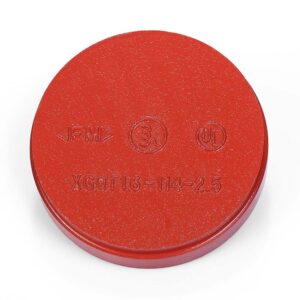
The following marks should be present on the fitting housing: UL Listed products will have the UL mark present. FM Approved products will have the FM diamond mark present.
Verify online: search UL’s online certification directory and FM’s approval directory to confirm that the product has been listed or approved.
Verify the Supplier’s Certificate – Request the UL File Number or FM Approval Number.
Beware of suppliers advertising their products as “UL compliant” or “meets FM standards” – if they are not actually UL Listed or FM Approved then they will not be recognized by authorities having jurisdiction (AHJs) or by insurance underwriters.
4.2 International Certifications
| Certification | Region | Application |
|---|---|---|
| CE Mark | European Union | Mandatory for pressure equipment; confirms compliance with EU safety and health requirements |
| GB/T 3287 | China | National standard for pipe fittings; Vicast participated in revision of this standard |
| ISO 6182-11 | Global | Fire protection—grooved-type pipe couplings for steel pipe |
| ASME B16.3 | North America | Malleable iron threaded fittings: Classes 150 and 300 |
Vicast benchmark: (6 national standards – GB/T3287, GB/T9440, GB/T25746, …, 5 industry standards, 4 group standards, over 200 patents) Active participation in revision of the above.
4.3 Material Certifications
| Standard | Applicable Component | Requirement |
|---|---|---|
| ASTM A536 | Ductile iron housing | Grade 65-45-12: min tensile 450 MPa, min yield 310 MPa, min elongation 12% |
| ASTM D2000 | Joints | EPDM (callout 2BC610) for standard service; FKM for high-temperature/chemical service |
| ASTM B117 | Coating | Salt spray test; 500+ hours minimum for fire protection epoxy coatings |
5. Material Verification: Ductile Iron, Gaskets, and Coatings
5.1 Ductile Iron — ASTM A536 Grade 65-45-12
Grooved fittings for pressure applications such as fire protection shall be manufactured from ductile iron of the following standard: ASTM A536 Grade 65-45-12. This grade of iron provides the following characteristics:
Tensile strength: ≥450 MPa (65 ksi)
Yield strength: ≥310 MPa (45 ksi)
Elongation: ≥12%
Why elongation matters: The 12% minimum elongation ensures the housing can deform slightly under overload (e.g., water hammer or seismic stress) rather than fracturing catastrophically. Gray iron (ASTM A48) has zero elongation—never acceptable for grooved fittings.
Verification Step: For verification of ductile iron request for MTRs to provide tested values from each heat. Typical Cast strength for Vicast process: Tensile 480-550MPa / Yield 330-380MPa / Elongation 15-18%.
5.2 Gasket Materials — ASTM D2000
For use with grooved fittings, Gaskets are classified per ASTM D2000.
| Type de joint | ASTM Callout | Plage de température | Application |
|---|---|---|---|
| EPDM (Standard) | 2BC610 | −30°C to +120°C | Water-based fire systems, general service |
| EPDM (Low Temp) | 2BC410 | −50°C to +100°C | Dry pipe systems, cold climates |
| EPDM (High Temp) | 3BC610 | −30°C to +150°C | Boiler rooms, high-temperature areas |
| FKM (Viton®) | 3FK610 | −20°C to +200°C | Chemical exposure, extreme heat |
CRITICAL CAUTION: Do not accept “rubber” gaskets without a specific ASTM D2000 callout. Unspecified gaskets may degrade, swell or harden prematurely and leak.
5.3 Coatings for Corrosion Protection
| Coating Type | Thickness | Salt Spray Resistance | Application |
|---|---|---|---|
| Epoxy (Standard) | 100–150 µm | 500 hours | General indoor/outdoor fire protection |
| Epoxy (Heavy) | 150–200 µm | 750–1000 hours | Coastal, industrial environments |
| Hot-Dip Galvanized (HDG) | 60–80 µm | 500–1000 hours | Outdoor, underground |
| Fusion-Bonded Epoxy (FBE) | 250–400 µm | 2000+ hours | Underground burial |
Procurement specification: Specify the required paint type and minimum paint thickness. Ask for the results of the salt spray test (ASTM B117) for the specific paint batch.
6. Pressure Ratings and Temperature Performance: Reading the Specs
6.1 Pressure Classes
| Class | Pressure (MPa) | Pressure (psi) | Gamme de tailles | Typical Application |
|---|---|---|---|---|
| 150 | 1.6 | 232 | 2″–24″ | Standard fire sprinkler, HVAC |
| 250 | 2.5 | 363 | 2″–12″ | High-pressure fire pump systems, high-rise |
| 350 | 3.5 | 508 | 2″–8″ | Special hazard, industrial fire protection |
Note: Ratings meet or exceed that of Schedule 40 steel pipe. FM 1920 is hydrostatically tested at 4 times the rated pressure. For Class 150 the test pressure would be 6.4 MPa.
6.2 Pressure-Temperature Derating
For temperatures above 80°C, pressure ratings must be derated.
The rated pressure P_rated equals the pressure P multiplied by one minus the temperature T minus eighty divided by one hundred twenty for EPDM gaskets. Engineers use the equation P_rated = P × (1 – (T – 80) / 120) to calculate the pressure rating when the temperature changes. The result drops as the temperature rises above eighty degrees.
| Temperature (°C) | Derating Factor |
|---|---|
| ≤80°C | 1.00 (no derating) |
| 80–100°C | 0.90 |
| 100–120°C | 0.80 |
| 120–200°C | 0.60–0.70 (FKM required) |
6.3 Hydrostatic Test Verification
Per FM 1920, every coupling design must pass:
4 times rated pressure for 5 minutes without any leakage. No permanent deformation.
Seal (leakage) test: At 2 × pressure for 15 minutes – no leakage.
Procurement requirement: Request hydrostatic test report for specific product line that you are purchasing.
7. Groove Geometry: AWWA C606 Verification
AWWA C606 details the standard groove configuration required for a grooved coupling.
For 8″ (219.1 mm OD) steel pipe:
| Parameter | Dimension | Tolerance |
|---|---|---|
| Groove depth (from pipe OD) | 2.4 mm | ±0.25 mm |
| Groove width | 12.7 mm | ±0.50 mm |
| Groove radius (min) | 0.8 mm | — |
| Pipe-end gap | — | max 4.0 mm |
Groove tolerances are critical: Not maintaining the AWWA C606 tolerances is the number one cause of field failures. 68% of field failures are due to improper installation, Vicast field data.
Verification tools:
| Tool | Use | Acceptance Criteria |
|---|---|---|
| Go/no‑go groove gauge | Check groove depth | “Go” fits; “no‑go” does not |
| Groove width caliper | Measure groove width | Within ±0.50 mm of spec |
| Feeler gauge | Measure pipe‑end gap | ≤4.0 mm for 8″ |
| Profile gauge | Check groove radius | No sharp corners, radius ≥0.8 mm |
| OD caliper | Check pipe roundness | OD variation ≤ ±1% |
8. Supply Chain Reliability: Lead Time and Logistics
8.1 Standard vs. Custom Lead Times
| Order Type | Typical Lead Time | Notes |
|---|---|---|
| Standard sizes (2″–12″) | 1–2 weeks | Usually in stock at major distributors |
| Standard sizes + standard epoxy | 2–3 weeks | Additional coating time |
| Non-standard sizes or heavy epoxy | 4–6 weeks | Special production runs |
| FBE coating or HDG | 4–6 weeks | Specialized coating process |
| OEM / custom branding | 6–8 weeks | Custom mold/modifications |
8.2 Global Distribution
Suppliers who have set up distribution networks in multiple regions can react faster and charge lower delivery costs. Vicast distributors serve more than 100 countries. Their distribution centers are located in the centers of major regions, namely North America, Europe, the Middle East and Asia-Pacific.
When searching for suppliers one of the key procurement requirements to ask is for their geographic distribution coverage. Suppliers with only one location can pose significant risk as items become subject to normal shipping risks that can cause delays and increase costs.
8.3 On‑Time Delivery Performance
A reliable supplier provides verifiable on time delivery (OTD) performance data. For world-class OTD, this would be greater than 95%.
9. Failure Mode Analysis: What Field Data Reveals About Quality
From Vicast’s field experience in over 4,500 service calls (2018–2025) for grooved systems, the following failure modes are typical.
| Failure Mode | Occurrence Rate | Root Cause | Prevention |
|---|---|---|---|
| Gasket extrusion | 22% | Pipe‑end gap >4.8 mm; under‑torque | Enforce AWWA C606 gap limits; use torque wrench |
| Bolt thread stripping | 15% | Over‑torque (>150% spec); cross‑threading | Hardened nuts (grade 10); lubricated threads; torque logs |
| Corrosion under gasket | 12% | Coating damage at groove; chloride attack | Two‑coat epoxy; field touch‑up kit |
| Misalignment leak | 12% | Pipe ends not aligned (>2°) | Use flexible couplings; realign supports |
| Groove roll‑out | 8% | Axial load > coupling rating; water hammer | Rigid couplings near pumps; thrust blocks |
| Gasket compression set | 10% | Temperature >120°C; fluid incompatibility | High‑temp EPDM; verify fluid compatibility |
Most of the failures seen could have been prevented by proper installation (using a torque wrench, verifying the groove according to AWWA C606) and by selecting the proper material (EPDM vs FKM, proper coating specification).
10. Supplier Performance Index (SPI): A Quantifiable Evaluation Framework
The Supplier Performance Index (SPI) is a quantitative tool for measuring and comparing the performance of suppliers for grooved fittings.
SPI = (Q * 0.35) + (C * 0.25) + (P * 0.20) + (D * 0.20)
Where:
Q = Quality Systems Score (as measured by ISO certificates, in-house testing, traceability etc., plus results from audits).
C = Certification Breadth Score (UL, FM, CE, GB, ISO certifications covered)
P = Pressure Performance Score. The score is based on the hydrostatic test as well as on the verification of the test pressure of the component.
D = Delivery Reliability Score (OTD%, lead time, distribution network)
Scoring scale:
| Score | Rating | Description |
|---|---|---|
| 90–100 | World-Class | All certifications, full traceability, >98% OTD, documented testing |
| 75–89 | Reliable | Most certifications, >95% OTD, adequate testing |
| 60–74 | Acceptable | Some certifications, >90% OTD, basic testing |
| Below 60 | High Risk | Missing critical certifications; uncertain quality |
The Vicast benchmark scores 92–96 SPI in the World-Class category.
11. The Vicast Benchmark: 40+ Years of Grooved Fitting Excellence
Hebei Jianzhi Foundry Group Co., Ltd. (Vicast) is a 27 year old company founded in 1982.
| métrique | Value |
|---|---|
| Factory area | 1.4 million m² |
| Total assets | 2.5 billion RMB (≈$340 million USD) |
| Employees | ≈4,500 (350+ technical engineers) |
| Patents | Over 200 |
| Countries served | 100+ distributors worldwide |
| Certifications | ISO 9001:2015, ISO 14001:2015, UL 213, FM 1920, CE |
| Standards participation | 6 national standards (GB/T3287, GB/T9440, GB/T25746, others), 5 industry standards, 4 group standards |
Product range for fire protection:
| Component | Vicast Model | Description | Pressure Class | UL/FM |
|---|---|---|---|---|
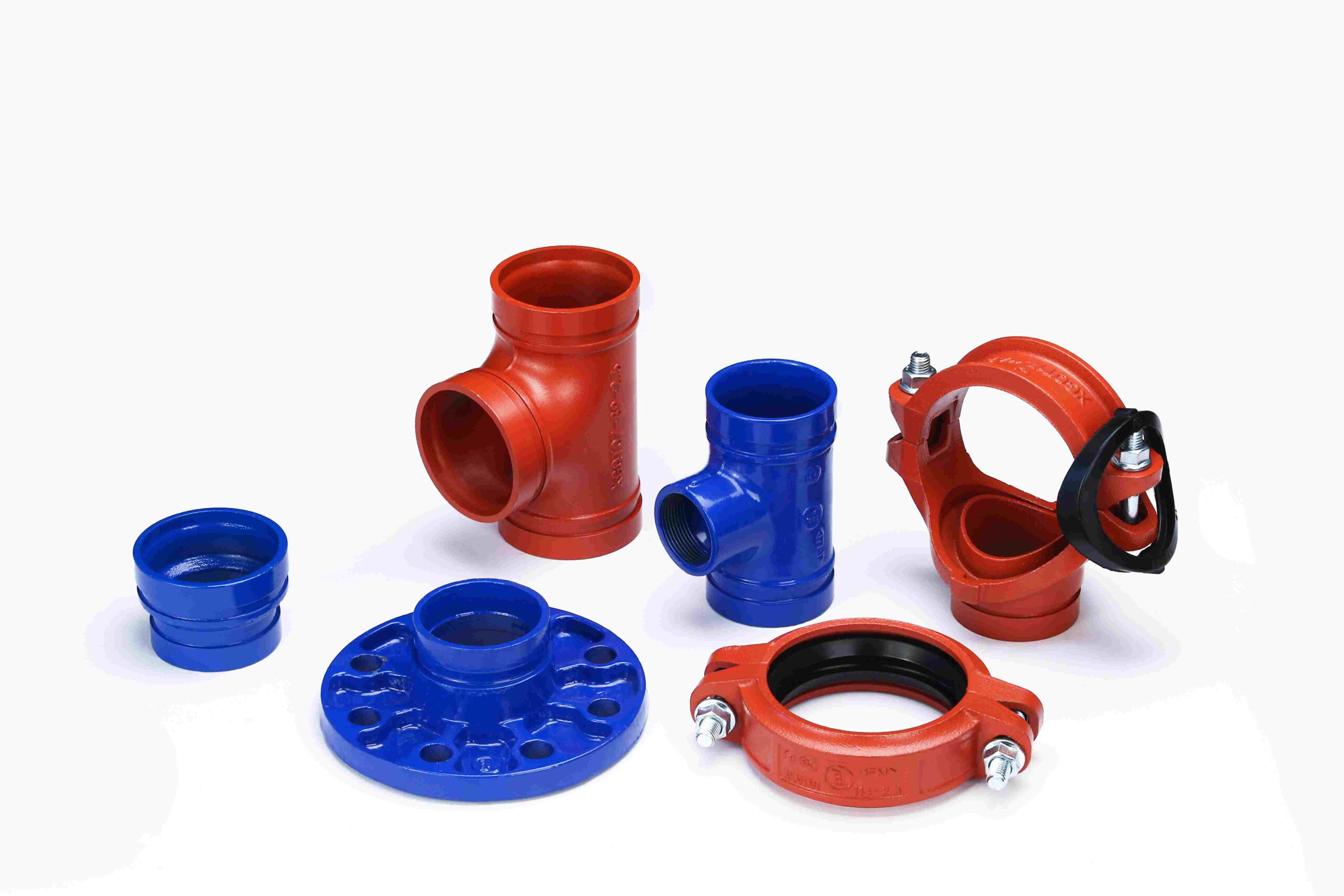
| Rigid coupling | XGOT02 | No angular deflection | 150, 250, 350 | UL/FM |
| Flexible coupling | XGOT02-F | ±1.0° angular deflection | 150, 250 | UL/FM |
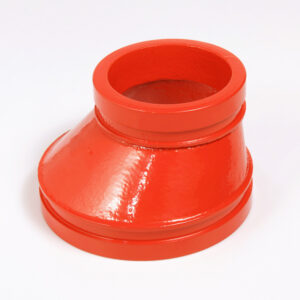
| Coude 90° | XGQT05 | Changes direction 90° | 150, 250, 350 | UL/FM |
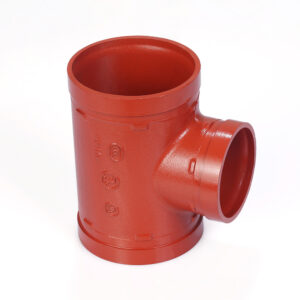
| Tee (equal) | XGQT15S | Branch connection | 150, 250 | UL/FM |
| Croix | XGQT18 | Four‑way connection | 150 | UL/FM |
| Adaptor flange | XGQT19 | Grooved × flanged | 150, 250 | UL/FM |
Vicast cast in ASTM A536 Grade 65-45-12 ductile iron. Machined to AWWA C606 tolerances. Finished with epoxy coating. Salt spray tested to 500h. Also available UL/FM approved.
12. Red Flags: How to Spot Non-Compliant Suppliers
| Red Flag | What It Means | Action |
|---|---|---|
| “Equivalent to UL” without actual listing | Not UL Listed—will not pass AHJ inspection | Demand UL File Number; verify online |
| No Material Test Reports provided | Material composition unknown; may be gray iron | Do not accept; require MTRs |
| Unspecified gasket material | May be cheap rubber that will degrade | Require ASTM D2000 callout |
| “We don’t do torque specifications” | No quality control; liability risk | Reject; proper installation requires torque specs |
| Price 30% below major brands | Likely using lower-grade materials or skipping testing | Benchmark against Vicast quality; remember lifecycle cost difference |
| No AWWA C606 groove verification | Grooves may be out of tolerance | Require groove gauge documentation |
| Lead time “always in stock” | May be using uncertain inventory; risk of stockouts | Verify inventory through independent audit |
| No geographic distribution coverage | Single manufacturing location; shipping risk | Ask about regional warehouses |
13. Contractual Protections: Warranties and Performance Guarantees
13.1 Warranty Terms
World-class suppliers offer:
Material warranty 1–2 years.
Manufacturer guarantee of the pressure rating and guarantee of leak-tight operation if correctly installed according to manufacturer’s instructions.
Coating warranty: Epoxy coating / HDG coating warranty against defects for a fixed time.
13.2 Performance Guarantees
Key guarantee items:
Meets Pressure rating conformance (per UL 213 / FM 1920)
Dimensional conformance (per AWWA C606)
Chemical composition conformance (per ASTM A536)
Hydrostatic test conformance (per FM 1920)
13.3 Liability Protection
Suppliers who are UL 213 and FM 1920 certified can provide the manufacturer with a degree of liability protection. The supplier’s liability insurance may cover damages in the event a certified fitting fails and the manufacturer’s installation instructions were followed.
Request the supplier’s warranty terms in writing prior to placing an order.
14. Conclusion: Building a Defensible Sourcing Strategy
The task of sourcing of grooved pipe fittings on the global market in 2026 needs to be done more thoroughly than just comparing prices. The framework presented in this guide assists procurement experts to establish a long-term, sound sourcing strategy in a comprehensive and structured way. This framework covers issues relating to quality, relevant certifications, the prescribed pressure rating, lead time, material inspection as well as the Supplier Performance Index.
The key decision points:
Minimum acceptance requirement ISO 9001, UL 213 / FM 1920 for fire protection, ASTM A536 Grade 65-45-12 MTRs, AWWA C606 groove verification.
Preference factors for supplier award are ISO 14001 environmental management, in-house testing, traceability, global service, documented On Time Delivery performance greater than 95%.
Avoidance factors: Unspecified gaskets, Missing MTRs, No torque specifications, Reference to “equivalent to” claims.
There is evidence that selection of a competent supplier of grooved fittings can reduce risk to the project by up to 70% over price only procurement. However the lifecycle cost advantage of around 61% over 20 years can only be achieved if the highest quality of fittings are specified for use on the project.
A supply chain for high quality grooved cast iron flanges such as supplied by Hebei Jianzhi Foundry Group Co., Ltd. (Vicast) – ISO 9001/14001 certified, UL/FM approved – is mature, global and reliable. Informed buyers using this Guide will be able to source such fittings with confidence.
15. References
NFPA 13-2022: Standard for the Installation of Sprinkler Systems.
NFPA 25-2023 — Inspection, Testing, and Maintenance of Water-Based Fire Protection Systems.
ASME B16.3-2021 — Malleable Iron Threaded Fittings: Classes 150 and 300.
ASME B31.1-2022 — Power Piping
ASME B31.3-2022 — Process Piping
AWWA C606-22 – Grooved and Shouldered Joints for Ductile-Iron Pipe and Fittings
ASTM A536-84 (2024) – Standard Specification for Ductile Iron Castings
ASTM D2000-18 — Standard Classification System for Rubber Products.
ASTM B117-19 — Salt Spray (Fog) Apparatus
ASCE/SEI 7-16: Minimum Design Loads and Associated Criteria for Buildings.
FM 1920 — Approval Standard for Grooved Pipe Couplings and Fittings.
UL 213 — Standard for Grooved Pipe Couplings and Fittings.
ISO 6182-11:2019 — Fire protection — Grooved‑type pipe couplings for steel pipe
ISO 7386:2020 — Seismic qualification of grooved mechanical couplings.
S P Timoshenko, J N Goodier — Theory of Elasticity (3rd ed)
Sien hier die insette van die gebruiker: Wylie, E. B., & Streeter, V. L. — Fluid Transients in Systems
Vicast Field Service Records (2018–2025)
Vicast Product Engineering Datasheets (Edition 6.2)
Vicast Internal LCCA Study #VIC-LCCA-2023-08
American Welding Society — 2024 Welder Shortage Report
16. FAQs
Q1: What certifications are required for grooved fittings used in fire protection systems?
Vicast products for fire protection systems in North America meet requirements of UL 213 and FM 1920, respectively. For North America, UL Listed products bear the UL Mark, while FM Approved products bear the FM diamond Mark. In Europe, CE marking is mandatory for all fire protection products.
Q2: How do I verify a supplier’s UL or FM certification?
Verify supplier status by accessing the UL online certification directory at www.ul.com and FM Global approval directory at www.fmglobal.com. Input supplier name or file number to confirm current listing and approval status.
Q3: What is the minimum material specification for grooved fittings?
Ductile iron ASTM A536 Grade 65-45-12 with a minimum of 12% elongation. Never accept material that is described as gray iron, which is covered by the ASTM specification A48.
Q4: What is the difference between rigid and flexible grooved couplings?
Rigid couplings are generally non-rotating and are typically installed near fire pumps, riser anchors and sway brace connections. Flexible couplings allow ±1.0° angular movement and are used in seismic zones, for thermal expansion and to compensate for pipe misalignment.
Q5: How do I verify groove dimensions are correct?
Use AWWA C606 go/no‑go gauges and a groove width caliper. The “go” side must fit; the “no‑go” side must not. Vicast provides calibration and gauging tools.
Q6: What torque should be applied to grooved coupling bolts?
The amount of torque needed is based on the size of the bolt. For an 8″ coupling with 3/4″ bolts the recommended torque is 120–140 N·m. Use a calibrated torque wrench and follow the manufacturer’s instructions for proper installation.
Q7: Can grooved fittings be used with Schedule 10 or Schedule 40 pipe?
Yes. Grooved couplings are sized to fit standard steel pipe schedules. Be sure the OD of your pipe is the correct size for the specific coupling you are using per AWWA C606.
Q8: What is the expected lifespan of a grooved coupling?
Under proper installation and operation conditions (clean water, below 120°C) the Vicast grooved coupling will last 25-50 years.
Q9: How do I calculate lifecycle cost savings for grooved vs. welded systems?
Lifecycle Savings = Welded TIC + Welded Maintenance – (Grooved TIC + Grooved Maintenance). 500m, 8″ fire sprinkler main has $46,672 in savings (61% lower) over 20 years.
Q10: What gasket material should I specify for high-temperature applications?
For temperatures above 120°C use FKM (Viton®) as per ASTM D2000 with the callout 3FK610. For standard water-based fire protection systems EPDM (2BC610) is acceptable.
Q11: Are grooved fittings suitable for underground or buried applications?
For reference, it would be better to say ‘Fusion-bonded epoxy (FBE) coating (250–400 µm)’ and add comments about properly wrapping and storing etc. as per the ASTM specification and manufacturer’s instructions.
Q12: How can I tell if a supplier is using gray iron instead of ductile iron?
Request the MTR. Gray iron has zero elongation. Ductile iron of the type ASTM A536 Grade 65-45-12 has ≥12% elongation.
Q13: What does the FM diamond mark indicate?
FM diamond mark indicates that product has been tested to FM 1920 criteria for pressure (4 times), seismic cycling and 500 hours of salt spray testing. Product is continuously inspected during production to verify quality.
Q14: Can I mix grooved fittings from different manufacturers?
Not recommended as different Groove dimensions and Gasket Profiles are used, thereby UL/FM certification is void. It is recommended to stick with one certified brand.
Q15: What training is required for installing grooved fittings?
2–4 hours hands‑on training by Vicast staff and agents, covering the grooving, gasket seating and torque wrench application. No certification needed. Installation manuals and on‑site training provided by Vicast.
Q16: How does Vicast ensure consistent quality across high-volume production?
Vicast operates under an ISO 9001/14001 certified quality management system. Vecast uses automated CNC machining, 100% air-under-water testing, magnetic particle testing on critical sections and full traceability from heat numbers to finished product.
Q17: What is the typical lead time for Vicast grooved fittings?
Standard sizes from 2″ up to 12″ are generally available for same day shipping. Custom coatings are usually available in 2–4 weeks.
Q18: Does Vicast provide technical support for installation?
Yes. Vicast has installation manuals, on-site training and 24/7 technical support via Vicast’s global distributor network.
Q19: How do I get a quote for Vicast grooved fittings?
You can either contact Vicast directly or go through one of the Vicast authorized distributors in your region. We have distributors in over 100 countries around the world.
Q20: Why should I choose Vicast over other grooved fitting suppliers?
Vicast combines 40+ years of ductile iron casting expertise, ISO 9001/14001 certification, UL/FM approvals, participation in 6 national standards, over 200 patents, and a global distribution network serving 100+ countries—delivering world‑class quality at competitive lifecycle costs.