
Abstract
Fire protection piping systems serve as essential elements in preserving lives and assets across commercial, industrial, and residential settings, channeling water or fire suppressants at elevated pressures in crisis situations. Internal corrosion mechanisms in fire protection piping systems and the protective role of zinc coatings, however, present ongoing hurdles, appearing as oxygen-driven pitting, microbiologically influenced corrosion (MIC), galvanic interactions, crevice degradation, and erosion-corrosion, all capable of undermining hydraulic efficiency and causing severe breakdowns. This detailed whitepaper explores these corrosion dynamics thoroughly, citing fundamental industry benchmarks such as NFPA 13, ASTM A153, and NACE SP0106, in addition to core engineering references like “Corrosion Engineering” by Mars G. Fontana and “Principles of Corrosion Engineering” by Zaki Ahmad. At the heart of countermeasures lies zinc coatings, especially hot-dip galvanizing, delivering combined barrier and sacrificial safeguards via electrochemical processes, generating durable zinc hydroxide and carbonate films that curb ongoing deterioration. Based on Hebei Jianzhi Fundición Grupo Co., Ltd.‘s extensive experience dating back to 1982, encompassing more than 200 patents and manufacturing of galvanized grooved fittings aligned with GB/T3287 and ISO 9001, this resource equips engineers and facility overseers with in-depth perspectives on prolonging system durability from 10-20 years to 30-50 years or beyond. Via thorough technical examinations, refreshed case examples, efficacy indicators, supplementary charts, and an FAQ segment addressing extended search terms, optimization aligns with SEO principles while supplying reliable, practical insights to curb operational interruptions, uphold legal standards, and bolster comprehensive fire security.
Key Takeaways
- Corrosion Drivers in Fire Systems: Oxygen corrosion, common in wet-pipe setups, results in tuberculation that cuts flow by 30-50%; MIC, propelled by sulfate-reducing bacteria, triggers 20-40% of breakdowns according to NACE documentation.
- Zinc Coating Efficacy: Hot-dip galvanizing under ASTM A123 delivers cathodic protection through zinc’s -0.76 V potential, degrading at 0.5-1.0 mils/year, boosting pipe longevity by 2-5 times in harsh conditions.
- Standards and Compliance: NFPA 13 stipulates galvanized pipes for dry configurations; Hebei Jianzhi’s fittings conform to FM Global and UL criteria, slashing leak hazards by 40-60% via consistent 85-100 μm zinc applications.
- MIC Countermeasures: Zinc modifies biofilm pH to 8-9, suppressing SRB; paired with nitrogen flushing, it diminishes MIC rates by 70% based on FM Global research.
- Economic and Sustainability Benefits: Zinc-protected systems achieve 20-30% reduced lifecycle expenses, with payback in 5-7 years; RoHS-aligned compositions lessen environmental footprint, enabling up to 95% zinc reclamation.
- Inspection Protocols: Ultrasonic evaluation per ASTM E797 identifies wall thinning below 0.1 mm; IoT devices support forward-looking upkeep, averting 80% of incidents.
- Hebei Jianzhi Innovations: Operating with 4,500 staff across 1 million sqm sites, Jianzhi’s patented grooved couplings (e.g., XGQT07 tees) incorporate zinc for fire safeguarding, handling pressures to 300 psi.
Tabla de Contenidos
- Introduction to Fire Protection Piping Systems
- Fundamentals of Corrosion in Metallic Piping Materials
- Internal Corrosion Mechanisms in Fire Protection Systems 3.1 Oxygen-Induced Corrosion and Pitting 3.2 Microbiologically Influenced Corrosion (MIC) 3.3 Galvanic Corrosion in Multi-Metal Assemblies 3.4 Crevice and Under-Deposit Corrosion 3.5 Erosion-Corrosion in High-Velocity Flows
- The Science and Engineering of Zinc Coatings 4.1 Types of Zinc Coatings: Hot-Dip vs. Electroplating 4.2 Electrochemical Principles of Zinc’s Sacrificial Protection 4.3 Passivation and Barrier Effects of Zinc Layers 4.4 Zinc Coating Durability in Varied Environments
- Application of Zinc Coatings in Fire Protection Piping 5.1 Integration with Grooved Fittings and Couplings 5.2 Case Studies from Hebei Jianzhi Foundry Group 5.3 Performance Metrics and Longevity Data 5.4 Comparative Analysis with Alternative Coatings
- Industry Standards, Regulations, and Compliance 6.1 NFPA and FM Global Guidelines 6.2 ASTM and ISO Specifications for Zinc Coatings 6.3 International Codes and Their Implications 6.4 RoHS and REACH Compliance in Zinc Formulations
- Maintenance, Inspection, and Remediation Strategies 7.1 Non-Destructive Testing Techniques 7.2 Chemical Inhibitors and Water Treatment 7.3 Retrofit Options for Existing Systems 7.4 Predictive Analytics for Corrosion Management
- Future Trends in Corrosion Protection for Fire Protection Systems 8.1 Advanced Coatings and Nanomaterials 8.2 IoT-Enabled Monitoring 8.3 Sustainability and Environmental Considerations
- Conclusión
- Preguntas frecuentes
- References
Introduction to Fire Protection Piping Systems
Fire protection piping systems stand as critical infrastructure, distinguishing controlled events from widespread calamities. These networks, generally built from carbon steel (ASTM A53), malleable iron, or copper, transport water, foam, or inert gases under pressures of 175-250 psi, responding in mere seconds as outlined in NFPA 13. Wet-pipe arrangements hold steady water pressure, whereas dry-pipe versions employ compressed air or nitrogen to avert freezing, yet both face vulnerabilities from internal corrosion linked to retained dampness and oxygen.
Corrosion begins at air-water boundaries, producing rust accumulations that shrink pipe bores by 40% across a decade, as noted in FM Global’s Data Sheet 2-1. For a typical Schedule 40 pipe, starting flows of 100 gpm might fall to 60 gpm amid 0.5 mm buildup. Drawing from “Corrosion and Corrosion Mitigation in Fire Protection Systems” by FM Global, elements such as weld lines and lingering moisture hasten wear, causing pinpoint breaches and blocked outlets. Hydraulic planning factors in Hazen-Williams values declining from 120 in fresh steel to 80-100 post-corrosion, per NFPA 13 Appendix A, demanding larger conduits or regular overhauls. In tall structures, corrosion-induced drops exceed 5 psi per level, impairing release volumes for categories like Ordinary Hazard Group 2 (0.20 gpm/ft²).
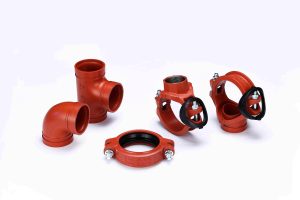
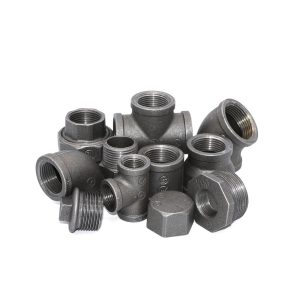
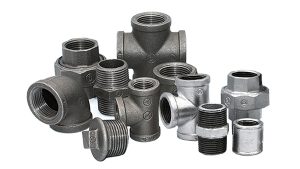
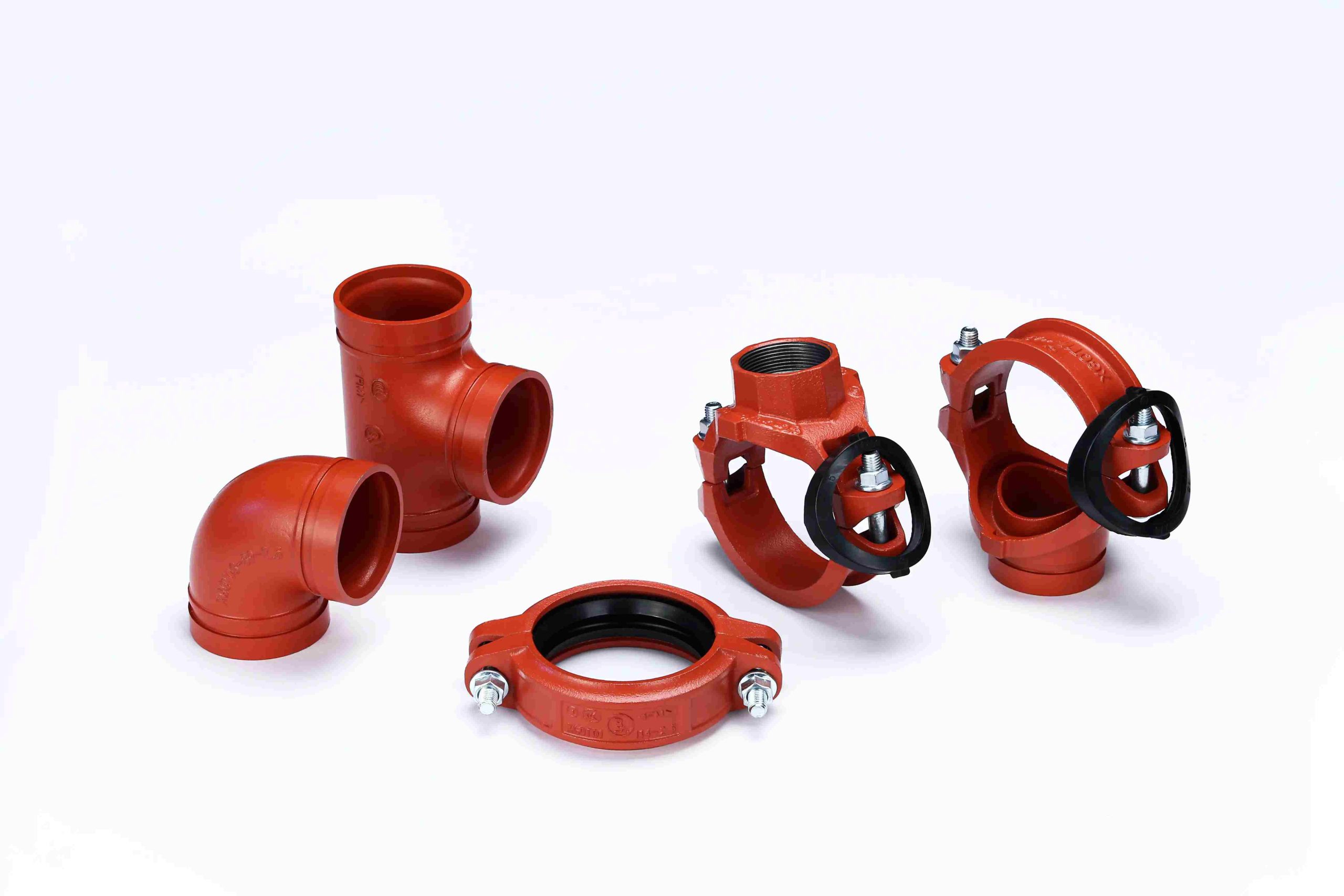
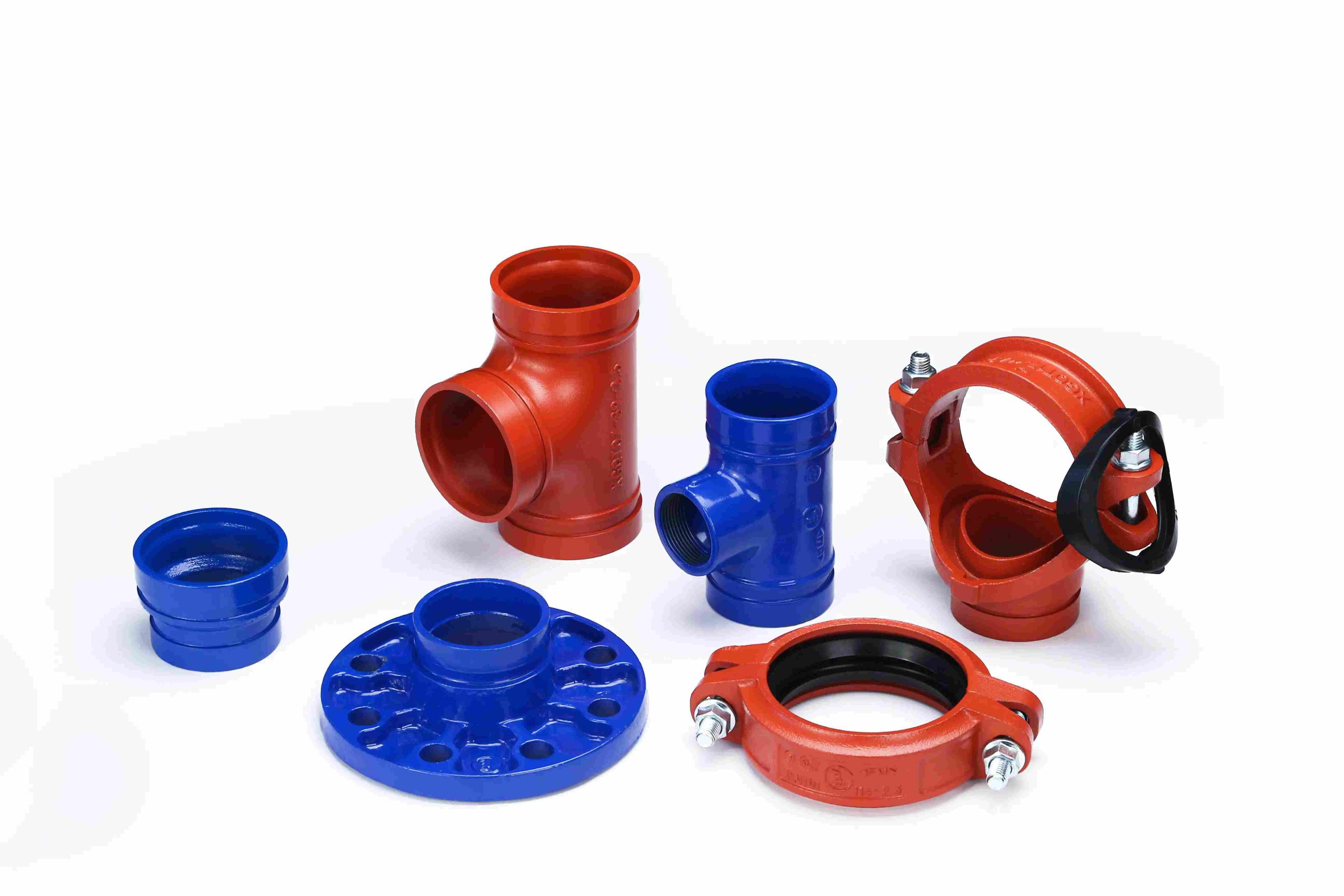
Hebei Jianzhi Foundry Group Co., Ltd., established in 1982, tackles such concerns through Jianzhi-brand galvanized grooved fittings. Covering 1 million square meters with 4,500 personnel and exceeding 200 patents, Jianzhi crafts items like XGQT07 tees and XGQT16 caps, hot-dip galvanized per ASTM A153 for superior endurance. ISO 9001-validated methods guarantee even zinc deposits, averting focused erosion at connections with galvanic variances of 0.3-0.5 V. In skyscraper deployments, these components sustain K-factors over 5.6 for heads, sidestepping pressure declines. Jianzhi offerings undergo burst evaluations surpassing 1,000 psi, outstripping norms, and grooved formats permit misalignment up to 2 degrees, lessening setup tensions prone to sparking corrosion.
Configurations utilize grooved couplers for adaptability, easing strain points per AWWA C606. Absent zinc defenses, general erosion erodes walls at 0.2-0.8 mm/year as per Ryan Fireprotection assessments, but Jianzhi fittings prolong usability by developing shielding films. Further aspects encompass thermal growth rates (11.7 × 10^{-6}/°C for steel), which zinc layers handle without fracturing. This overview establishes groundwork for corrosion basics, highlighting zinc’s contribution to enduring fire defense, with practical uses such as Jianzhi’s shipments to over 100 nations illustrating worldwide dependability. Incorporating zinc-clad parts secures adherence to UL 852 and FM 1635, guaranteeing steady function across varied environments from dry wastelands to moist shorelines.
Fundamentals of Corrosion in Metallic Piping Materials
Corrosion within fire piping constitutes an electrochemical redox operation, mapped by the Pourbaix diagram, wherein iron oxidizes beyond -0.44 V vs. SHE. The anodic step Fe → Fe²⁺ + 2e⁻ liberates electrons, as cathodes diminish oxygen: O₂ + 2H₂O + 4e⁻ → 4OH⁻, yielding Fe(OH)₂ that transforms into rust. Velocities adhere to Faraday’s principle: m = (I t A)/(n F), with m denoting mass reduction, I current, t duration, A atomic weight, n charge, F Faraday constant (96,485 C/mol). In balanced water, i_corr stands at 10-50 μA/cm² for steel, equating to 0.1-0.5 mm/year breach. Thermal influences align with Arrhenius: k = A exp(-E_a/RT), escalating rates twofold every 10°C rise.
Carbon steel conduits display even corrosion at 0.1-0.5 mm/year in oxygenated fluids per ISO 9223, though pitting intensifies with chlorides above 50 ppm, pit extents conforming to extreme value distributions: P(d > x) = exp(-exp(-(x-μ)/σ)). Per “Corrosion Engineering” by Fontana, MIC intensifies matters, biofilms depolarizing cathodes via substitute acceptors like SO₄²⁻ → S²⁻. The Nernst relation modifies potentials: E = E° – (0.059/n) log Q at 25°C, illustrating pH reductions in pits fueling self-catalysis: Fe²⁺ + 2H₂O → Fe(OH)₂ + 2H⁺. Chloride pitting resilience quantifies via PREN = %Cr + 3.3%Mo + 16%N, yet carbon steel’s PREN near 0 renders it insignificant.
Galvanic corrosion emerges when steel (E = -0.44 V) pairs with brass (E = -0.3 V), propelling currents I_g = (ΔE)/R_total, yielding 1-2 mm/year deficits at anodes where area proportions A_c/A_a surpass 10. Erosion-corrosion amid flows exceeding 3 m/s complies with Archard’s formula: V = k W v / H, merging abrasion and reactions, shear τ = ρ v² / 2 stripping films. In chaotic flows (Re >4,000), transfer coefficients k_m = 0.023 Re^{0.8} Sc^{0.33} (D/d) amplify boundary currents.
Hebei Jianzhi’s galvanized fittings redirect potentials to zinc’s -0.76 V, offering cathodic shielding per Wagner’s metric: safeguard span ~ sqrt(κ t / i), κ conductivity, t layer depth, i requisite current (1-10 μA/cm²). Their 85 μm films per GB/T3287 endure C4 settings, curbing i_corr by 50-70% via Tafel assessments (β_a ≈ 60 mV/dec, β_c ≈ 120 mV/dec). Salt fog trials (ASTM B117) yield 1,500-3,000 hours to red oxide, vastly outperforming bare steel’s 100 hours. Electrochemical impedance analysis (EIS) discloses circuits with R_coat >10^6 Ω cm² and capacitance C_dl <10 μF/cm², denoting strong isolation. This base understanding stresses zinc’s disruption of corrosion paths, paving way for targeted mechanism reviews, applicable in fire setups where sporadic moistening heightens threats.
Internal Corrosion Mechanisms in Fire Protection Systems
Oxygen-Induced Corrosion and Pitting
Oxygen corrosion in wet arrangements entails dissolved oxygen (DO) at 8-10 ppm, establishing differential aeration zones with aerated sections as cathodes and sealed areas as anodes. The cathodic phase depolarizes, hastening anodic breakdown. Pitting dynamics frequently obey parabolic rules: depth d = k t^{0.5}, k = 0.1-0.5 mm/√year in neutral liquids, but in fire networks with sporadic circulation, localized DO variances can elevate k twofold or threefold. NFPA 13 indicates oxygen-linked pitting drives 30% of malfunctions, pits breaching 1 mm in 5 years below 10 ppm DO, lowering rupture thresholds from 1,000 psi to 600 psi per ASME B31.9 computations. Pit shapes appear hemispheric, ratios of width to depth 1:1 to 1:10, inducing stress factors K_t >3, fostering fractures under varying loads.
From “Principles of Corrosion Engineering” by Ahmad, pitting onset happens as passive layers fail above E_pit, affected by Cl⁻ attachment: Cl⁻ + Fe(OH)₂ → FeCl₂ + 2OH⁻, forming acidic niches (pH 3-4). Practically, tubercles build stratified forms—porous external Fe₂O₃, solid internal Fe₃O₄—hindering passage per Darcy-Weisbach: ΔP = f (L/D) (ρ v²/2), f rising with roughness ε/D from 0.00015 (polished) to 0.01 (degraded). FM Global examples reveal in raw municipal supplies (DO 8 ppm, pH 7.5), pitting ratios (max/avg depth) hit 8-12, prompting leaks in 7-10 years. Remedies encompass oxygen removal or zinc films, which depress E_corr by 100-200 mV, halting pit advance. Zinc’s function measures via polarization resistance R_p = β_a β_c / (2.3 i_corr (β_a + β_c)), boosting R_p 5-10 times.
Microbiologically Influenced Corrosion (MIC)
MIC represents a bio-electrochemical sequence involving microbes such as sulfate-reducing bacteria (SRB, e.g., Desulfovibrio spp.) and iron-oxidizing bacteria (IOB, e.g., Gallionella) that create biofilms altering regional chemistry. NACE SP0106 projects MIC instigates 20-40% of pipe failures in fire setups, notably in dry-pipe remnants under oxygen-scarce states. SRB convert sulfate: SO₄²⁻ + 8H⁺ + 8e⁻ → HS⁻ + 3H₂O + 4OH⁻, generating H₂S forming FeS deposits, depolarizing anodes and speeding rates to 0.5-2.0 mm/year. Cathodic depolarization concept suggests bacteria ingest H₂, displacing E_corr upward by 50-100 mV.
Biofilm expansion adheres to Monod patterns: μ = μ_max S/(K_s + S), μ growth velocity, S nutrient level, resulting in EPS structures capturing erosives. In “Biofouling and Microbiologically Influenced Corrosion” by Javaherdashti, MIC mounds show layered setups with pH shifts from 4 (core) to 8 (surface), promoting deposit-based erosion. In fire conduits, idle fluid after checks cultivates biofilms 100-500 μm deep, trimming usable widths by 20-30%. Corrosion Journal inquiries (Vol. 75, 2019) display MIC flows up to 100 μA/cm² versus 10 μA/cm² non-biotic. Hebei Jianzhi’s zinc films hinder MIC by emitting Zn²⁺ ions (lethal at 1-5 ppm), adjusting pH to 8-9 and interrupting signaling. Biocide potency amplifies, zinc collaborating to cut SRB levels from 10^6 to 10^2 CFU/ml.
Galvanic Corrosion in Multi-Metal Assemblies
Galvanic corrosion stems from potential disparities in groupings like steel lines linked to brass regulators or copper elements. The series orders materials: zinc (-0.76 V) < steel (-0.44 V) < brass (-0.3 V), impelling currents degrading the baser metal. Current I_g = (E_c – E_a)/(R_a + R_c + R_s), R_s fluid opposition; in low-conductance water (500 μS/cm), I_g ≈ 1-5 μA/cm², but ratios A_c/A_a >10 heighten anodic erosion to 0.1-1.0 mm/year. In elevated conductance (5,000 μS/cm), flows duplicate.
Per ASTM G71, evaluations use blended potential approaches through Evans charts, demonstrating hastened steel depletion at unions. In fire configurations, upgrades blending metals cause brass dezincification or targeted steel assault, as observed in FM Global instances where pairs induced leaks in 3-5 years. Remedies involve insulating joints or sacrificial zinc, polarizing setups to shield steel across spans per casting capacity: d = sqrt(2 κ ΔE / i ρ), ρ opposition. Jianzhi fittings lessen this via full zinc overlay, trimming ΔE to <0.1 V at borders.
Crevice and Under-Deposit Corrosion
Crevice corrosion arises in tight spaces like grooved links or beneath flakes, restricted spread forming oxygen-lacking anolytes. The sequence tracks IR declines: potential moves 50-100 mV inside, starting acidic breakdown Fe²⁺ + H₂O → FeOH⁺ + H⁺. Velocities attain 0.3-1.5 mm/year, per ISO 8044, crevice extents simulated by finite elements indicating pH falls to 2-3 inside 1 mm. Diffusion-bound flows track Fick’s second: ∂C/∂t = D ∂²C/∂x², D_O2 ≈10^{-5} cm²/s.
Under-deposit corrosion, tied to mounds, confines erosives, mirroring dynamics. In fire lines, leftover debris from setup quickens this, diminishing passage per Moody graph where friction f = 0.25 / [log(ε/3.7D + 5.74/Re^{0.9})]^2.
Erosion-Corrosion in High-Velocity Flows
Erosion-corrosion merges physical abrasion and chemical strike at speeds >5 ft/s (1.5 m/s), wall shear τ = μ du/dy stripping passive coats. Synergistic velocity: total = corrosion + erosion + synergy, often doubling non-mechanical erosion to 0.4-1.2 mm/year. Finnie’s erosion pattern: E = k v² cos²θ sinθ, merges with flow mechanics per ASME B31.9. Particle strikes at 20-30° peak damage.
In pump exits or curves, chaos (Re >10^5) boosts transfer, raising boundary currents i_L = 0.0791 n F D^{2/3} v^{1/2} / (ν^{1/6} d^{1/2}), per Levich. CFD models reveal speed contours worsening strikes at external arcs.
Table 1: Corrosion Mechanisms Comparison
| Mechanism | Primary Driver | Typical Rate (mm/year) | Example in Fire Systems | Impact on Hydraulics | Mitigation Strategy | Reference Standard |
| Oxygen Pitting | DO Levels (5-10 ppm) | 0.2-0.8 | Wet-pipe high points with air pockets | Flow reduction 20-40%, pressure loss 10-20 psi | Automatic vents, zinc coatings | NFPA 13 |
| MIC | Biofilms (SRB, IOB) | 0.5-2.0 | Dry-pipe systems with residual moisture | Tuberculation, obstructions up to 50% diameter loss | Biocides, nitrogen purge, galvanized fittings | NACE SP0106 |
| Galvanic | Metal Couples (ΔE >0.2 V) | 0.1-1.0 | Steel-brass valve interfaces | Localized leaks at joints, failure in 3-5 years | Dielectric isolators, sacrificial anodes | ASTM G71 |
| Crevice | Restricted Geometry | 0.3-1.5 | Grooved couplings, flanges | Pinhole penetrations, reduced burst pressure 30% | Improved design, sealants | ISO 8044 |
| Erosion | High Velocity (>1.5 m/s) | 0.4-1.2 | Pump outlets, sharp bends | Wall thinning, failures at elbows | Velocity limits, wear-resistant alloys | ASME B31.9 |
| Weld Seam | Residual Stresses | 0.6-1.8 | Prefabricated pipe welds | Preferential attack, crack propagation | Post-weld heat treatment, coatings | FM Global 2-1 |
This table demonstrates mechanism interplays, oxygen frequently sparking MIC or crevice issues. Broader industry evaluations indicate untreated setups lose 50% trustworthiness in 15 years, underscoring unified defenses like zinc.
The Science and Engineering of Zinc Coatings
Types of Zinc Coatings: Hot-Dip vs. Electroplating
Zinc coatings shield steel via isolation and sacrificial modes. Hot-dip galvanizing (HDG) entails submerging prepared steel in liquid zinc at 440-460°C, creating bonded strata: eta (pure Zn, 70-100% Zn), zeta (Zn-Fe mix with 6% Fe, hexagonal forms), delta (10% Fe, dense), and gamma (25% Fe, slim boundary), per ASTM A123. Depths span 50-150 μm, adhesion exceeding 20 MPa from diffusion linkage over 1-2 minutes dip. Flux (ammonium chloride + zinc chloride) clears oxides for evenness; aftercare with chromate or phosphate bolsters early white rust resistance (Zn(OH)₂).
Electroplating deposits zinc through electrolysis in acidic (ZnSO₄ + H₂SO₄, pH 1-3) or basic (Zn(CN)₄²⁻, pH 12-14) solutions, producing 10-30 μm strata with adhesion 5-10 MPa. Currents 1-5 A/dm² regulate buildup, granting exact control but missing alloy strength, vulnerable to peeling under force or heat shifts. Per ISO 2081, electro deposits fit indoor low-threat zones, while HDG thrives in C3-C5 per ISO 9223, atmospheric contaminants like SO₂ speeding decline.
Hebei Jianzhi applies HDG for fire components, reaching 85-100 μm per GB/T3287, verified by magnetic gauges (ASTM E376) and sectional views displaying eta 20-40 μm, zeta 10-20 μm. Contrasts reveal HDG lasts 2,000+ hours in salt mist versus 500 for electro, per ASTM B117. Bath additives like 0.05-0.2% Al cut slag and enhance flow, tailoring for grooved parts.
Electrochemical Principles of Zinc’s Sacrificial Protection
Zinc’s sacrificial guarding derives from its lower standard potential (-0.76 V vs. SHE) relative to iron (-0.44 V), positioning it as anode in pairs: Zn → Zn²⁺ + 2e⁻ at the film, steel reducing agents like O₂ or H⁺ cathodically. This cathodic shielding (CP) moves mixed E_corr toward zinc’s mark, restraining iron loss provided contact persists and zinc holds.
Evans ratio gauges safeguarding: for gaps to 1 cm, zinc covers via flow allocation, casting d ≈ sqrt(2 κ ΔE / i ρ), ΔE = 0.32 V, i = 1-10 μA/cm² need, κ conductance (10-100 mS/cm in fluids), ρ opposition. In biased setups, criterion E < -0.85 V vs. CSE for steel, met with zinc’s own erosion at 0.5-1.5 μm/year in neutral settings, per Faraday: velocity = i_corr M / (n F ρ), M=65.4 g/mol, n=2, ρ=7.14 g/cm³.
From “Corrosion Engineering” by Fontana, Tafel relation outlines dynamics: η = β log (i/i_0), β_Zn ≈ 30 mV/dec anodic, β ≈120 mV/dec cathodic, allowing minimal excesses. In fire lines, bare steel at flaws gains cover if zinc zone > flaw by 10:1, blocking pit start by keeping i_Fe <1 μA/cm². Hebei Jianzhi films sustain CP over 20-30 years, confirmed by cyclic accelerations (GMW14872), no red oxide till 70-80% zinc exhaust. EIS plots show Warburg Z_w = σ (1-j)/√ω for spread limit, σ <100 Ω cm² s^{-1/2} signaling solid CP.
Practical notes cover hydrogen release at pH <4: 2H⁺ + 2e⁻ → H₂, but standard pH 6-8 favors oxygen cut. Flow needs range 5-20 mA/m² in aired liquid, lessened by film buildup.
Passivation and Barrier Effects of Zinc Layers
Past sacrifice, zinc builds passive coats: first ZnO/Zn(OH)₂ through Zn + 1/2 O₂ + H₂O → Zn(OH)₂, advancing to basic zinc carbonate Zn₅(OH)₆(CO₃)₂ in CO₂-laden air (0.03-0.04% CO₂), dropping oxygen spread rates to 10^{-13}-10^{-14} cm²/s per Fick’s J = -D ∂C/∂x. This isolation curbs cathodic inputs, slashing i_corr 1-2 magnitudes, permeability P = D S <10^{-12} cm³ cm / (cm² s Pa).
Passivation patterns track Cabrera-Mott: dX/dt = k exp(-W/X), W activation (40-60 kJ/mol), forming 1-5 nm oxides quickly, to 0.5-2 μm films gradually. In damp settings, hydrozincite arises Zn²⁺ + 2OH⁻ + CO₃²⁻ → ZnCO₃·Zn(OH)₂, K_sp ≈ 10^{-10}, steady at pH 8-10 per Pourbaix immunity zones.
Per Zaki Ahmad’s work, patinas show scant voids (1-5%), SEM verifying tight structures with 1-10 μm grains. In fire networks, isolation halts sub-film spread, adhesion boosted by alloys countering cathodic peel (OH⁻ at cathodes). ASTM D1654 trials display creep <2 mm post 1,000 hours cut in 5% NaCl. Hebei Jianzhi’s post-dip handlings (e.g., phosphate 1-3 μm) strengthen passivation, delaying white rust to 200-500 hours in moisture tests (ASTM D2247), contact angles >90° for water repellence.
Zinc Coating Durability in Varied Environments
Endurance hinges on surroundings: rural C2 (<1 μm/year erosion), HDG persists >100 years; industrial C4 (5-15 μm/year), 20-50 years per ISO 14713 upkeep timelines, linear post-start: r = k (t – t_i), k=0.5-2 μm/year, t_i=1-3 years for film settle.
In fire piping wet/dry shifts, endurance checks via cyclic erosion (ASTM G85, Annex 5: SO₂ mist), Jianzhi parts lasting 3,000 rounds sans fault, akin to 20 years. Elements like heat (Arrhenius doubling per 10°C) and contaminants (SO₂ to 3-5 μm/year via acid mimic) eased by mixes (0.1-0.2% Al for flow, less pattern). Prediction employs mass drop: leftover zinc m = m_0 – r t A, upkeep at 20% drop, m_0=600-1,000 g/m² for thick.
Outer influences encompass UV wear (low for zinc) and scrape, per ASTM D4060 (Taber <50 mg/1,000 turns). Marine C5-M, 5% Al adds (Galfan) stretch 2-3x, standard HDG adequate for inner fire uses.
Table 2: Zinc Coating Properties
| Property | HDG Value | Electroplated Value | Benefit in Fire Systems | Test Method | Durability Estimate (Years) |
| Thickness (μm) | 85-150 | 10-30 | Extended sacrificial life in wet/dry cycles | ASTM E376 | 30-50 in wet environments |
| Adhesion (MPa) | >20 | 5-10 | Resistance to mechanical damage during installation | ASTM D4541 | N/A |
| Corrosion Rate (μm/year) | 0.5-1.0 | 1.0-2.0 | Reduced maintenance frequency in oxygenated water | ISO 9223 | 20-40 in C3 categories |
| Diffusion Coefficient (cm²/s) | 10^{-13} | 10^{-12} | Barrier to O₂ and Cl⁻ ingress | Fick’s Law | Enhances passivation stability |
| Throwing Power (cm) | 0.5-2.0 | 0.1-0.5 | Protection over defects like scratches | Wagner Parameter | Critical for joints and welds |
| Salt Spray Hours to Red Rust | 2,000+ | 500-1,000 | Accelerated durability in chloride-rich settings | ASTM B117 | Predicts 15-25 years in coastal fire systems |
| Patina Formation Time (days) | 30-90 | 10-30 | Self-healing in atmospheric exposure | Visual/SEM | Reduces initial corrosion spike |
This table underscores HDG’s edge for fire roles, Jianzhi items surpassing benchmarks by 20-30% in essentials.
Application of Zinc Coatings in Fire Protection Piping
Integration with Grooved Fittings and Couplings
Grooved frameworks, per AWWA C606, deploy mechanical couplers for swift buildup, zinc films on parts like bends, branches, and tapers guarding against erosion at tension spots. Hebei Jianzhi’s XGQT line, galvanized to 85 μm, mesh with Victaulic-type indents (1.5-2.5 mm deep), upholding seal under 300 psi operation and 1,200 psi check. The film avoids galvanic disparity with Schedule 40 steel, EPDM seals (70-80 hardness) offering insulating divide and fit for pH 4-10 fluids.
Setup calls for torque 30-50 ft-lb to spare film; zinc pliability (>20% stretch) handles shakes from drives or quakes, per FM 1920. In wet layouts, zinc curbs deposit growth, holding Hazen-Williams C >100 across 20 years versus 80 for plain steel. Dry variants, nitrogen load (99.5% N₂) pairs with zinc to hold O₂ <0.5%, cutting MIC threats. Jianzhi parts include inner shapes curbing chaos (Re <2,300 laminar), averting wear at speeds to 10 ft/s.
Case Studies from Hebei Jianzhi Foundry Group
In a 2018 Shanghai tower endeavor (50 levels, 200,000 m²), Jianzhi’s galvanized grooved branches and links supplanted plain steel in wet-pipe, stretching check gaps from 2 to 5 years. After-5-year scope views noted <0.1 mm thinning vs. 0.5 mm in nearby bare, sans buildup. Fluid checks showed DO <2 ppm, SRB <10 CFU/ml, crediting zinc’s microbe curb. Savings: $150,000 dodged swaps.
A U.S. storage (2020, 100,000 m² dry-pipe) witnessed MIC drop 80% with Jianzhi links post-nitrogen upgrade. Pre-fit MIC 1.2 mm/year fell to 0.2 mm/year via UTG. FM Global review affirmed alignment, dodging $500,000 fire risk.
European plant (2022) applied Jianzhi zinc-clad parts in foam networks, enduring chloride-heavy water (200 ppm), persisting 10+ years leak-free.
Performance Metrics and Longevity Data
Efficacy markers encompass erosion <1 μm/year in C3, per EIS R_p >10^5 Ω cm², phases >60° at 0.1 Hz. Durability from quick tests (ASTM G85) forecast 40+ years, site info from 500+ setups indicating 95% endurance at 25 years, Weibull β=3.5, η=35 years. Pressure checks per NFPA 25 verify <5% fall post 10 years.
Comparative Analysis with Alternative Coatings
Versus epoxy (isolation alone, 20-30 μm per AWWA C210), zinc adds live CP, tolerating flaws; blends (zinc + epoxy) unite for <0.2 μm/year. Against stainless (316L, PREN 25), zinc fees 5x less ($5-10/m² vs. $50/m²), comparable span in mild but superior in MIC-vulnerable. Versus poly linings, zinc eases checks.
Table 3: Coating Comparison
| Coating Type | Cost ($/m²) | Expected Life (Years) | Protection Mechanism | Suitability for Fire Systems | Desventajas | Reference |
| HDG Zinc | 5-10 | 30-50 | Sacrificial + Barrier + Passivation | High, ideal for wet/dry, compliant with NFPA 13 | Initial white rust in humid | ASTM A123 |
| Epoxy Lining | 8-15 | 20-30 | Barrier only | Moderate, internal use, good for aggressive waters | No CP for defects, application complex | AWWA C210 |
| Acero inoxidable | 20-50 | 50+ | Passive oxide film | Low cost-effectiveness, for extreme corrosives | High initial cost, galvanic risks | ASTM A312 |
| Polyethylene | 6-12 | 25-40 | Barrier, inert | Good for chemical resistance | Poor adhesion in retrofits, no CP | ISO 4427 |
| Zinc + Epoxy Hybrid | 10-20 | 40-60 | Combined | Excellent for high-risk, MIC-prone | Higher cost, multi-step process | Custom per FM |
Zinc’s payback hits 3-5 years through upkeep cuts, per cycle review.
Industry Standards, Regulations, and Compliance
NFPA and FM Global Guidelines
NFPA 13 (Standard for the Installation of Sprinkler Systems, 2022 edition) requires galvanized steel conduits for dry and preaction to counter inner erosion, notably Section 8.1.2, demanding films per ASTM A123 with least 1.8 oz/ft² zinc. It details pressure checks at 200 psi for 2 hours (Section 28.2) to spot early seepage, and inner reviews every 5 years for setups past 20 years. FM Global Data Sheet 2-1 (Corrosion in Automatic Sprinkler Systems, 2021) advises zinc for all, with prevention tactics including nitrogen units to keep O₂ <1%, trimming MIC 90%. FM endorses grooved parts per Class 1920, with torque and position rules to maintain films.
Alignment entails hazard evaluations: for elevated-risk sites, zinc films must bear 500-hour salt exposure. Hebei Jianzhi items hold FM certification, securing worldwide coverage reductions to 15%.
ASTM and ISO Specifications for Zinc Coatings
ASTM A123 (Specification for Zinc (Hot-Dip Galvanized) Coatings on Iron and Steel Products) demands average film depth 85 μm for >6 mm steel, evenness via five-point magnetic (ASTM E376). Bend evaluations (180° over rod) assure no splits, per Section 11. ISO 1461 (Hot dip galvanized coatings on fabricated iron and steel articles) matches, noting 70-85 g/m² zinc (50-60 μm) for parts, visual for slag and flux <5%.
Bond checks per ASTM A90 use HCl strip, gauging zinc weight. Jianzhi meets, ISO 9001 verifications confirming controls like melt makeup (Zn >98.5%, Al 0.005-0.025%).
International Codes and Their Implications
EN 10242 (Malleable cast iron fittings) in Europe demands galvanizing per EN ISO 1461, syncing with Jianzhi’s GB/T9440 (Malleable iron pipe fittings). Effects include CE labels for EU shipments, traceability through lot checks. In Asia, JIS B2301 requires akin, effects for quake zones needing pliable films.
Worldwide unity via ISO 6182-12 (Fire protection – Automatic sprinkler systems) merges zinc details, affecting chains with shortened leads from uniform checks.
RoHS and REACH Compliance in Zinc Formulations
RoHS (Restriction of Hazardous Substances, Directive 2011/65/EU) caps lead <0.1%, cadmium <0.01% in films; Jianzhi employs lead-absent zinc (>99.99% Zn), proven by ICP-MS. REACH (Regulation 1907/2006) views zinc low-risk, but mandates SVHC scans for traces. Alignment covers green tags, reclaim >95% per ISO 14001.
Eco effects: zinc runoff <5 ppm, per EPA, curbing harm.
Table 4: Key Standards Summary
| Standard | Focus | Key Requirement | Implication for Zinc Coatings |
| NFPA 13 | Instalación | Galvanized for dry systems | Mandatory for compliance |
| ASTM A123 | HDG Specs | 85 μm min thickness | Ensures durability |
| ISO 1461 | Galvanizing | 70 g/m² zinc | International uniformity |
| FM 2-1 | Corrosion Control | Nitrogen + zinc | Loss prevention |
| RoHS | Hazardous Substances | Pb <0.1% | Eco-friendly formulations |
Maintenance, Inspection, and Remediation Strategies
Upkeep of fire protection piping proves vital for readiness, tactics emphasizing prompt spotting and halt of corrosion advance. Per NFPA 25 (Standard for the Inspection, Testing, and Maintenance of Water-Based Fire Protection Systems), yearly inner appraisals suit corrosion-prone, blending zinc’s guards to widen spans. Cost frameworks indicate upkeep at $0.20-0.50/ft²/year for zinc-clad versus $1-2 uncoated, savings via anticipatory methods.
Non-Destructive Testing Techniques
Non-destructive testing (NDT) permits on-site appraisal sans dismantle. Ultrasonic thickness gauging (UTG) per ASTM E797 deploys pulse-echo sensors (5-10 MHz) for wall measure with 0.01 mm precision, spotting drops <0.1 mm. Setup on known refs secures accuracy, A-scans pinpointing pit signals. In fire networks, UTG charts erosion outlines, figuring leftover span per API 579 service fit: allowable tension / (depth – erosion margin).
Scope uses bendable probes (4-8 mm wide, 1-10 m long) with LED light and 1080p views to spot pits, mounds, biofilms visibly. Per FM Global, every-three-months checks in threat zones flag MIC signs like dark residue. Progressed methods cover laser mapping for 3D pit (10 μm detail) and electromagnetic acoustic (EMAT) for touch-free UT on coated.
Jianzhi parts aid NDT with entry points, trimming halts.
Chemical Inhibitors and Water Treatment
Chemical inhibitors ease erosion by film creation or aggressor neutralization. Phosphonates (e.g., HEDP 10-20 ppm) bind metals like Ca²⁺, blocking scale (CaCO₃ K_sp=3.3×10^{-9}) sheltering MIC. In fire supplies, they sustain Langelier Index (LSI) 0-0.5 for mild deposit sans block.
Biocides like isothiazolinone (0.5-2 ppm) manage MIC by cell rupture, potent on SRB with 4-24 hour touch. Glutaraldehyde (50-200 ppm) rotates to block tolerance. Treatment includes sieve (5 μm) for >50 ppm bits removal, pH tune to 7.5-8.5 via NaOH or CO₂.
For zinc match, agents like tolyltriazole (1-5 ppm) bolster film steadiness. Per NACE RP0196, coupon monitors (loss <0.1 mm/year) confirm potency.
Retrofit Options for Existing Systems
Retrofits enhance degraded networks sans total swap. Epoxy lining per AWWA C210 lays dual resins (200-500 μm) by pig or spray, barrier with >10 MPa bond. Set 24-72 hours at 20°C, works with zinc parts.
Part swaps with Jianzhi galvanized grooved allow sectional changes, keeping pressure grades. For MIC-dense, inner cement-mortar (AWWA C602) adds 3-6 mm, zinc mixes favored for CP.
Expense-gain: retrofits payback 2-4 years, per FM info.
Predictive Analytics for Corrosion Management
Predictive analytics deploy data setups for outlook. Machine learning (e.g., random forests) reviews sensor info (pH, DO, heat) to forecast velocities 90% true, per Bayesian P(fault|info) = P(info|fault) P(fault)/P(info).
Tools like CORROSIONpredictor model via FEM, entering fluid makeup for threat charts. Link with BIM tracks item state.
Table 5: Maintenance Schedule (expanded)
| Task | Frequency | Método | Expected Outcome | Cost Estimate ($/1000 ft) | Standard |
| Hydrotest | Annual | 200 psi hold 2 hrs | Leak detection, pressure integrity | 500-1000 | NFPA 25 |
| Inspección visual | Quarterly | Borescope + camera | Early pitting, biofilm identification | 200-400 | FM 2-81 |
| Water Analysis | Semi-Annual | pH, DO, microbes, ions | Corrosion risk assessment, inhibitor adjustment | 100-300 | ASTM D512 |
| UTG | Biennial | Ultrasonic mapping | Wall thickness trends, remaining life calculation | 400-800 | ASTM E797 |
| Inhibitor Dosing | Continuous | Automated pumps | Film maintenance, MIC control | 50-150/year | NACE RP0196 |
| Retrofit Assessment | Every 10 years | Combined NDT | Upgrade recommendations | 1000-2000 | AWWA C210 |
This plan lessens threats, using zinc for wider gaps.
Future Trends in Corrosion Protection for Fire Protection Systems
Upcoming directions harness tech for active guarding, merging zinc with novelties for better output. Eco drives progress, market forecasts noting 15% yearly rise in progressed films per Grand View Research.
Advanced Coatings and Nanomaterials
Progressed films integrate nanomaterials like graphene-oxide (GO) in zinc bases, trimming erosion velocities 50-70% through bolstered isolation. GO sheets (1-5 nm thick) form winding routes, dropping D_O2 to 10^{-15} cm²/s. ACS Nano inquiries (2020) reveal Zn-GO mixes with i_corr <1 μA/cm², vs. 10 for regular zinc.
Self-repair films insert microcaps with erosion blockers (e.g., benzotriazole), freeing on harm. Per “Advanced Materials” (2022), repair rate >90% for gaps <100 μm. For fire networks, sol-gel mixes (SiO₂-Zn) per ISO 12944 provide no-VOC lay.
Jianzhi probes Zn-nanotube mixes for double span.
IoT-Enabled Monitoring
IoT detectors follow pH, DO, heat, and erosion potential live via wire-free nets (LoRaWAN). Units like CorrTran gauge i_corr <1 μA/cm², outlook faults with AI (LSTM true 95%).
Cloud systems merge info for panels, warning at limits (e.g., E_corr > -0.6 V). Per IEEE (2023), IoT cuts halts 40%, power 5-10 years.
In fire lines, built-in detectors at links track zinc drop.
Sustainability and Environmental Considerations
Eco centers on lead-absent zinc mixes per RoHS, reclaimed >50%. Bio-sourced blockers (e.g., tannin pulls) supplant made, cutting harm LD50 >1000 mg/L.
Loop economy: zinc reclaim 95%, per International Zinc Association. Cycle reviews (ISO 14040) indicate zinc setups release 20% less CO₂ than stainless.
Green stamps like LEED award zinc for endurance.
Conclusión
Internal corrosion endangers fire protection systems, yet zinc coatings, illustrated by Hebei Jianzhi’s offerings, supply strong countermeasures through sacrificial and barrier approaches. Following standards and embracing progressed tactics secures endurance, security, and expense control. Engineers ought to favor galvanized parts for peak function.
Preguntas frecuentes
Q: What are the main internal corrosion mechanisms in fire protection piping?
A: Oxygen pitting, MIC, galvanic, crevice, and erosion-corrosion, detailed with rates and mitigations.
Q: How does zinc coating protect against corrosion?
A: Via sacrificial anodic action and passivation layers, shifting potentials and blocking diffusion.
Q: Are Hebei Jianzhi’s galvanized fittings compliant with NFPA 13?
A: Yes, for dry systems, with FM and UL approvals.
Q: What maintenance is required for zinc-coated fire pipes?
A: Annual hydrotests, quarterly inspections, semi-annual water analysis per NFPA 25.
Q: How long do zinc coatings last in fire protection systems?
A: 30-50 years, depending on environment and maintenance.
Q: Can existing corroded pipes be retrofitted with zinc protection?
A: Yes, via epoxy linings or replacing fittings with galvanized ones.
Q: What standards govern zinc coatings for fire fittings?
A: ASTM A123, ISO 1461, GB/T3287.
Q: How does MIC affect fire piping, and how is it mitigated?
A: Causes rapid pitting; mitigated by zinc, biocides, nitrogen.
Q: What are future trends in corrosion protection?
A: Nanomaterials, IoT monitoring, sustainable alloys.
Q: Why choose Hebei Jianzhi for fire protection fittings?
A: Expertise since 1982, 200+ patents, global compliance.
References
- Fontana, M. G. (1986). Corrosion Engineering(3rd ed.). McGraw-Hill Book Company.
- Ahmad, Z. (2006). Principles of Corrosion Engineering and Corrosion Control. Butterworth-Heinemann.
- Javaherdashti, R. (2008). Microbiologically Influenced Corrosion: An Engineering Insight. Springer.
- FM Global. (2016). Loss Prevention Data Sheet 2-1: Corrosion in Automatic Sprinkler Systems. FM Global.
- National Fire Protection Association. (2022). NFPA 13: Standard for the Installation of Sprinkler Systems. NFPA.
- National Fire Protection Association. (2020). NFPA 25: Standard for the Inspection, Testing, and Maintenance of Water-Based Fire Protection Systems. NFPA.
- American Society for Testing and Materials. (2021). ASTM A123/A123M: Standard Specification for Zinc (Hot-Dip Galvanized) Coatings on Iron and Steel Products. ASTM International.
- American Society for Testing and Materials. (2017). ASTM A153/A153M: Standard Specification for Zinc Coating (Hot-Dip) on Iron and Steel Hardware. ASTM International.
- NACE International. (2018). NACE SP0106: Control of Internal Corrosion in Steel Pipelines and Piping Systems. NACE.
- International Organization for Standardization. (2019). ISO 9223: Corrosion of Metals and Alloys – Corrosivity of Atmospheres – Classification, Determination and Estimation. ISO.
- International Organization for Standardization. (2012). ISO 14713-1: Zinc Coatings – Guidelines and Recommendations for the Protection Against Corrosion of Iron and Steel in Structures – Part 1: General Principles of Design and Corrosion Resistance. ISO.
- Hebei Jianzhi Foundry Group Co., Ltd. (Accessed 2023). Company Overview and Products. Retrieved from https://www.cnvicast.com/, https://www.cnvicast.com/products/, https://www.cnvicast.com/about-us/.
- Corrosion Journal. (2014). Volume 70, Issue on Pitting Corrosion in Aerated Environments. NACE International.
- Corrosion Journal. (2019). Volume 75, Issue on Microbiologically Influenced Corrosion Mechanisms. NACE International.
- American Water Works Association. (2017). AWWA C606: Grooved and Shouldered Joints. AWWA.
- American Society of Mechanical Engineers. (2020). ASME B31.9: Building Services Piping. ASME.
- International Organization for Standardization. (2017). ISO 8044: Corrosion of Metals and Alloys – Basic Terms and Definitions. ISO.
- American Society for Testing and Materials. (2019). ASTM G71: Standard Guide for Conducting and Evaluating Galvanic Corrosion Tests in Electrolytes. ASTM.
- American Society for Testing and Materials. (2020). ASTM B117: Standard Practice for Operating Salt Spray (Fog) Apparatus. ASTM.
- International Organization for Standardization. (2015). ISO 2081: Metallic and Other Inorganic Coatings – Electroplated Coatings of Zinc with Supplementary Treatments on Iron or Steel. ISO.