
Abstract
Global buyers of raccords tuyaux rainurés face a difficult procurement problem: the products appear simple, but the risk profile is highly technical. A grooved coupling, mechanical tee, grooved flange, elbow, reducer, or end cap must match pipe outside diameter, groove geometry, pressure class, gasket compound, coating system, certification scope, project code, installation method, and long-term operating environment. If any one of these factors is wrong, the result can be leakage, joint separation, gasket extrusion, failed inspection, shipment rejection, or project delay.
This buyer’s guide provides a practical framework for sourcing grooved pipe fittings for fire protection, HVAC, water supply, industrial piping, commercial buildings, factories, warehouses, and retrofit projects. It is built around international standards including AWWA C606, ASTM A536, ASTM A395, ASTM D2000, ISO 6182, UL 213, FM 1920, and GB 5135.11. AWWA C606 covers grooved and shouldered joints for ductile-iron pipe, metallic pressure pipe, fittings, and related components; ASTM A536 covers ductile iron castings with spheroidal or nodular graphite; UL 213 covers rubber-gasketed fittings for assembling pipe sections in fire protection systems; and ISO 6182-12 specifies performance requirements, grooving dimensions, test methods, and marking requirements for grooved-end couplings used with grooved steel pipe and fittings.
The core selection formula is:
Qualified Grooved Fitting = Correct Size + Correct Groove Standard + Correct Material + Correct Pressure Rating + Correct Gasket + Correct Certification + Verified Supplier
For pressure design, the practical screening rule is:
Rated Working Pressure ≥ Maximum Operating Pressure + Surge Allowance
For transient pressure evaluation, the first-pass engineering formula is the Joukowsky equation:
ΔP = ρ × a × Δv
The Joukowsky equation has long been used as a first approximation for estimating water hammer pressure surge, although engineering literature warns that it is only a starting point because reflected waves, diameter changes, vapor collapse, and line-pack effects can produce higher pressures in real systems.
For sealing mechanics, grooved couplings rely on gasket compression and pressure response:
σseal = σinitial + P × Acontact / Agasket
This explains why high-quality grooved joints can maintain sealing force under internal pressure when gasket geometry, housing engagement, bolt torque, and groove dimensions are correctly controlled. The attached reference guide uses this same self-energizing seal model for grooved pipe systems in fire protection applications.
For international sourcing, the question is not simply “Which supplier has the lowest unit price?” The real question is: Which supplier can provide technically compliant, traceable, pressure-rated, project-ready grooved pipe fittings with stable documentation and repeatable manufacturing quality?
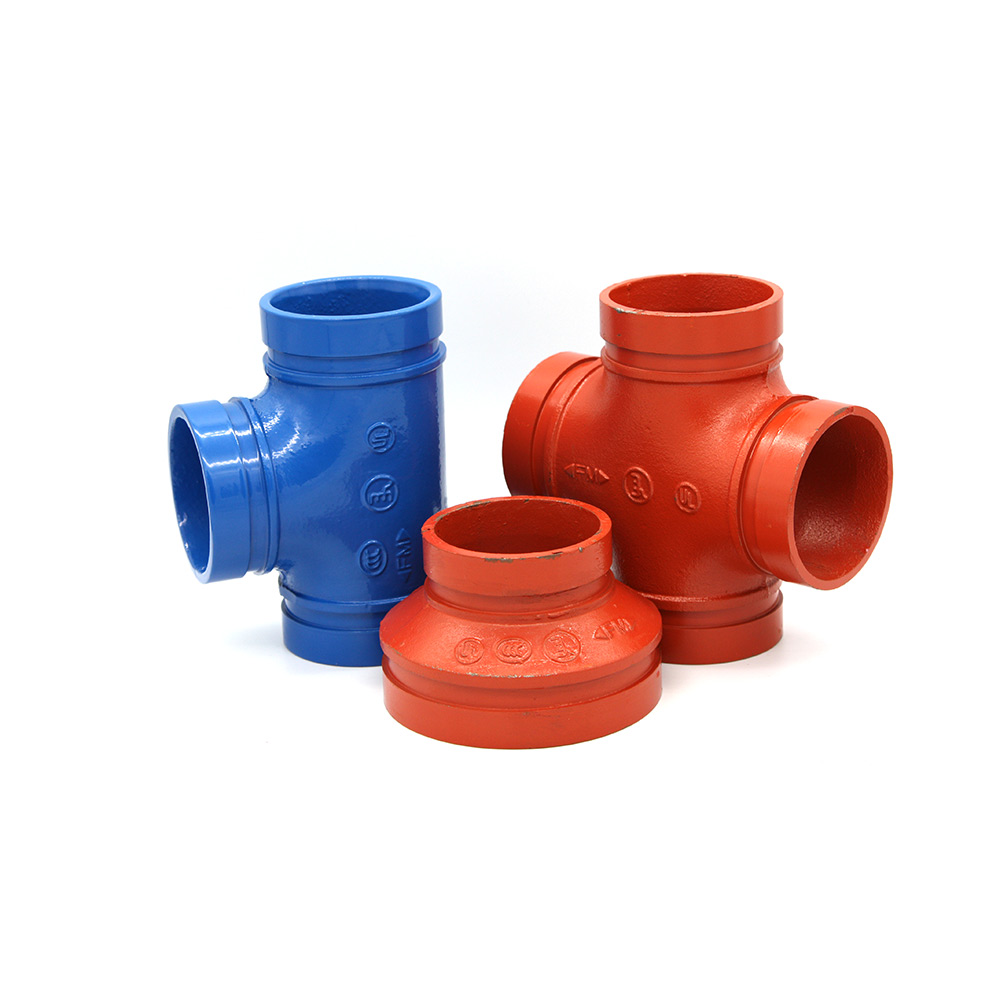
Hebei Jianzhi Foundry Group Co., Ltd. and its Vicast brand offer a full product range including grooved couplings, mechanical tees, mechanical crosses, grooved flanges, and grooved connection fittings. Vicast’s flexible grooved coupling page lists sizes from 1″ to 12″ / DN25 to DN300, a temperature range of -20°F to +180°F / -29°C to +82°C, material standards ASTM A536 Grade 65-45-12 and ASTM A395 Grade 65-45-15, and design standards including ISO 6182, AWWA C606, and GB 5135.11.
Key Takeaways
| Key Point | Buyer Implication |
|---|---|
| AWWA C606 is the groove geometry checkpoint. | Verify groove dimensions, pipe OD compatibility, groove depth, groove width, and coupling engagement before approving bulk orders. |
| ASTM A536 Grade 65-45-12 is the common ductile iron benchmark. | Look for ductile iron housing with proper tensile strength, yield strength, elongation, nodularity, and material test reports. |
| Pressure rating is not only a catalog number. | Check working pressure, test pressure, hydrostatic test records, surge allowance, and application-specific approval scope. |
| UL 213 and FM 1920 matter for fire protection projects. | For sprinkler systems and fire mains, request UL Listing, FM Approval, certificate validity, model coverage, and pressure class. |
| ISO 6182 and GB 5135.11 help global and China-linked projects. | These standards support international fire protection and grooved connection compliance. |
| Gasket selection is a failure-control decision. | EPDM is common for water service; NBR, silicone, or FKM may be needed for oil, chemical, temperature, or special media exposure. |
| Supplier verification should include documents, not promises. | Request MTRs, dimensional reports, coating reports, pressure test reports, certificates, traceability records, and packaging specifications. |
| The cheapest fitting may create the highest project cost. | Wrong size, poor coating, low-grade castings, incorrect gasket material, or invalid certification can cause rework and inspection failure. |
| A strong supplier should support product breadth. | Couplings, elbows, tees, reducers, mechanical tees, mechanical crosses, flanges, and end caps should be sourced as a compatible system. |
| Vicast is positioned for B2B global procurement. | Vicast’s official About page states that the company was founded in 1982, has about 4,500 employees, over 350 technical engineers, a 1.4 million m² factory, ISO 9001 and ISO 14001 processes, and distributors in over 100 countries. |
Table des matières
- What Are Grooved Pipe Fittings and Why Do Global Buyers Use Them?
- Which Standards Should Buyers Check First?
- How Should Buyers Read Size, Pipe OD, and Groove Geometry?
- Which Materials Are Suitable for Reliable Grooved Pipe Fittings?
- How Should Buyers Evaluate Pressure Ratings and Test Pressure?
- How Do Gaskets Affect Sealing, Media Compatibility, and Service Life?
- Which Coating and Surface Treatment Should Buyers Specify?
- How Should Buyers Match Grooved Fittings to Applications?
- What Documents Should a Qualified Supplier Provide?
- How Can Buyers Verify a Grooved Pipe Fittings Manufacturer?
- What Are the Most Common Purchasing Mistakes?
- Why Choose Hebei Jianzhi Foundry Group Co., Ltd. as a Grooved Pipe Fittings Supplier?
- Conclusion
- References
- Questions fréquentes
1. What Are Grooved Pipe Fittings and Why Do Global Buyers Use Them?
Grooved pipe fittings are mechanical piping components designed to connect grooved-end pipes without welding, threading, or conventional flanging. A typical grooved joint includes grooved pipe ends, an elastomeric gasket, ductile iron housing segments, bolts, and nuts. The housing keys engage the pipe grooves, while the gasket forms a pressure-responsive seal around the pipe outside diameter.
1.1 What Makes a Grooved Joint Different from Welded, Threaded, and Flanged Joints?
A welded joint is permanent. A threaded joint depends on cut threads and sealant. A flanged joint relies on flange alignment, gasket compression, and multiple bolts. A grooved joint, by contrast, is mechanical, demountable, and comparatively fast to install.
For global buyers, this matters because grooved systems can reduce installation complexity, especially in fire protection, HVAC, plant rooms, water supply, commercial buildings, warehouses, and industrial retrofit projects. Fire protection professionals also commonly use grooved fittings in sprinkler mains and branch lines.
The key procurement advantage is not just installation speed. It is system flexibility. Grooved couplings can simplify maintenance, modification, prefabrication, and inspection. A buyer importing grooved pipe fittings for a distributor network or project package should therefore evaluate the product as part of a complete mechanical piping system, not as a single casting.
1.2 What Are the Main Product Types?
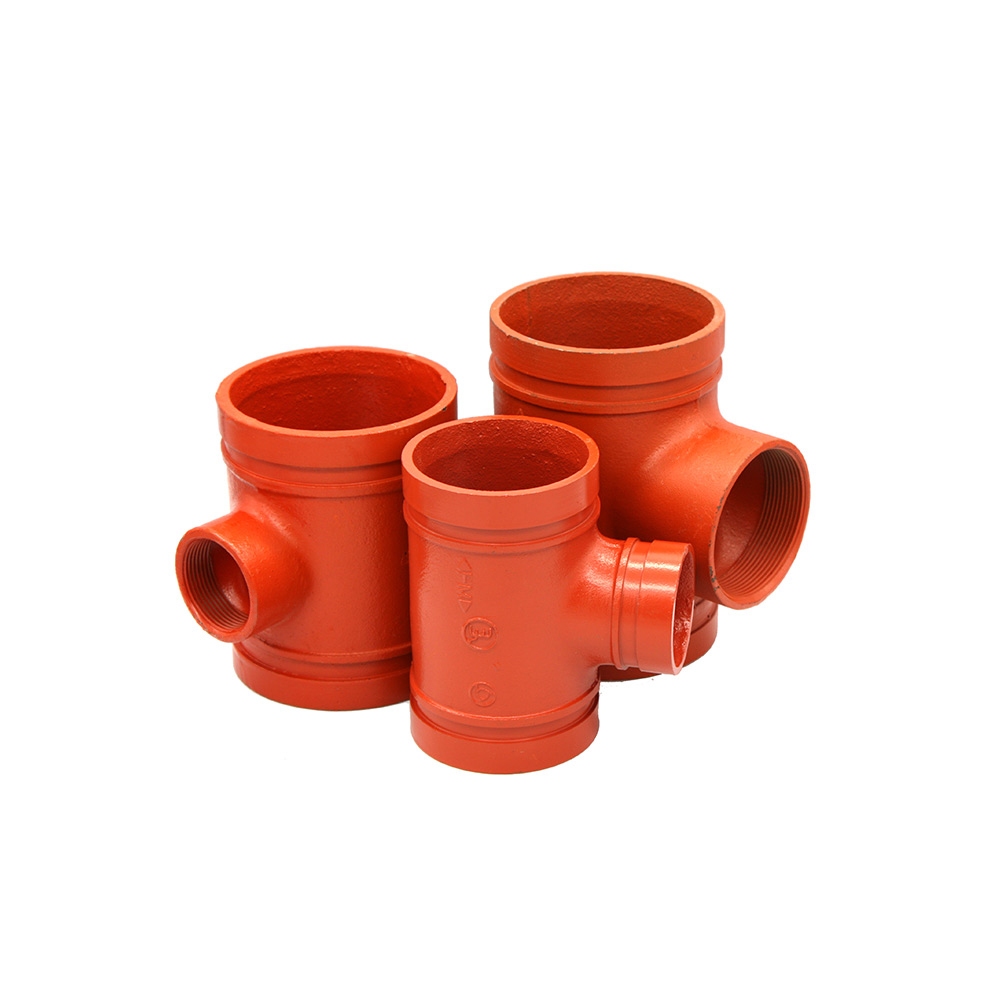
Vicast’s official products page groups its grooved pipe fittings into couplings, mechanical tees, mechanical crosses, grooved flanges, and grooved connection fittings.
| Product Type | Common Function | Buyer’s Technical Check |
|---|---|---|
| Rigid grooved coupling | Holds pipe alignment with minimal movement | Size, pressure class, gasket, bolt torque, certification |
| Coupling rainuré flexible | Allows controlled angular/axial movement | Deflection allowance, seismic or vibration application |
| Grooved elbow | Changes flow direction | Angle, radius, pressure class, coating |
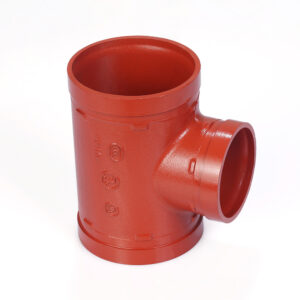
| Grooved tee | Creates branch flow | Main size, branch size, flow requirement |
| Tee mécanique | Creates branch without full pipe separation | Hole size, gasket seating, saddle fit, torque |
| Croix mécanique | Creates two opposite branch outlets | Alignment, pressure class, branch dimensions |
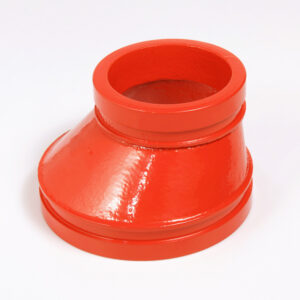
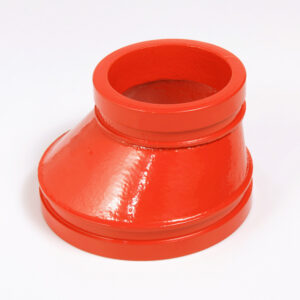
| Grooved reducer | Transitions between pipe sizes | Concentric/eccentric type, flow direction |
| Grooved flange | Connects grooved pipe to flanged equipment | Flange standard, PN/Class rating, valve compatibility |
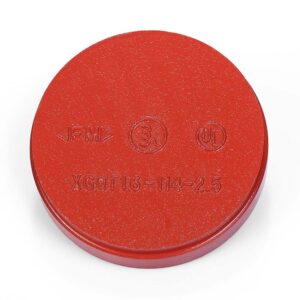
| Capuchon de fin | Closes a pipe end | Pressure class, thrust restraint, test pressure |
2. Which Standards Should Buyers Check First?
A credible grooved pipe fitting quotation should state which standards apply to design, material, testing, performance, and certification. Standards are the language that connects the buyer, supplier, engineer, contractor, inspector, and end user.
2.1 What Is the Core Standards Map?
| Standard | Main Scope | Why Buyers Should Care |
|---|---|---|
| AWWA C606 | Grooved and shouldered joints for ductile-iron pipe, metallic pressure pipe, fittings, and related components | Controls groove geometry, compatibility, and joint engagement |
| ASTM A536 | Ductile iron castings with spheroidal graphite | Defines ductile iron material basis for housings and fittings |
| ASTM A395 | Ferritic ductile iron pressure-retaining castings | Often used for pressure-related ductile iron components |
| ASTM D2000 | Rubber products classification | Helps define gasket compound requirements |
| ISO 6182-12 | Performance requirements, grooving dimensions, test methods, and marking for grooved-end couplings up to DN300 | Important for fire protection and global projects |
| UL 213 | Rubber-gasketed fittings for fire protection service | Critical for US and AHJ-driven fire protection projects |
| FM 1920 | Pipe couplings and fittings for aboveground fire protection systems | Important for insurance-driven and industrial fire projects |
| GB 5135.11 | China fire protection grooved connection reference | Useful for China-linked manufacturing and project compliance |
AWWA states that C606 covers grooved and shouldered joints for ductile-iron pipe, metallic pressure pipe of iron pipe size, fittings, and other components for water, wastewater, reclaimed water, and other services. ASTM states that A536 covers ductile iron castings, also known as spheroidal or nodular iron, where graphite is substantially spheroidal in shape. UL 213 covers rubber-gasketed fittings intended for assembling sections of pipe in fire protection systems.
2.2 Why Should Buyers Avoid “Standard-Like” Claims?
In global sourcing, many suppliers write “according to international standard” without naming the exact standard, edition, size scope, test method, or certificate body. This is not enough.
A professional RFQ should ask:
| Weak Supplier Claim | Strong Buyer Requirement |
|---|---|
| “Standard size” | State AWWA C606 groove dimensions and pipe OD compatibility |
| “Ductile iron” | State ASTM A536 grade and provide material test report |
| “High pressure” | State rated working pressure and hydrostatic test method |
| “Fire approved” | Provide UL/FM certificate with model and size coverage |
| “Good rubber gasket” | State EPDM/NBR/FKM compound and ASTM D2000 class |
| “Good coating” | State coating type, thickness, adhesion, and salt spray test |
3. How Should Buyers Read Size, Pipe OD, and Groove Geometry?
Size errors are among the most expensive mistakes in grooved fitting procurement. A nominal size such as DN100 or 4″ does not fully define the pipe outside diameter, groove profile, pipe wall thickness, or connection compatibility.
3.1 What Size Data Should Appear in the Datasheet?
A complete grooved pipe fitting datasheet should include:
| Datasheet Item | Example | Buyer’s Action |
|---|---|---|
| Nominal pipe size | 4″ / DN100 | Match project drawing |
| Pipe OD | 114.3 mm for many steel pipe systems | Confirm actual pipe standard |
| Groove standard | AWWA C606 | Check compatibility with pipe and coupling |
| Product type | Rigid coupling / flexible coupling / tee | Match system function |
| Pressure rating | 300 psi / 363 psi / 500 psi / PN16 / PN25 | Compare with design pressure |
| Temperature range | -29°C to +82°C | Check gasket and application |
| Matériel | ASTM A536 Grade 65-45-12 | Request MTR |
| Coating | Epoxy / painted / galvanized | Match corrosion environment |
| Certification | UL / FM / ISO / CE | Confirm project requirement |
Vicast’s flexible grooved coupling page lists sizes from 1″ to 12″ / DN25 to DN300, temperature from -20°F to +180°F / -29°C to +82°C, and design standards including ISO 6182, AWWA C606, and GB 5135.11.
3.2 Why Does Groove Geometry Control Joint Reliability?
The housing key must engage the groove properly. If the groove is too shallow, the housing may not lock correctly. If the groove is too deep, the pipe wall can be weakened. If the groove width is wrong, the gasket may not seat correctly. If the pipe end gap is excessive, gasket extrusion becomes more likely.
The engineering logic can be summarized as:
Joint Integrity = Housing Key Engagement + Gasket Compression + Pipe End Control + Bolt Torque
For buyers, this means the supplier should not only ship fittings. The supplier should also provide groove dimension guidance, installation manuals, go/no-go gauge recommendations, and technical support.
3.3 What Should Be Checked Before Mass Shipment?
| Checkpoint | Inspection Method | Acceptance Logic |
|---|---|---|
| Pipe OD compatibility | OD caliper | Must match pipe standard |
| Groove depth | Groove gauge | Must match AWWA C606 tolerance |
| Groove width | Caliper | Must allow housing key engagement |
| Pipe end gap | Feeler gauge | Must stay within manufacturer limit |
| Pipe roundness | OD measurement | Out-of-round pipe can leak |
| Gasket seating | Inspection visuelle | Lip must not be twisted or pinched |
| Housing gap | Visual/feeler gauge | Must be uniform after torque |
| Bolt torque | Calibrated torque wrench | Must follow manufacturer instruction |
4. Which Materials Are Suitable for Reliable Grooved Pipe Fittings?
Material quality is the foundation of grooved fitting safety. A low-cost casting with poor nodularity, porosity, inclusions, or weak elongation may pass a visual inspection but fail under pressure, impact, vibration, or field handling.
4.1 Why Is ASTM A536 Grade 65-45-12 Commonly Used?
ASTM A536 Grade 65-45-12 is widely used because it provides a balance of tensile strength, yield strength, elongation, machinability, and impact resistance. Ductile iron differs from gray iron because graphite forms nodules rather than flakes. This reduces internal stress concentration and improves ductility.
ASTM’s official description states that A536 covers ductile iron castings with graphite substantially spheroidal in shape and essentially free of other graphite forms. Independent foundry material references also describe ASTM A536 65-45-12 as nodular iron with mechanical behavior comparable to low-alloy steels, depending on microstructure and heat treatment.
| Property | Typical ASTM A536 65-45-12 Meaning | Buyer’s Verification |
|---|---|---|
| Tensile strength | 65 ksi minimum class | MTR and tensile test |
| Yield strength | 45 ksi minimum class | MTR |
| Elongation | 12% minimum class | MTR and batch testing |
| Graphite morphology | Nodular/spheroidal graphite | Metallographic report if required |
| Casting integrity | No cracks, major porosity, or shrinkage defects | Visual, pressure, and sampling inspection |
4.2 Why Should Buyers Avoid Unverified Gray Iron?
Gray iron is brittle compared with ductile iron. Its graphite flake structure can act as an internal crack initiator under impact, bending, water hammer, and vibration. For pressure-retaining grooved pipe fittings, buyers should require ductile iron, not vague “cast iron.”
4.3 What About ASTM A395?
ASTM A395 is commonly associated with ferritic ductile iron pressure-retaining castings. When a supplier lists ASTM A395 Grade 65-45-15, buyers should ask which exact products use this grade and request the corresponding MTR. Vicast’s flexible coupling page lists ASTM A536 Grade 65-45-12 and ASTM A395 Grade 65-45-15 as material standards.
5. How Should Buyers Evaluate Pressure Ratings and Test Pressure?
Pressure rating is one of the most misunderstood items in grooved pipe fitting procurement. Buyers often compare only the stated psi value, but professional evaluation requires working pressure, test pressure, pipe schedule, fluid, temperature, surge pressure, certification scope, and safety factor.
5.1 What Is the Difference Between Working Pressure and Test Pressure?
| Term | Meaning | Buyer’s Use |
|---|---|---|
| Working pressure | Maximum pressure allowed in normal service | Main selection parameter |
| Design pressure | Engineer’s required system pressure | Must be equal to or below rated working pressure |
| Hydrostatic test pressure | Temporary pressure used for verification | Confirms sealing and strength |
| Burst pressure | Failure pressure in destructive testing | Not a normal operating value |
| Surge pressure | Transient pressure from sudden velocity change | Must be considered in pumps and valves |
The first-pass rule is:
Rated Working Pressure ≥ Maximum Operating Pressure + Surge Allowance
The reference fire protection guide you uploaded also uses pressure classes and hydrostatic testing logic to show why buyers should distinguish normal system pressure from temporary test loads.
5.2 How Should Buyers Account for Water Hammer?
Water hammer can occur when pumps start or stop, valves close quickly, or flow changes suddenly. A basic first-pass calculation uses:
ΔP = ρ × a × Δv
Where:
| Symbol | Meaning |
|---|---|
| ΔP | Surge pressure |
| ρ | Fluid density |
| a | Pressure wave speed |
| Δv | Change in fluid velocity |
ASME-published engineering literature notes that the Joukowsky equation has been used for more than a century as a first approximation for water hammer pressure surge, while also warning that it may be non-conservative in certain pipe networks.
For buyer decisions, the practical lesson is simple: if the system includes pumps, long mains, quick-closing valves, or high flow velocity, do not select fittings only on static pressure. Ask the engineer to evaluate transient pressure and choose Class 250, Class 350, PN25, or higher-rated components where needed.
5.3 Pressure Class Screening Table
| Application | Common Pressure Concern | Buyer’s Suggested Check |
|---|---|---|
| Standard HVAC chilled water | Moderate pressure, temperature cycles | Working pressure and EPDM compatibility |
| Fire sprinkler mains | AHJ, UL/FM, hydrostatic test | UL/FM model coverage and test records |
| High-rise buildings | High static head and pump pressure | Higher pressure class and fire approval |
| Industrial water | Surge, vibration, corrosion | Pressure class + coating + gasket compound |
| Pump rooms | Water hammer and end load | Rigid couplings, thrust restraint, surge check |
| Municipal water | AWWA C606 compatibility | Groove dimensions and pipe OD standard |
6. How Do Gaskets Affect Sealing, Media Compatibility, and Service Life?
The gasket is not an accessory. It is the sealing element that determines whether the grooved joint can maintain leak-tight performance under pressure, temperature, fluid exposure, vibration, and aging.
6.1 How Does the Self-Energizing Seal Work?
A grooved coupling gasket is compressed during assembly. Internal pressure then acts on the gasket lips, increasing sealing force. A simplified model is:
σseal = σinitial + P × Acontact / Agasket
| Term | Meaning |
|---|---|
| σseal | Total sealing stress |
| σinitial | Initial compression from assembly |
| P | Internal pressure |
| Acontact | Pressure-exposed gasket area |
| Agasket | Gasket lip sealing area |
This principle is useful for explaining why proper gasket geometry, bolt torque, and housing engagement are essential. The attached reference article uses the same self-energizing seal model for grooved fire protection systems.
6.2 Which Gasket Material Should Buyers Choose?
| Gasket Material | Typical Media | General Strength | Buyer Warning |
|---|---|---|---|
| EPDM | Water, fire protection, HVAC | Excellent water and aging resistance | Not suitable for petroleum oils |
| NBR / Buna-N | Oil-related media | Better oil resistance | Check temperature limit |
| Silicone | Certain high/low temperature conditions | Good flexibility | Check pressure and tear resistance |
| FKM | Chemicals, high temperature | Strong chemical and heat resistance | Higher cost |
| Special compounds | Project-specific fluids | Custom compatibility | Require written confirmation |
ASTM D2000 is often used to classify rubber products and define mechanical properties such as hardness, tensile strength, elongation, heat resistance, and compression set. For global buyers, the minimum requirement is to ask the supplier to identify the gasket compound clearly and confirm compatibility with the fluid.
6.3 What Gasket Mistakes Cause Field Failure?
| Mistake | Result |
|---|---|
| EPDM used with petroleum oil | Swelling, softening, leakage |
| Wrong lubricant | Rubber degradation or assembly slip |
| Pinched gasket | Immediate weeping during pressure test |
| Dirty pipe end | Seal surface damage |
| Excess pipe-end gap | Gasket extrusion |
| Reused damaged gasket | Unstable sealing |
| Unknown compound | No traceability during failure investigation |
7. Which Coating and Surface Treatment Should Buyers Specify?
Coating protects ductile iron from corrosion during storage, shipment, installation, and service. It also influences market acceptance because many distributors and contractors identify grooved fittings by color and finish.
7.1 What Are Common Coating Options?
| Surface Treatment | Common Use | Buyer’s Check |
|---|---|---|
| Orange/red paint | Fire protection and general indoor systems | Adhesion, appearance, packaging protection |
| Epoxy coating | Fire, HVAC, industrial water | Thickness, adhesion, salt spray data |
| Hot-dip galvanizing | Outdoor, humid, corrosion-prone areas | Zinc thickness and finish quality |
| Black finish | Some industrial or project-specific uses | Rust prevention during storage |
| Fusion-bonded epoxy | Higher corrosion protection | Coating process and thickness |
Vicast’s published fire protection guide states that its grooved pipe fittings are cast from ASTM A536 Grade 65-45-12 ductile iron, machined to AWWA C606 tolerances, and coated with epoxy, with UL/FM approved options available.
7.2 How Should Buyers Match Coating to Environment?
| Environment | Recommended Coating Logic |
|---|---|
| Indoor dry building | Standard painted or epoxy-coated finish |
| Indoor humid mechanical room | Epoxy or galvanized |
| Fire pump house | Epoxy with good corrosion resistance |
| Coastal area | Heavy epoxy or galvanized |
| Industrial chemical atmosphere | Confirm coating and gasket compatibility |
| Underground or buried service | Special coating and project engineering review |
8. How Should Buyers Match Grooved Fittings to Applications?
The same fitting can be unsuitable if the application is wrong. Buyers should match fitting type, pressure class, gasket, coating, and certification to the system.
8.1 Application Selection Matrix
| Application | Common Products | Main Buyer Concern |
|---|---|---|
| Protection contre les incendies | Rigid/flexible couplings, elbows, tees, mechanical tees, flanges | UL/FM, ISO 6182, pressure rating, EPDM |
| HVAC | Couplings, elbows, reducers, flanges | Vibration, maintenance, temperature range |
| Industrial water | Couplings, reducers, tees, end caps | Pressure, corrosion, surge |
| Pump rooms | Rigid couplings, grooved flanges, reducers | End load, water hammer, alignment |
| Warehouses | Fire mains, sprinkler lines, mechanical tees | Fast installation and inspection |
| Commercial buildings | HVAC and sprinkler systems | Space constraints and maintainability |
| Retrofit projects | Mechanical tees, grooved couplings | Reduced hot work and shorter shutdown |
NFPA states that NFPA 13 addresses sprinkler system design approaches, system installation, and component options to prevent fire deaths and property loss. For fire protection sourcing, buyers should not rely only on general product compliance. They should confirm the actual UL/FM listing for the exact model, size, pressure class, and intended service.
8.2 Rigid vs. Flexible Coupling Selection
| Coupling Type | Best Use | Avoid When |
|---|---|---|
| Rigid coupling | Alignment control, pump rooms, riser anchors, equipment connections | Expansion, movement, seismic drift allowance is required |
| Flexible coupling | Vibration, misalignment, thermal movement, seismic accommodation | Rigid restraint is required near certain equipment |
The buyer should ask the supplier for the movement allowance, angular deflection, axial movement, and installation guidance. The uploaded reference article provides an example of using flexible couplings for seismic and water hammer control in fire protection systems.
9. What Documents Should a Qualified Supplier Provide?
A serious grooved pipe fittings supplier should support each shipment with technical and commercial documents. This is especially important for importers, engineering contractors, project buyers, and distributors.
9.1 Core Document Checklist
| Document | Objectif | Buyer Priority |
|---|---|---|
| Product datasheet | Confirms size, pressure, material, standards | Haut |
| Material test report | Verifies ductile iron grade | Haut |
| Dimensional inspection report | Confirms groove and casting dimensions | Haut |
| Hydrostatic test report | Confirms pressure performance | Haut |
| UL/FM certificate | Confirms fire protection approval scope | High for fire projects |
| ISO certificate | Confirms quality/environmental systems | Medium to high |
| Coating test report | Confirms thickness, adhesion, corrosion resistance | Medium |
| Gasket compound confirmation | Confirms media compatibility | Haut |
| Installation manual | Prevents field failure | Haut |
| Torque table | Supports correct assembly | Haut |
| Packing list | Prevents logistics disputes | Medium |
| Country-of-origin document | Supports customs clearance | As required |
| Warranty policy | Supports after-sales risk control | Medium |
9.2 How Should Buyers Read a Certificate?
A certificate is only useful if it matches the product being purchased.
| Certificate Check | Question to Ask |
|---|---|
| Certificate holder | Is it the actual manufacturer or a trading company? |
| Product model | Does the model match the quotation? |
| Size range | Are all ordered sizes covered? |
| Pressure rating | Is the required pressure class included? |
| Validity | Is the certificate current? |
| Standard | UL 213, FM 1920, ISO 6182, or other? |
| Factory location | Does it match the supplier’s production site? |
| Marking | Is the product marked according to certificate requirements? |
FM-related public documents identify FM 1920 as the approval standard for pipe couplings and fittings for aboveground fire protection systems. UL 213 covers rubber-gasketed fittings for fire protection service, including couplings and side outlets.
10. How Can Buyers Verify a Grooved Pipe Fittings Manufacturer?
Supplier verification is the difference between procurement and risk management. For global sourcing, especially from overseas manufacturers, buyers should verify capacity, quality systems, product range, documentation, export experience, and technical support.
10.1 Supplier Verification Scorecard
| Category | Weight | What to Check |
|---|---|---|
| Product range | 15% | Couplings, elbows, tees, reducers, mechanical tees, flanges, end caps |
| Standard compliance | 20% | AWWA C606, ASTM A536, ISO 6182, UL/FM if required |
| Material control | 15% | MTRs, furnace control, nodularity, tensile tests |
| Pressure testing | 15% | Hydrostatic test procedure, batch records |
| Certification | 15% | Valid certificates and exact model coverage |
| Export capability | 10% | Packaging, documentation, Incoterms, country experience |
| Technical support | 10% | Installation manuals, torque guidance, application review |
10.2 What Questions Should Buyers Ask Before Placing an Order?
| Buyer Question | Pourquoi ça compte |
|---|---|
| Which standard controls your groove dimensions? | Prevents compatibility issues |
| What ductile iron grade do you use? | Confirms mechanical integrity |
| Can you provide MTRs by batch? | Confirms traceability |
| What pressure class is this model rated for? | Prevents under-specification |
| Is this exact model UL Listed or FM Approved? | Prevents failed fire inspection |
| What gasket compound is included? | Prevents media incompatibility |
| What coating is standard? | Prevents corrosion disputes |
| Can you provide installation torque values? | Prevents leakage and overtightening |
| What packaging protects coating during shipment? | Prevents rust and paint damage |
| Do you support mixed container orders? | Helps distributors build inventory |
10.3 Why Does Factory Scale Matter?
Factory scale does not automatically guarantee quality, but it does matter for repeatability, order fulfillment, quality control, and long-term distributor support. Vicast’s About page states that the company was founded in 1982, has about 4,500 employees, over 350 technical engineers, a 1.4 million m² factory, ISO 9001 and ISO 14001 processes, and distributors covering over 100 countries.
11. What Are the Most Common Purchasing Mistakes?
Many grooved pipe fitting problems are created before installation begins. They start with incomplete RFQs, vague specifications, or weak supplier verification.
11.1 Common Mistake Matrix
| Mistake | Consequence | Prevention |
|---|---|---|
| Buying only by lowest price | Higher leakage, rework, rejection risk | Use total qualified cost |
| No pipe OD confirmation | Wrong fit | Confirm pipe standard and OD |
| No pressure class verification | Unsafe operation | Match design pressure and surge |
| No certificate scope check | Failed inspection | Match exact model and size |
| Wrong gasket compound | Swelling, cracking, leakage | Confirm media and temperature |
| Mixed brands in one system | Compatibility and warranty issues | Use one certified system where possible |
| No torque table | Under/over-tightening | Request manufacturer instructions |
| Poor packaging | Coating damage and rust | Specify export packaging |
| No MTR | No material traceability | Require batch documentation |
| No installation training | Field failure | Request manuals and support |
11.2 Total Qualified Cost Formula
For B2B procurement, use:
Total Qualified Cost = Unit Price + Freight + Customs + Inspection + Documentation + Rework Risk + Delay Risk + Warranty Risk
A cheap fitting with poor documentation may be expensive after project rejection. A properly documented product with stable certification may be cheaper over the full project lifecycle.
12. Why Choose Hebei Jianzhi Foundry Group Co., Ltd. as a Grooved Pipe Fittings Supplier?
Hebei Jianzhi Foundry Group Co., Ltd., with the Vicast brand, is positioned as a global manufacturer and supplier of grooved pipe fittings. The company’s official product page covers grooved couplings, mechanical tees, mechanical crosses, grooved flanges, and grooved connection fittings, giving buyers a broad system-based sourcing option rather than a single-product purchase.
12.1 What Makes Vicast Relevant for Global Buyers?
Vicast’s official About page states that the company was founded in 1982 and has about 4,500 employees, over 350 technical engineers, a factory area of 1.4 million m², ISO 9001 quality process, ISO 14001 environmental process, and distributors in over 100 countries.
For global buyers, these points matter because grooved pipe fittings require repeatable casting quality, dimensional control, coating consistency, testing documentation, and long-term supply stability. A buyer building a distribution program or project procurement package needs more than a one-time shipment. The supplier must support technical communication, product matching, installation guidance, and continuous availability.
12.2 How Does the Vicast Product Range Support Procurement?
| Product Category | Procurement Advantage |
|---|---|
| Couplings rainurés | Core connection component for most grooved systems |
| Mechanical tees | Efficient branch connection for fire and HVAC lines |
| Mechanical crosses | Multi-branch connection for system layouts |
| Brides rainurées | Connection to valves, pumps, and flanged equipment |
| Grooved connection fittings | Supports elbows, reducers, end caps, and layout adaptation |
A system-level product range helps distributors reduce supplier fragmentation and helps project buyers improve compatibility across fittings.
13. Conclusion
Grooved pipe fittings are not commodity hardware. They are engineered mechanical joint components that must satisfy standards, pressure, sealing, material, coating, and certification requirements. A buyer who evaluates only unit price is exposed to hidden risks: incorrect groove dimensions, low-grade castings, weak gasket compounds, invalid certificates, unverified pressure ratings, coating failure, poor packaging, and field installation problems.
The strongest procurement framework is:
Standards first. Material second. Pressure third. Gasket fourth. Certification fifth. Supplier verification always.
AWWA C606 should guide groove compatibility. ASTM A536 and ASTM A395 should guide ductile iron material selection. ASTM D2000 should guide gasket classification. ISO 6182, UL 213, FM 1920, and GB 5135.11 should be checked according to project type and region. Engineering formulas such as ΔP = ρ × a × Δv for water hammer and σseal = σinitial + P × Acontact / Agasket for sealing logic help buyers think beyond catalog numbers and evaluate real operating risk.
For global buyers, distributors, contractors, and project engineers, Hebei Jianzhi Foundry Group Co., Ltd. / Vicast offers a broad grooved pipe fittings product range, long manufacturing history, technical team scale, global distribution reach, and documented alignment with key grooved fitting standards. The right sourcing decision is not simply about finding a grooved fitting supplier. It is about building a reliable, traceable, pressure-rated, standards-based supply chain for long-term piping system performance.
14. References
- AWWA C606 — Grooved and Shouldered Joints.
- ASTM A536 — Standard Specification for Ductile Iron Castings.
- ASTM A395 — Ferritic Ductile Iron Pressure-Retaining Castings.
- ASTM D2000 — Rubber Products Classification System.
- ISO 6182-12 — Fire Protection: Grooved-End Pipe Couplings.
- UL 213 — Rubber Gasketed Fittings for Fire-Protection Service.
- FM 1920 — Pipe Couplings and Fittings for Aboveground Fire Protection Systems.
- NFPA 13 — Standard for the Installation of Sprinkler Systems.
- Timoshenko, S. P., and Goodier, J. N. — Theory of Elasticity, McGraw-Hill.
- Wylie, E. B., Streeter, V. L., and Suo, L. — Fluid Transients in Systems, referenced in water hammer literature.
- Walters, T. W., and Leishear, R. A. — ASME paper on limitations of the Joukowsky equation for water hammer pressure estimation.
- Vicast Products Page.
- Vicast Flexible Grooved Coupling Product Page.
- Vicast About Page.
- Uploaded reference article: Grooved Pipe Fittings for Fire Protection Systems: Engineering Design Guide Based on NFPA 13 and FM Standards.
15. FAQs
Q1: What are grooved pipe fittings used for?
Grooved pipe fittings are used to connect grooved-end pipes in fire protection, HVAC, water supply, industrial piping, commercial buildings, warehouses, and retrofit projects. Common products include rigid couplings, flexible couplings, elbows, tees, reducers, mechanical tees, grooved flanges, and end caps.
Q2: Which standard controls grooved pipe dimensions?
AWWA C606 is one of the key standards for grooved and shouldered joints. It covers grooved joints for ductile-iron pipe, metallic pressure pipe, fittings, and related components. Buyers should use it to verify groove geometry and connection compatibility.
Q3: What material should high-quality grooved pipe fittings use?
Ductile iron conforming to ASTM A536 Grade 65-45-12 is commonly used for grooved coupling housings and fittings. ASTM A536 covers ductile iron castings with spheroidal or nodular graphite, which gives better ductility and impact resistance than gray iron.
Q4: Are grooved pipe fittings suitable for fire protection systems?
Yes, when the correct listed or approved products are used. UL 213 covers rubber-gasketed fittings for assembling pipe sections in fire protection systems, and FM 1920 applies to pipe couplings and fittings for aboveground fire protection systems.
Q5: What is the difference between rigid and flexible grooved couplings?
Rigid couplings are designed to hold pipe alignment with little movement. Flexible couplings allow limited angular or axial movement and can help accommodate vibration, thermal movement, minor misalignment, or seismic movement depending on design and approval scope.
Q6: How should buyers choose the correct pressure rating?
Buyers should compare the fitting’s rated working pressure with the maximum operating pressure plus surge allowance. For systems with pumps, quick-closing valves, or high velocity, transient pressure should be evaluated using engineering methods such as the Joukowsky equation as a first-pass screen.
Q7: Is EPDM the right gasket for all grooved fittings?
No. EPDM is widely used for water-based systems such as fire protection and HVAC, but it is not suitable for all media. Oil, fuel, chemicals, high temperature, or special fluids may require NBR, FKM, silicone, or another compound. Always ask the supplier to confirm gasket compatibility.
Q8: What documents should I request from a grooved pipe fittings supplier?
Request product datasheets, material test reports, dimensional inspection reports, hydrostatic test reports, UL/FM certificates if applicable, gasket compound confirmation, coating reports, installation manuals, torque tables, packing lists, and traceability documents.
Q9: Can I mix grooved fittings from different manufacturers?
It is not recommended unless the engineer and manufacturers confirm compatibility. Different housing key profiles, gasket designs, groove tolerances, and approval scopes may create sealing or listing problems. For project reliability, use one certified system where possible.
Q10: Why consider Hebei Jianzhi Foundry Group Co., Ltd. / Vicast?
Vicast offers a broad grooved pipe fittings range, including couplings, mechanical tees, mechanical crosses, grooved flanges, and grooved connection fittings. Its official About page states that the company was founded in 1982, has about 4,500 employees, over 350 technical engineers, a 1.4 million m² factory, and distributors in over 100 countries.