Nouvelles

Nouvelles

Hot-Dip Galvanizing vs. Electro-Galvanizing
The Role of Malleable Iron Pipe Fittings in Compressed Air Systems for Manufacturing Plants
Compressed air systems keep the wheels turning in just about every manufacturing plant out there, feeding...
Hot-Dip Galvanizing vs. Electro-Galvanizing A Metallurgical and Performance Benchmark Study
Hot-Dip Galvanizing vs. Electro-Galvanizing: A Metallurgical and Performance Benchmark Study
Abstract  Hot-dip galvanizing (HDG) and electro-galvanizing (EG, widely recognized as zinc electroplating)...
Grooved Couplings vs Flanged The Best Choice for Industrial Pipe Retrofits in 2026 (Real Cost & Decision Guide)
When crews tackle industrial pipe retrofits, the pressure hits hard: upgrade old lines without shutting...
Rigid vs Flexible Grooved Couplings in Fire Protection Key Differences and Uses
Rigid vs Flexible Grooved Couplings in Fire Protection: Key Differences and Uses
In fire protection systems, picking the proper joints often determines whether a setup holds up during...
Engineering Service Life in Galvanized Pipe Fittings Predictive Corrosion Modeling for Industrial Systems to Maximize Durability and Efficiency
Engineering Service Life in Galvanized Pipe Fittings: Predictive Corrosion Modeling for Industrial Systems to Maximize Durability and Efficiency
Abstract In industrial piping systems, galvanized pipe fittings remain a go-to choice for their dependable...
How to Verify Gasket Compatibility for Grooved Fittings in Hot Water HVAC Loops
Verifying gasket compatibility for grooved pipe fittings in hot water HVAC loops prevents a range of...
Grooved Pipe Fitting Gasket Pinching in HVAC Chilled Water Lines Causes, Fixes & Prevention
Grooved Pipe Fitting Gasket Pinching in HVAC Chilled Water Lines: Causes, Fixes & Prevention
Grooved pipe fitting gasket pinching continues to cause headaches on chilled water jobs. The seal fails...
Coupling rigide vs couplage flexible lequel choisir pour les ascenseurs de sprinkler d'incendie
Coupling rigide vs couplage flexible: lequel choisir pour les ascenseurs de sprinkler d'incendie Rigide vs flexible. ..
Comment mesurer le diamètre de la rainure pour les raccords rainurés du sprinkler
Comment mesurer le diamètre de la rainure pour le raccord de tuyauterie rainurée pour la tuyauterie d'aspersion d'incendie est une question qui. ..
Causes de fuites d'accouplement de tuyaux d'aspersion et réparations pour les aspersionnaires d'incendie
Fuites d'accouplement de tuyaux d'aspersion: causes et solutions pour les aspersionnaires d'incendie
Fuites d'accouplement de tuyaux d'aspersion: causes et solutions pour les systèmes d'aspersion incendie. Si vous avez jamais regardé. ..
Hot-Dip Galvanizing vs. Electro-Galvanizing

The Role of Malleable Iron Pipe Fittings in Compressed Air Systems for Manufacturing Plants

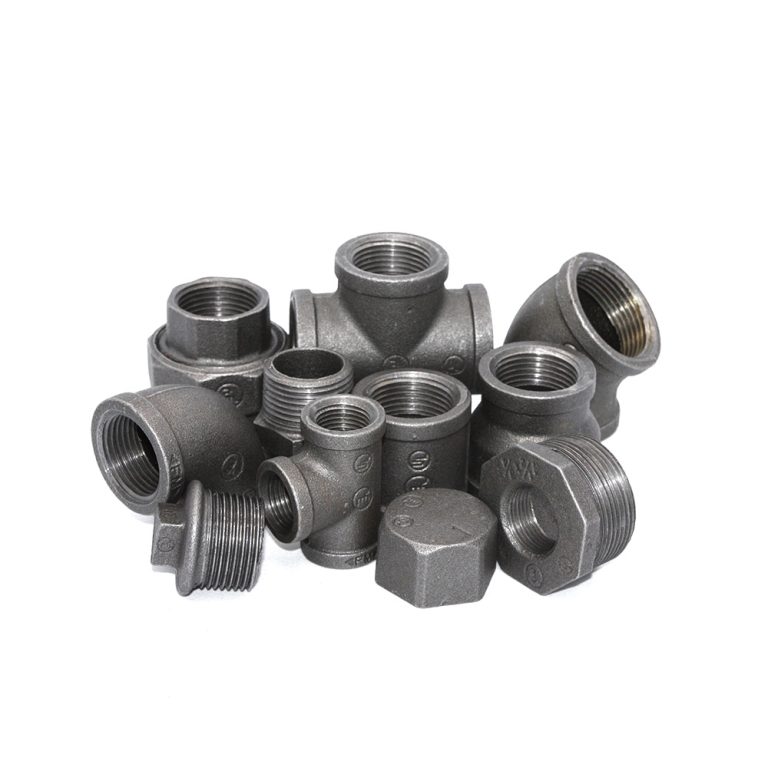
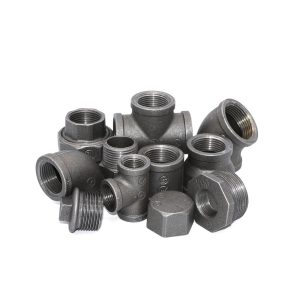
Compressed air systems keep the wheels turning in just about every manufacturing plant out there, feeding torque wrenches, cylinders, conveyors, and every other pneumatic device on the floor. The role of malleable iron pipe fittings in compressed air systems for manufacturing plants comes down to being the tough, threaded workhorse that ties black iron pipe together and takes the daily beating of 120–150 psi, constant vibration, and the occasional slug of condensate without popping loose or rusting out overnight. Elbows, tees, unions, couplings, reducers—these are the pieces that make the drops to each station and keep the whole network from bleeding pressure.   Understanding Malleable Iron Pipe Fittings in Compressed Air Contexts Malleable iron fittings start life as whiteheart castings, then get annealed long and slow until the carbon turns into those little graphite clusters that give the stuff its give. That heat treat is what separates them from regular gray iron—gray
Hot-Dip Galvanizing vs. Electro-Galvanizing A Metallurgical and Performance Benchmark Study

Hot-Dip Galvanizing vs. Electro-Galvanizing: A Metallurgical and Performance Benchmark Study

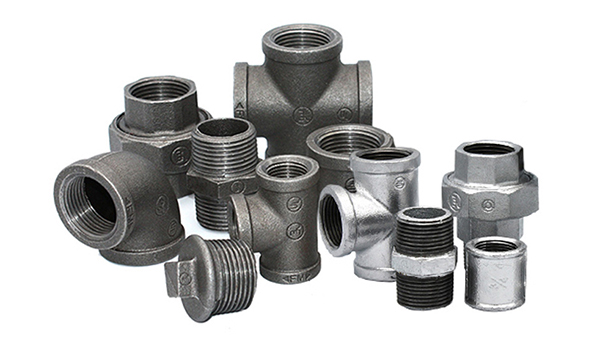
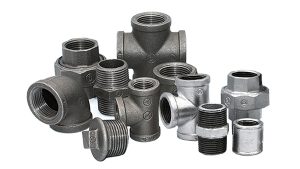
Abstract  Hot-dip galvanizing (HDG) and electro-galvanizing (EG, widely recognized as zinc electroplating) stand as the foremost zinc coating processes employed to provide long-term corrosion resistance to ferrous substrates. These coating technologies hold direct relevance for malleable cast iron grooved pipe fittings manufactured by Hebei Jianzhi Foundry Group Co., Ltd. and distributed under the Vicast and Jianzhi brand names. The organization operates extensive production facilities covering more than 1 million square meters located in Tangshan, Hebei Province, and Chifeng, Inner Mongolia. It maintains a workforce of over 4,500 employees, including more than 350 engineers and specialized technical staff, operates under ISO 9001 quality management certification and ISO 14001 environmental management certification, and maintains active involvement in the formulation and periodic updating of several important Chinese national standards—most notably GB/T 3287 for malleable iron threaded and grooved pipe fittings, GB/T 9440 specifying malleable cast iron grades and associated mechanical properties, and GB/T 25746

Grooved Couplings vs Flanged The Best Choice for Industrial Pipe Retrofits in 2026 (Real Cost & Decision Guide)

Grooved Couplings vs Flanged The Best Choice for Industrial Pipe Retrofits in 2026 (Real Cost & Decision Guide)

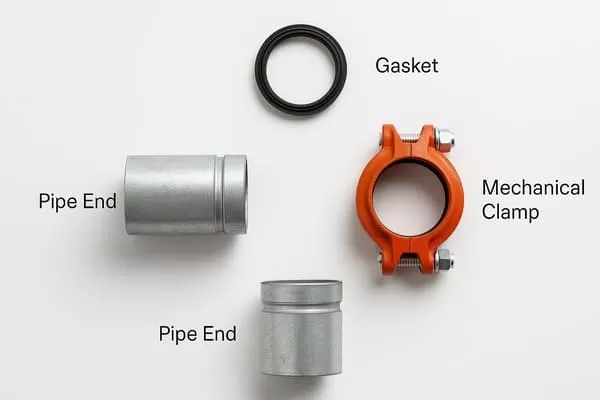
When crews tackle industrial pipe retrofits, the pressure hits hard: upgrade old lines without shutting down operations for long, squeeze into tight spots around existing equipment, deal with misaligned or worn-out sections, and keep budgets in check. Grooved couplings versus flanged connections often becomes the deciding factor in these upgrades. Grooved couplings join pipes through pre-grooved ends, a compressed gasket, and bolted housings that lock everything together mechanically. Flanged connections bolt flat faces with gaskets in between. Across many industrial pipe retrofits heading into 2026, grooved couplings deliver noticeable edges in installation speed, system flexibility, and total ownership cost, although flanged setups still hold firm in extreme high-pressure or fully rigid requirements.   Grooved Couplings vs Flanged Connections: Core Dimension Comparison Breaking down the key differences side by side reveals patterns seen repeatedly on job sites. The following table pulls from field experience and standard observations on how these joints perform during

Rigid vs Flexible Grooved Couplings in Fire Protection Key Differences and Uses

Rigid vs Flexible Grooved Couplings in Fire Protection: Key Differences and Uses

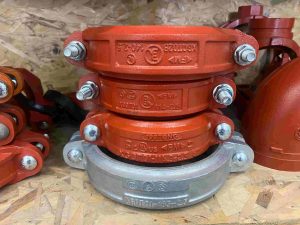
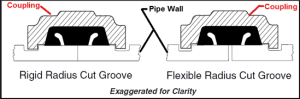
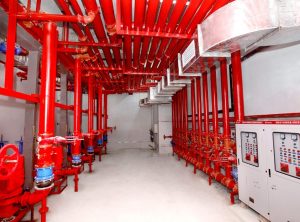
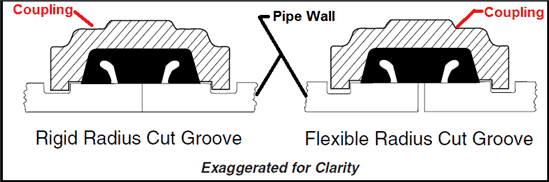
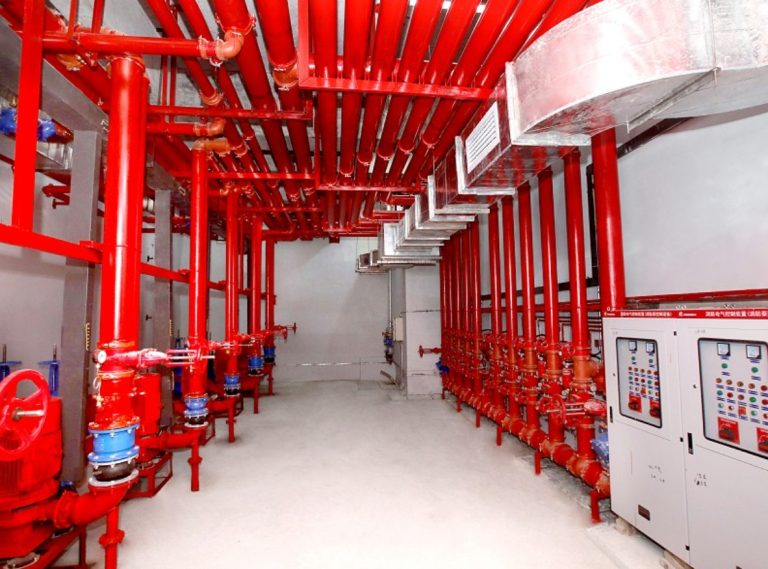
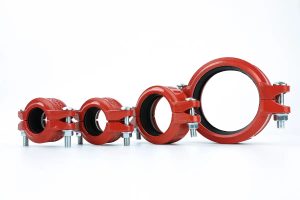
In fire protection systems, picking the proper joints often determines whether a setup holds up during emergencies or falters when pressures peak. Rigid vs flexible grooved coupling emerges as a pivotal choice for those designing or maintaining sprinkler networks. These mechanical connections link pipes without the hassle of welding, delivering speed in assembly while meeting demands for either rock-solid hold or some give under strain. Grasping what sets them apart aids in hitting code requirements and boosting performance in critical setups.   What Are Grooved Couplings? Essential Basics Grooved couplings form a key element in today’s piping arrangements, especially for fire suppression tasks. The setup involves a housing that clamps over grooved ends of pipes, fastened with bolts to seal the joint. Those grooves get rolled or machined into the pipe, providing a secure mechanical bite that stands up to internal forces. In fire protection scenarios, where water must surge through

Engineering Service Life in Galvanized Pipe Fittings Predictive Corrosion Modeling for Industrial Systems to Maximize Durability and Efficiency

Engineering Service Life in Galvanized Pipe Fittings: Predictive Corrosion Modeling for Industrial Systems to Maximize Durability and Efficiency

Abstract In industrial piping systems, galvanized pipe fittings remain a go-to choice for their dependable structural strength and proven long-term performance across a wide range of corrosive environments. This whitepaper focuses on estimating the realistic engineering service life of these fittings using established predictive corrosion models, with the goal of providing practical, actionable input for structured preventive maintenance programs and long-range cost control. The core approach uses the straightforward linear zinc consumption formula: L = h / R, where L is expected service life (years), h is initial zinc coating thickness (μm), and R is the average annual zinc corrosion rate (μm/year). When combined with ISO 12944 corrosivity categories and full lifecycle cost engineering methods, this model delivers reliable forecasts of material loss patterns and helps guide the selection of cost-effective protection strategies. In field applications we routinely incorporate Arrhenius temperature acceleration (typically ~doubling of rate per 10°C rise), Faraday’s

How to Verify Gasket Compatibility for Grooved Fittings in Hot Water HVAC Loops

How to Verify Gasket Compatibility for Grooved Fittings in Hot Water HVAC Loops

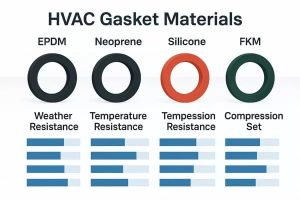
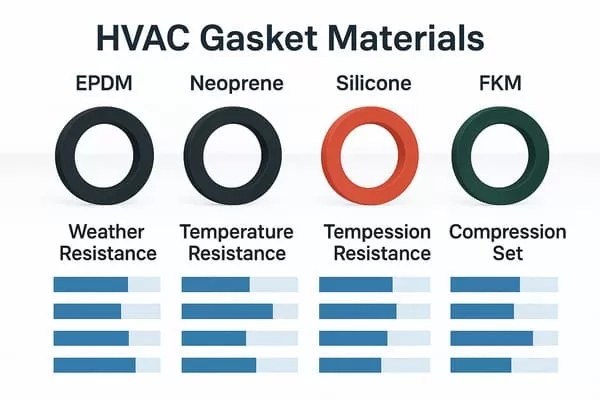
Verifying gasket compatibility for grooved pipe fittings in hot water HVAC loops prevents a range of avoidable problems in hydronic heating systems. Supply temperatures commonly hold between 140°F and 200°F, with certain commercial or older installations running sustained at 210–220°F near boilers. Standard EPDM gaskets serve reliably in many water services, yet prolonged exposure at elevated temperatures accelerates compression set, hardening, or swelling—particularly when glycol mixtures, corrosion inhibitors, or biocides enter the equation. Joints that pass initial pressure testing sometimes develop slow leaks months later, damaging insulation, staining ceilings, or triggering callbacks during peak heating season. The verification routine starts early in the project cycle—during submittal review or material procurement—and continues through on-site inspection. Matching gasket ratings to actual system conditions, fluid makeup, and thermal cycling patterns delivers joints that maintain integrity over years of operation.   Why Compatibility Verification Matters in Hot Water Hydronic Loops Hot water circuits place different

Grooved Pipe Fitting Gasket Pinching in HVAC Chilled Water Lines Causes, Fixes & Prevention

Grooved Pipe Fitting Gasket Pinching in HVAC Chilled Water Lines: Causes, Fixes & Prevention

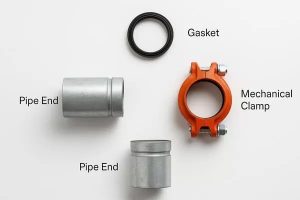
Grooved pipe fitting gasket pinching continues to cause headaches on chilled water jobs. The seal fails when the gasket compresses unevenly or gets trapped during assembly, leading to leaks that show up right away or after the system runs through a few cycles. In chilled water lines—usually holding steady at 40–55°F under typical operating pressures—the EPDM material stiffens just enough in the cold to lose some pliability. Any slip in technique then turns a minor misalignment or dry spot into a weak point that lets water escape. These failures translate to real costs: callbacks eat time, water damage hits ceilings and floors in corridors or mechanical rooms, pressure tests fail, and schedules slip. Field experience shows that digging into the main triggers, learning to spot trouble early, and sticking to proven assembly steps cuts most of these issues. The sections below lay out the mechanics, the patterns seen in chilled water

Coupling rigide vs couplage flexible lequel choisir pour les ascenseurs de sprinkler d'incendie

Coupling rigide vs couplage flexible lequel choisir pour les ascenseurs de sprinkler d'incendie

Coupling rigide vs couplage flexible: lequel choisir pour les ascenseurs de sprinkler d’incendie Coupling rainé rigide vs flexible: lequel choisir pour les ascenseurs de sprinkler d’incendie est le genre de question qui se pose lorsque vous regardez une course verticale qui doit passer un test de pression, répondre aux spécifications du projet et se comporter comme une « colonne » prévisible pendant des années. Beaucoup de pages en ligne s'arrêtent à la différence du manuel - rigide restreint le mouvement, flexible permet le mouvement. C’est vrai, mais cela ne vous aide pas à décider ce qu’il faut faire lors d’un décalage du montant, d’une pénétration au sol, d’une transition en haut du montant ou d’une section qui voit la vibration et la dérive du bâtiment. Ce guide est conçu pour les concepteurs, les entrepreneurs, les ateliers préfabriqués et les inspecteurs qui veulent une logique de sélection claire, ainsi que des contrôles pratiques que vous pouvez effectuer sur place pour défendre la décision. Si vous construisez une norme pour votre équipe, gardez-la liée à une référence système rainurée cohérente

Comment mesurer le diamètre de la rainure pour les raccords rainurés du sprinkler

Comment mesurer le diamètre de la rainure pour les raccords rainurés du sprinkler

Comment mesurer le diamètre de la rainure pour le raccord de tuyauterie rainurée pour les tuyauteries d'aspersion d'incendie est une question qui se pose généralement lorsque les horaires sont serrés: la ligne est préparée pour un test hydrostatique, un accouplement ne sera pas assis comme il devrait, ou le QA / QC a besoin de quelque chose de plus solide que « ça semblait bien ». Ce qu'ils ne vous donnent pas, c'est une méthode prête au champ avec des étapes répétables, une logique claire de passage / échec et les erreurs courantes qui font que les bonnes rainures se lisent mal (ou que les mauvaises rainures glissent). Ce guide est écrit pour les installateurs, les ouvriers, les ateliers préfabriqués et les inspecteurs qui veulent une mesure propre et défendable qu'ils peuvent répéter sur un chantier.   Réponse: Comment mesurer le diamètre de la rainure pour le raccord de tuyauterie rainurée pour la tuyauterie de sprinkler d'incendie Pour mesurer le diamètre de la rainure pour le raccord de tuyauterie rainurée pour la tuyauterie de sprinkler d'incendie, vous devez

Causes de fuites d'accouplement de tuyaux d'aspersion et réparations pour les aspersionnaires d'incendie

Fuites d'accouplement de tuyaux d'aspersion: causes et solutions pour les aspersionnaires d'incendie

Fuites d'accouplement de tuyaux d'aspersion: causes et solutions pour les systèmes d'aspersion incendie. Si vous avez déjà vu une « transpiration » articulaire lors d’un test hydrostatique ou trouvé une goutte lente après que le système soit de retour en service, vous connaissez déjà la partie frustrante: la fuite semble souvent petite, mais les temps d’arrêt, le retravail et la responsabilité peuvent être importants. Cet article décrit le problème de la façon dont les équipes de terrain et les équipes de mise en service le résolvent réellement, en commençant par des contrôles rapides et non destructifs et en passant par des preuves solides. Vous obtiendrez des méthodes de vérification pratiques avec les bons outils, des critères clairs de réussite / échec et les erreurs les plus courantes qui perdent du temps.   Réponse: Fuites d'accouplement de tuyaux d'aspersion: causes et solutions pour les systèmes d'aspersion incendie Un accouplement de tuyaux d'aspersion fuit généralement pour l'une des quatre raisons: le joint est pincé ou roulé lors d'un serrage inégal, le couple de boulon est en dehors de la plage prévue de l'accouplement (trop bas ou trop couple), la rainure ou l'extrémité du tuyau est

Téléchargez nos documents