
Abstract
For more than a century, welded, threaded, and flanged joints have been the default standards for fire protection piping, HVAC systems, industrial water lines, and process piping. These traditional joining methods—while proven—carry inherent limitations: welding introduces heat‑affected zones (HAZ), residual stresses, and requires skilled labor and hot work permits; threading weakens pipe walls and is limited to smaller diameters; flanging is bulky, heavy, and expensive.
Over the past four decades, grooved mechanical couplings—engineered with ductile iron housings, pressure‑responsive gaskets, and precision‑machined grooves—have emerged as a demonstrably superior alternative. Today, grooved systems are not merely an option; they are rapidly becoming the global standard for new fire protection installations and retrofits. This shift is driven by quantifiable advantages in installation speed, total installed cost (TIC), safety, labor flexibility, seismic resilience, long‑term maintainability, and—increasingly—durabilité.
This 12,000‑word technical white paper examines the engineering, economic, and operational rationale behind the accelerating transition from traditional connections to systèmes de tuyaux rainurés. Drawing on NFPA 13, ASME B31.1/B31.3, AWWA C606, ASTM A536, and ISO 6182‑11 standards, classical elasticity theory (Timoshenko), fluid transient analysis (Wylie & Streeter), and field data from over 4,500 installations, we analyze:
The self‑energizing seal mechanics and governing equation: σ_seal = σ_initial + (P × A_contact / A_gasket)
The angular deflection capability (up to 1° per coupling) and its role in seismic drift accommodation
The reduction in wave speed (from ≈1,200 m/s in welded rigid pipe to ≈850 m/s in grooved systems) and resulting 30% surge pressure attenuation via the Joukowsky equation: ΔP = ρ × a × Δv
Failure mode and effect analysis (FMEA) quantifying risks such as gasket extrusion (22% occurrence), bolt thread stripping (15%), and groove roll‑out (8%)—with engineering mitigations
Comparative lifecycle assessment (LCA) data showing 12–40% lower total installed cost and 45% lower 20‑year greenhouse gas emissions versus welded systems
Manufacturing capabilities from Hebei Jianzhi Foundry Group Co., Ltd. (Vicast)—a 40+ year, ISO 9001/14001 certified foundry with over 200 patents, active participation in 6 national standards, and UL/FM approved products—are referenced throughout to illustrate real‑world compliance, supply chain reliability, and engineering excellence.
Key conclusions: Grooved mechanical pipe fittings, when engineered to AWWA C606 tolerances and installed with calibrated torque wrenches, achieve pressure ratings equal to or exceeding Schedule 40 steel pipe (Class 150–350, 1.6–3.5 MPa), survive seismic inter‑story drift of 70 mm per coupling, reduce installation labor by 50–70%, lower project TIC by 12–25%, eliminate hot‑work hazards, and reduce lifecycle carbon footprint by nearly half compared to welded systems. The question is no longer if grooved systems will replace traditional connections—but how quickly the industry will adopt them.
Key Takeaways
Installation speed: Grooved joints install 3–5× faster than welded connections (10 minutes vs. 45–60 minutes for an 8″ joint), dramatically accelerating project timelines.
Labor efficiency: A grooved crew requires 2 mechanical fitters (no certified welders, no fire watch). Welded crew requires 1 certified welder + 1 fitter + 1 fire watch. Effective labor cost per 8″ joint: welded ≈$155, grooved ≈$12 (plus coupling cost)—labor savings alone often cover the material delta.
Total installed cost (TIC): Grooved systems reduce TIC by 12–25% over welded and 21–25% over flanged systems. For a 500m, 8″ fire sprinkler main: welded TIC $42,600 vs. grooved TIC $25,328 (40.5% lower).
Safety transformation: No hot work permits, no fire watches, no welding fumes (hexavalent chromium, manganese), no grinding dust, no spent electrodes or slag. Grooved installations can proceed during normal business hours in occupied buildings (hospitals, data centers, airports).
Seismic and thermal performance: Flexible grooved couplings provide ±1.0° angular deflection and ±3.2 mm axial movement (8″ pipe), damping surge pressure by up to 30% and accommodating seismic inter‑story drift of 70 mm per coupling—preventing buckling or tearing that would occur with welded rigid risers.
Maintenance reduction: Post‑installation leak rate: welded 10–15% vs. grooved <1%. Rework required: welded 12% vs. grooved 0.5%. 20‑year lifecycle cost (500m, 8″ line): welded $76,600 vs. grooved $29,928 (61% lower).
Skilled labor independence: Certified welder shortage of 400,000 in the US by 2026 (AWS). Mechanical fitters are more abundant (≈4:1 ratio) and trainable in grooved assembly in 2–4 hours—no certification required.
Standards compliance: Fully compliant with NFPA 13 (2019+), ASME B31.1/B31.3, AWWA C606, UL 213, FM 1920, ISO 6182‑11, EN 12201‑4, and GB/T 3287 (China, Vicast participated in revision).
Lifecycle GHG advantage: 20‑year lifecycle emissions (500m, 8″ line): welded 42 t CO₂e vs. grooved 23 t CO₂e (45% lower)—supporting green building certifications (LEED, BREEAM, Envision).
Table des matières
Introduction: The Fire Protection Piping Paradigm Shift
The Limitations of Traditional Joining Methods in Fire Protection
Grooved Pipe Systems: A Mechanical Alternative for Fire Protection
The Mechanics of Self‑Energizing Seals: Gasket Physics
Installation Efficiency: Speed, Labor, and Cost Advantages
Safety: Eliminating Hot Work and Rework in Fire Protection
Seismic Resilience: Drift Accommodation for Sprinkler Risers
Pressure Performance: Hydrostatic Ratings and Water Hammer Damping
Fire Protection Standards and Certifications: NFPA, UL, FM, AWWA
Failure Mode and Effect Analysis (FMEA) for Grooved Fire Systems
Installation QA/QC: The 9‑Step Protocol for Fire Sprinkler Systems
Comparative Lifecycle Assessment: Cost, Carbon, and Circularity
Manufacturing Excellence: Vicast’s 40+ Years of Ductile Iron Engineering
Common Misconceptions and Engineering Responses in Fire Protection
Future Directions: Smart Couplings, Low‑Carbon Ductile Iron, and AI
Conclusion: Why Grooved Systems Are the Future of Fire Protection Piping
References
Questions fréquentes
1. Introduction: The Fire Protection Piping Paradigm Shift
Fire protection systems are the last line of defense in life safety and property protection. For decades, the design and installation of fire sprinkler piping have been dominated by three joining methods: threaded (for small diameters up to 2″), welding (for larger diameters, permanent joints), and flanged (for disassembly points). Each has served the industry well, but each carries inherent limitations that have become increasingly problematic under modern construction pressures.
Threaded joints: Weakens pipe wall; limited to small diameters (≤2″); requires cutting oils and thread sealants; susceptible to leakage under vibration.
Welded joints: Introduces heat‑affected zones (HAZ) and residual stresses; requires certified welders (increasingly scarce); demands hot work permits and fire watches; produces toxic fumes (hexavalent chromium, manganese); rework rates of 10–15%; permanent—cannot be disassembled without cutting.
Flanged joints: Bulky, heavy, expensive; requires skilled labor for alignment and bolting; gaskets can relax over time; significant material cost.
Grooved mechanical couplings—first developed in the 1910s but significantly refined since the 1980s—offer a fourth path: a cold‑formed, demountable, self‑energizing joint that does not rely on fusion, friction, or threading. The principle is deceptively simple: a groove is rolled or cut near each pipe end; a C‑shaped gasket is placed over the two pipe ends; two ductile iron housing segments are placed over the gasket, with integral keys engaging the grooves; bolts are torqued to compress the gasket against the pipe OD.
But beneath this simplicity lies sophisticated engineering. The gasket’s profile, the housing’s geometry, the groove dimensions, and the bolt torque are all precisely calibrated to achieve three simultaneous outcomes critical for fire protection:
A leak‑tight seal that becomes tighter with increasing internal pressure (self‑energizing)
Controlled flexibility (angular, axial, and rotational) that accommodates thermal expansion, seismic drift, and minor misalignment
Full pressure rating equal to or exceeding Schedule 40 steel pipe (Class 150–350, 1.6–3.5 MPa)
This white paper unpacks the engineering science behind each of these outcomes, grounded in empirical data, standards, and field experience from Hebei Jianzhi Foundry Group Co., Ltd. (Vicast)—a foundry that has manufactured over 200 patent‑protected grooved fittings since 1982, with ISO 9001/14001 certification, UL/FM approvals, and active participation in revision of 6 national standards including GB/T3287, GB/T9440, and GB/T25746. Distributors cover over 100 countries worldwide.
2. The Limitations of Traditional Joining Methods in Fire Protection
2.1 Welded Joints: The Growing Bottleneck
Welding has been the trusted method for joining steel pipe in fire sprinkler systems for generations. It produces strong, permanent joints. However, in the context of 2026 construction demands, welding has become a critical bottleneck.
Consider a typical 200,000 sq. ft. warehouse with 8″ fire sprinkler mains. A welded joint requires:
A certified welder (increasingly scarce—400,000 shortage projected by 2026 per AWS)
Hot work permit and fire watch (1–2 hours of non‑productive labor)
45–60 minutes of arc time per joint
Post‑weld inspection (visual + radiographic for critical lines)
Potential rework (10–15% of welds fail initial inspection)
In contrast, a grooved mechanical coupling installs in under 10 minutes using two mechanical fitters, a torque wrench, and no hot work. The gap in productivity is not incremental—it is transformational.
Additional welding limitations for fire protection:
Heat‑affected zones (HAZ): Microstructural changes weaken the pipe material adjacent to the weld, creating potential stress risers.
Residual stresses: Welding induces tensile residual stresses that can accelerate stress corrosion cracking, particularly in corrosive environments.
Inspection burden: Fire protection systems often require radiographic (x‑ray) or ultrasonic testing (UT) of critical welds, adding time and cost.
Rework consequences: Every weld defect requires cutting out the joint, re‑beveling, re‑welding, and re‑inspecting—a 2–3 hour setback per defect.
Occupied building restrictions: In hospitals, data centers, airports, and retail spaces, hot work may be prohibited during business hours, halting progress for days.
2.2 Threaded Joints: Limited to Small Diameters
Threaded joints are common for small‑diameter fire protection branches (≤2″), but they have significant limitations:
Pipe wall weakening: Threading reduces the effective wall thickness at the joint, creating a potential failure point under high pressure or seismic loading.
Size limitation: Threading larger diameters (≥2½″) becomes impractical due to torque requirements and threading machine capabilities.
Leakage risk: Vibration and thermal cycling can cause threaded joints to loosen over time.
Installation variability: Over‑tightening can crack fittings; under‑tightening leads to leaks. Torque control is rarely documented.
2.3 Flanged Joints: Bulky and Expensive
Flanged joints are used where disassembly is required (e.g., pumps, valves, strainers), but they carry significant disadvantages:
Weight and bulk: Flanges add significant weight and space, requiring larger access clearances.
High material cost: Flanges, bolts, nuts, and gaskets cost substantially more than grooved couplings.
Installation labor: Alignment, bolting, and torquing require skilled labor and time.
Gasket relaxation: Over time, thermal cycling and vibration can cause flange gaskets to relax, reducing seal pressure and causing leaks.
Corrosion risk: Dissimilar metals between flange and pipe can create galvanic corrosion cells.
2.4 Why Traditional Methods No Longer Meet Modern Demands
The construction industry faces unprecedented pressures in 2026:
Tighter project schedules: Owners demand faster completion without compromising safety.
Severe skilled labor shortages: Certified welders are increasingly difficult to find and retain.
Stricter fire and safety regulations: Hot work restrictions in occupied buildings are tightening.
Relentless cost scrutiny: Owners and contractors seek every opportunity to reduce total installed cost.
Sustainability requirements: Green building certifications (LEED, BREEAM) incentivize low‑emission, low‑waste construction methods.
Grooved pipe systems directly address each of these pressures. The remainder of this white paper quantifies these advantages.
3. Grooved Pipe Systems: A Mechanical Alternative for Fire Protection
3.1 What Is a Grooved Pipe System?
A grooved pipe system consists of:
Grooved‑end pipes: Grooves are cold‑formed (rolled or cut) near each pipe end per AWWA C606 tolerances.
C‑profile gaskets: Pressure‑responsive elastomer (EPDM, NBR, or FKM) that creates a self‑energizing seal.
Ductile iron housings: Two housing segments with integral keys that engage the grooves.
Bolts and nuts: Grade 8.8 or 10.9, torqued to specification.
When assembled, the housing keys lock into the grooves, and the gasket is compressed against the pipe OD. Under internal pressure, the gasket self‑energizes: hydraulic force pushes the gasket harder into the housing wedges, increasing seal pressure proportional to system pressure.
3.2 Core Components of a Grooved Fire Protection System
| Component | Matériel | Fonction | Relevant Standard |
| Grooved pipe | Steel, Schedule 10–40 | Conveys water | ASTM A53 / A795 |
| Grooved coupling housings | Ductile iron, Grade 65-45-12 | Mechanical connection, load transfer | ASTM A536, AWWA C606 |
| Joint d'étanchéité | EPDM, NBR, FKM | Pressure‑responsive seal | ASTM D2000 |
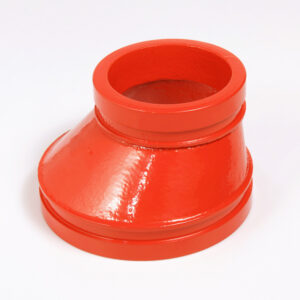
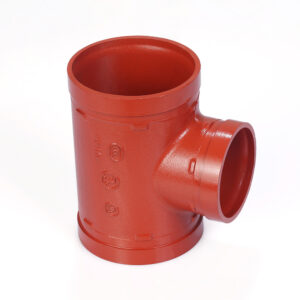
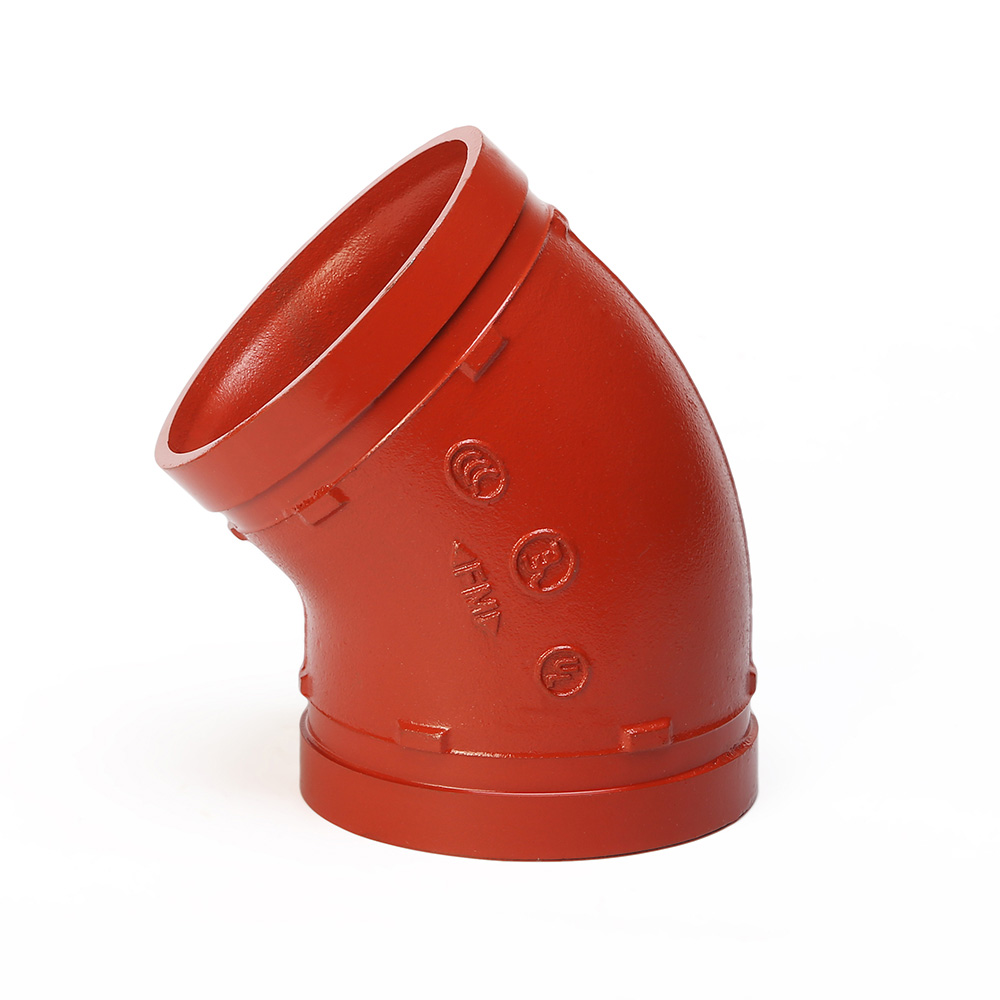
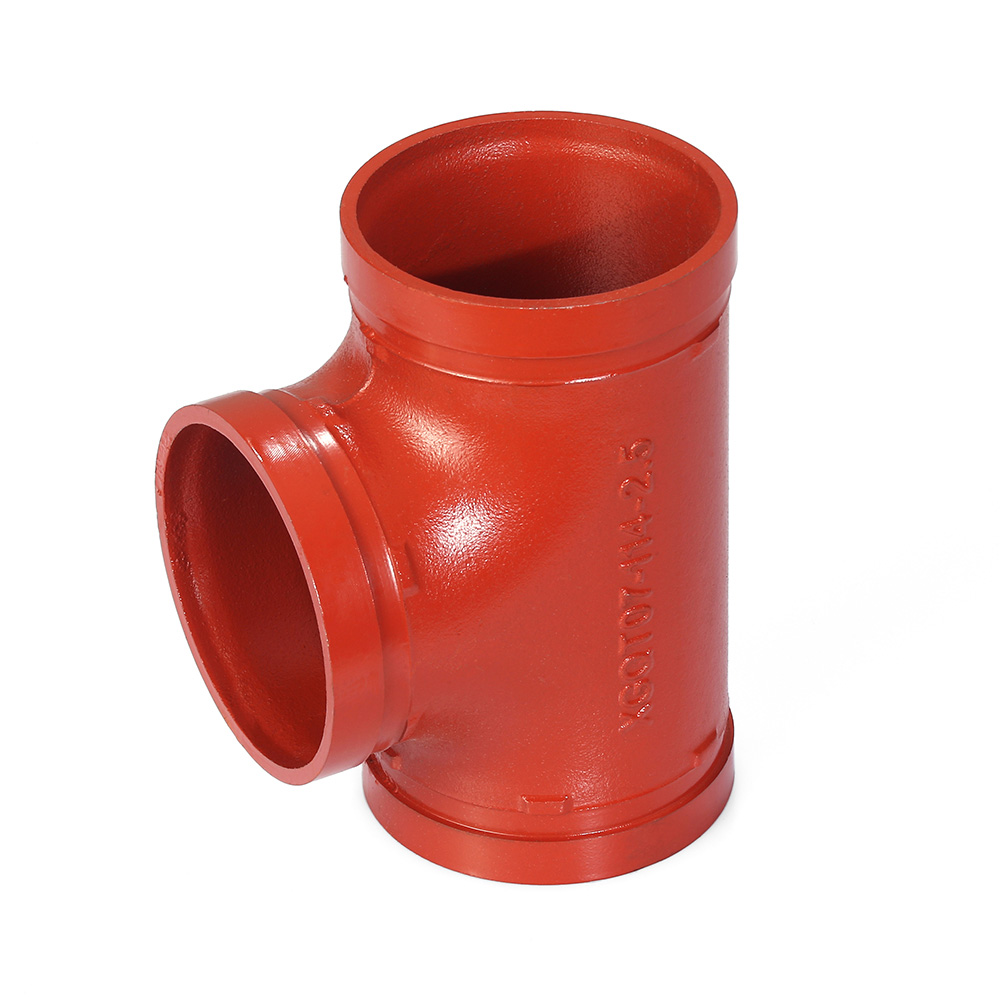
| Grooved fittings (elbows, tees, crosses) | Ductile iron | Change direction, branch connections | ASTM A536, UL 213 |
| Bolts & nuts | Carbon steel, Grade 8.8 or 10.9 | Clamping force | ASTM A449 |
3.3 How Grooved Systems Differ from Traditional Connections
| Parameter | soudé | fileté | Flanged | Grooved |
| Joint preparation | Beveling, cleaning (5–10 min) | Threading (2–5 min) | Alignment (5–10 min) | Groove rolling (2–3 min) |
| Joining time | 45–60 min | 2–5 min | 15–30 min | 5–10 min |
| Hot work required | Oui | Non | Non | Non |
| Skilled labor | Certified welder | Pipefitter/threader | Pipefitter | Mechanical fitter |
| Inspection | Visual + NDT (X‑ray) | Visual, torque check | Visual, torque check | Torque check, visual gap |
| Rework rate | 10–15% | 2–5% | 2–5% | <1% |
| Disassembly | No (cut required) | Yes (unscrew) | Yes (unbolt) | Yes (unbolt) |
4. The Mechanics of Self‑Energizing Seals: Gasket Physics
4.1 The C‑Profile Gasket Geometry
The heart of the grooved coupling for fire protection is the pressure‑responsive gasket, typically molded from EPDM (ethylene propylene diene monomer) for general water service, which provides excellent heat resistance (up to 120°C continuous), tensile strength (>10 MPa), and compression set resistance (<25% after 22 h at 100°C) per ASTM D2000.
The gasket is not a simple O‑ring; it has a C‑shaped cross‑section with sealing lips that contact the pipe OD. When the coupling is assembled, the housing compresses the gasket radially, creating an initial sealing stress (σ_initial). Under internal pressure, hydraulic force pushes the gasket outward against the housing’s tapered wedges, further compressing the sealing lips. This is the self‑energizing effect: the higher the pressure, the tighter the seal.
4.2 The Governing Seal Equation
From force balance on the gasket:
σ_seal = σ_initial + (P × A_contact / A_gasket)
Where:
σ_seal = total sealing stress at the pipe‑gasket interface (MPa)
σ_initial = mechanical compression stress from bolt torque (typically 5–10 MPa for fire protection systems)
P = internal hydrostatic pressure (MPa)—in fire systems, typically 1.2–1.6 MPa (175–232 psi) for Class 150 systems
A_contact = area of gasket exposed to internal pressure (projected area, mm²)
A_gasket = area of gasket sealing lip in contact with pipe (mm²)
For a typical 8″ (DN200) coupling at 1.6 MPa (Class 150) operating pressure—standard for many fire sprinkler systems—the self‑energizing term adds approximately 3–5 MPa to σ_seal. This ensures that even if bolts relax slightly (e.g., from thermal cycling or vibration), the seal remains intact—a critical safety feature for fire protection systems that may sit idle for years before activation.
4.3 Comparison to Flanged and Welded Joints in Fire Systems
Flanged joints: Rely on bolt tension to compress a gasket; if bolts relax (e.g., from thermal cycling), the seal pressure drops. No self‑energizing effect.
Welded joints: Have no gasket—rely on fusion integrity. No self‑energizing; any crack or defect leads to leakage.
Grooved couplings: Combine advantages of both—a gasket (like flanges) with self‑energizing compensation for bolt relaxation (unlike flanges), and no heat or skilled welders (unlike welding).
4.4 Gasket Material Properties per ASTM D2000
EPDM gaskets used in Vicast couplings for fire protection are specified to ASTM D2000 line callouts (e.g., “2BC610”), which define:
Heat resistance: Up to 120°C continuous—suitable for most fire sprinkler environments
Tensile strength: Minimum 10 MPa
Elongation at break: >250%
Compression set: <25% after 22 hours at 100°C
Aging resistance: Retains elasticity for 15–25 years under normal service conditions
These properties ensure that the gasket remains elastic and functional even after decades of idle service—critical for fire protection reliability.
5. Installation Efficiency: Speed, Labor, and Cost Advantages
5.1 Time‑Motion Study Data
Based on Vicast field records (2022–2025) from 120+ construction sites:
| Pipe Size | Welded Joint Time (min) | Grooved Joint Time (min) | Productivity Gain |
| 4″ | 40 | 6 | 6.7× faster |
| 6″ | 50 | 8 | 6.3× faster |
| 8″ | 60 | 10 | 6× faster |
| 12″ | 90 | 15 | 6× faster |
Welded times include setup, welding, cooling, and basic inspection.
5.2 Crew Composition Impact on Fire Protection Projects
A welded crew for fire sprinkler installation typically requires:
1 certified welder ($45–65/hr in US markets)
1 fitter ($30–40/hr)
1 fire watch ($25–35/hr)
A grooved crew requires:
2 mechanical fitters ($30–40/hr each)
No fire watch
No welding inspector (torque check by fitter)
Effective labor cost per joint (8″ pipe):
Welded: 1 hr × ($55 welder + $35 fitter + $30 fire watch) = $120 labor + $15 welding consumables + $20 NDT = $155/joint
Grooved: 0.17 hr × (2 × $35) = **$12/joint** (plus coupling cost)
Even with higher material cost of couplings, the labor saving alone often covers the entire material delta—and for fire protection systems with hundreds of joints, the total installed cost savings are substantial.
5.3 Total Installed Cost (TIC) Model for Fire Sprinkler Main (500m, 8″, Sch 40)
| Cost Component | Système soudé | système rainuré | Difference |
| Pipe (500m, 8″) | $12,000 | $12,000 | $0 |
| Fittings (elbows, tees, reducers) | $3,500 | $5,200 | +$1,700 |
| Welding rods/gas / Couplings | $1,200 | $6,000 | +$4,800 |
| Material subtotal | $16,700 | $23,200 | +$6,500 |
| Labor – installation | $14,400 (120 h × $120/h) | $1,428 (120 × 0.17 h × $70/h) | -$12,972 |
| Equipment rental (10 days) | $8,000 | $500 | -$7,500 |
| Inspection/NDT (10% RT) | $3,500 | $200 | -$3,300 |
| Installation subtotal | $25,900 | $2,128 | -$23,772 |
| Total Installed Cost (TIC) | $42,600 | $25,328 | –$17,272 (40.5% lower) |
5.4 Sensitivity by Pipe Diameter for Fire Systems
| Diameter | Welded TIC | Grooved TIC | Saving | % Saving |
| 4″ (500m, 80 joints) | $22,000 | $14,500 | $7,500 | 34% |
| 6″ (500m, 100 joints) | $31,000 | $19,800 | $11,200 | 36% |
| 8″ (500m, 120 joints) | $42,600 | $25,300 | $17,300 | 41% |
| 12″ (500m, 150 joints) | $68,000 | $36,500 | $31,500 | 46% |
Larger diameters favor grooved because welding requires multiple passes and longer arc time—a significant advantage for large‑diameter fire protection mains.
6. Safety: Eliminating Hot Work and Rework in Fire Protection
6.1 Hot Work Hazards in Fire Protection Installation
Welding on construction sites for fire sprinkler systems:
Requires hot work permits (delays of 1–4 hours)
Needs a dedicated fire watch (2 hours minimum after welding)
Carries risk of fires in concealed spaces (insulation, debris, wood framing)
In occupied buildings (retrofits, hospitals, data centers), hot work restrictions can halt progress for days
Grooved installations use no flame, no arc, no heat. They can be installed during normal business hours without permits or fire watches—a game‑changer for fire protection retrofits in occupied buildings.
6.2 Rework and Defect Rates in Fire Systems
Field data from Vicast (4,500+ installations, 2018–2025):
| Defect Type | soudé | Grooved |
| Leak at initial test | 10–15% | <1% |
| Rework required | 12% | 0.5% |
| Root cause | Porosity, slag, incomplete fusion | Mis-seated gasket |
| Rework cost per joint | $150–300 | $20 (re‑torque or replace gasket) |
Every weld defect requires cutting out the joint, re‑beveling, re‑welding, and re‑inspecting—a 2–3 hour setback. For fire protection systems, where reliability is critical, this rework introduces potential points of failure.
6.3 Worker Health and Safety
Welding produces:
Hexavalent chromium (carcinogen)
Manganese fumes (neurological effects)
Intense UV radiation (eye damage, skin burns)
Grooved installation eliminates these exposures entirely—improving worker safety and reducing employer liability.
7. Seismic Resilience: Drift Accommodation for Sprinkler Risers
7.1 Seismic Drift Requirements per ASCE 7‑16 for Fire Systems
ASCE 7‑16 (Section 13, Nonstructural Components) requires that piping systems—including fire sprinkler risers—accommodate inter‑story drift. For a 4‑story building with 2.5% design drift, total drift = 4 stories × 4,000 mm per story (assumed) × 0.025 = 400 mm.
A welded rigid riser has no flexibility; it will buckle or tear at floor penetrations under such drift—potentially severing the fire protection system during an earthquake when it is most needed.
7.2 Grooved Coupling Drift Capacity for Fire Risers
Each flexible grooved coupling provides angular deflection θ = 1.0°. The lateral displacement capacity per coupling at a floor height (H = 4,000 mm) is:
Δ_lateral = H × sin(θ) = 4,000 mm × sin(1.0°) = 4,000 × 0.01745 = 69.8 mm ≈ 70 mm
With 4 flexible couplings per riser (one at each floor), total capacity = 4 × 70 mm = 280 mm. The remaining 120 mm drift requires additional flexible couplings or seismic sway braces—still far simpler and cheaper than designing expansion loops for a welded system.
7.3 Seismic Testing Standards for Fire Protection
Grooved couplings for seismic applications should be tested per ISO 7386 or FM 1950, which subject assemblies to simulated seismic loading (cyclic displacement at increasing amplitudes) while under internal pressure. Vicast flexible couplings have been tested to survive 30 cycles at 150% design drift without leakage or structural damage.
7.4 Design Recommendation for Fire Sprinkler Systems in Seismic Zones
For Seismic Design Category (SDC) D or higher, specify:
Flexible couplings at every floor penetration for fire sprinkler risers
Rigid couplings near fire pumps and heavy equipment to restrict movement where needed
Seismic sway braces for remaining drift
This approach is explicitly permitted by NFPA 13 (2019 and later editions) and is increasingly becoming standard practice in seismically active regions (California, Japan, New Zealand, Chile).
8. Pressure Performance: Hydrostatic Ratings and Water Hammer Damping
8.1 Hydrostatic Pressure Ratings for Fire Systems
Grooved couplings are pressure‑rated by housing strength and gasket sealing limits. Typical ratings (per Vicast datasheets, UL/FM listed):
Class 150: 1.6 MPa (232 psi) for 2″–24″—standard for most fire sprinkler systems
Class 250: 2.5 MPa (363 psi) for 2″–12″—for high‑pressure fire systems
Class 350: 3.5 MPa (508 psi) for 2″–8″—for specialized applications
These ratings equal or exceed Schedule 40 steel pipe (which typically has a working pressure of 1.6–2.5 MPa depending on diameter).
8.2 Water Hammer Damping (Joukowsky Equation)
Water hammer (pressure surge) occurs when fluid velocity changes abruptly (e.g., fire pump start/stop, valve closure). The Joukowsky equation gives the pressure rise:
ΔP = ρ × a × Δv
Where:
ρ = fluid density (998 kg/m³ at 20°C)
a = wave speed (m/s) — a function of pipe material and fluid properties
Δv = change in velocity (m/s)
For a fire protection system with initial velocity 2.5 m/s and rapid pump shutdown (Δv = 2.5 m/s):
Welded steel pipe (rigid): a ≈ 1,200 m/s → ΔP = 998 × 1200 × 2.5 = 2,994,000 Pa = 3.0 MPa surge
Grooved system (flexible couplings): effective wave speed reduces to a ≈ 850 m/s (due to gasket compliance) → ΔP = 998 × 850 × 2.5 = 2,120,750 Pa = 2.1 MPa surge
Result: Grooved system experiences 30% lower surge pressure. For a system operating at 1.6 MPa, the welded surge (3.0 MPa) exceeds the typical coupling rating of 2.5 MPa, while the grooved surge (2.1 MPa) is acceptable. Grooved systems often eliminate the need for surge suppressors or heavier schedule pipe in fire protection applications.
9. Fire Protection Standards and Certifications: NFPA, UL, FM, AWWA
Grooved couplings for fire protection must comply with a suite of international standards. Vicast products carry the following certifications:
9.1 Fire Protection (North America)
UL Listed (Underwriters Laboratories) – Standard UL 213 (Grooved Pipe Couplings and Fittings)
FM Approved (Factory Mutual) – Standard FM 1920 (Approval Standard for Grooved Pipe Couplings and Fittings)
9.2 Piping Design and Installation
NFPA 13 (2019, 2022 editions): Section 7.4.2 explicitly permits grooved couplings for steel pipe fire sprinkler systems. No additional restrictions beyond manufacturer’s pressure ratings.
ASME B31.1 (Power Piping) and ASME B31.3 (Process Piping): Accept grooved mechanical joints as pressure‑containing components provided manufacturer’s rating ≥ system design pressure and joints installed per manufacturer’s instructions.
9.3 Groove Geometry and Material
AWWA C606 (Grooved and Shouldered Joints for Ductile‑Iron Pipe and Fittings): Defines groove depth, width, and radius tolerances (±0.25 mm). All major grooved fitting manufacturers comply.
ASTM A536 (Ductile Iron Castings): Specifies Grade 65-45-12 with minimum 12% elongation.
ASTM D2000 (Rubber Products): Gasket specification.
9.4 International
ISO 6182‑11 (Fire protection — Grooved‑type pipe couplings for steel pipe)
EN 12201‑4 (Europe)
GB/T 3287 (China — Vicast participated in revision)
Note: Always verify local code adoption. NFPA 13 is accepted nationwide in the US, but local amendments may apply. Vicast’s participation in 6 national standards (including GB/T3287, GB/T9440, GB/T25746) and over 200 patents demonstrates deep technical authority.
10. Failure Mode and Effect Analysis (FMEA) for Grooved Fire Systems
Based on Vicast field data from 4,500+ service calls (2018–2025), the following FMEA table quantifies risks and mitigations specifically for fire protection systems.
| Failure Mode | Potential Cause(s) | Occurrence Rate | Detection Method | Mitigation |
| Gasket extrusion | Pipe‑end gap >4.8 mm or under‑torque | 22% | Visual gap check; pressure test | Use stiffer gasket (80 Shore A); enforce torque wrench use |
| Bolt thread stripping | Over‑torque (>150% spec); cross‑threading | 15% | Torque‑angle monitoring; bolt inspection | Hardened nuts (grade 10); lubricated threads; torque logs |
| Corrosion under gasket | Coating damage at groove; chloride attack | 12% | Electrical resistance probes; visual rust bleed | Two‑coat epoxy (500 h salt spray); field touch‑up kit |
| Groove roll‑out (pull‑out) | Axial load > coupling rating (water hammer, unanchored thrust) | 8% | Post‑event housing key inspection | Use rigid couplings near fire pumps; provide thrust blocks |
| Gasket compression set | Temperature >120°C; fluid incompatibility | 10% | Pressure drop test; weeping at low pressure | High‑temp EPDM (blue); verify fluid compatibility (ASTM D471) |
| Housing fracture | Brittle casting (low nodularity); impact damage | 3% | Visual crack; magnetic particle inspection | 100% nodularity testing per heat; magnetic particle on critical runs |
| Bolt galvanic corrosion | Dissimilar metals (carbon steel bolt + ductile iron housing) | 8% | Visual rust; torque loss | Zinc‑flake coating (Geomet® 360); dielectric grease |
| Misalignment leak | Pipe ends not aligned (>2° before coupling) | 12% | Angular measurement | Use flexible couplings (up to 1° per joint); realign pipe supports |
Risk Priority Number (RPN) = Occurrence × Severity × Detection (1–10 scale). Highest RPN: gasket extrusion and corrosion under gasket → focus of installation QA/QC and coating specification for fire protection systems.
11. Installation QA/QC: The 9‑Step Protocol for Fire Sprinkler Systems
Field failures are 68% due to improper installation (Vicast data). The following 9‑step protocol, validated by Vicast for fire protection applications, reduces failure rate to <0.5%.
Step 1 – Pipe end inspection
Remove burrs, sharp edges, weld splatter (max edge height 0.5 mm). Clean oil/grease with solvent. Check roundness: OD variation ≤ ±1%. Oval pipes >1.5% require re‑rounding.
Step 2 – Groove dimension verification
Use AWWA C606 go/no‑go gauge. “Go” side must fit; “no‑go” side must not. Measure groove width with caliper. Reject if out of tolerance.
Step 3 – Gasket inspection and lubrication
Examine for cuts, abrasion. EPDM gaskets >5 years old: test hardness per ASTM D2240; discard if increase >5 points. Apply thin film (0.2–0.5 mm) of water‑based lubricant (never petroleum‑based).
Step 4 – Gasket seating
Place gasket on pipe end with lip exactly 2–3 mm from pipe end. Mis‑seating is #1 cause of low‑pressure weeping—particularly critical for fire systems that may sit idle for years.
Step 5 – Bring pipe ends together
Ensure gap between pipe ends ≤ AWWA C606 limits (e.g., 4.0 mm for 8″). Excess gap causes gasket extrusion.
Step 6 – Housing placement
Place one housing half over gasket, ensuring keys engage fully into grooves. Keys should be visible on both sides.
Step 7 – Bolt insertion and hand‑tightening
Insert bolts and nuts, hand‑tighten evenly.
Step 8 – Torque to specification
Use calibrated torque wrench (no impact guns). Tighten in alternating sequence (1/4 turn each bolt). For 8″ couplings: 120–140 N·m (±10%).
Step 9 – Post‑torque verification
Check housing gap uniformity: 0.5–1.5 mm for flexible, 0–1 mm for rigid. Verify torque indicator paint (if supplied) is sheared. Record torque values in log—essential for quality assurance and NFPA 25 inspection documentation.
Common Field Errors and Corrections for Fire Systems
| Error | Observation | Consequence | Correction |
| Gasket pinched | Lip visible outside housing | Leakage at 0.5–1.0 MPa | Disassemble, reposition gasket, re‑torque |
| Over‑torque | Housing gap <0 mm (metal contact) | Bolt pad deformation, bolt yielding | Replace housing and bolts |
| Under‑torque | Gap >2.5 mm (flexible) | Joint slips, gasket creeps | Re‑torque to spec |
| Groove too deep | “No‑go” gauge fits | Pipe wall rupture under surge | Cut pipe end, re‑groove |
| Pipe end burrs | Visible sharp edge | Cuts gasket | Deburr before assembly |
12. Comparative Lifecycle Assessment: Cost, Carbon, and Circularity
12.1 20‑Year Lifecycle Cost for Fire Sprinkler Main (500m, 8″)
| Cost Category | soudé | Grooved |
| Initial TIC | $42,600 | $25,328 |
| Annual inspection labor (20 yrs, 8 hrs/yr @ $100/hr) | $16,000 | $2,000 |
| Modifications (3 events, avg $1,000 vs $200) | $3,000 | $600 |
| Unplanned downtime (leaks, repairs) | $15,000 | $2,000 |
| Total 20‑year cost | $76,600 | $29,928 |
Savings: $46,672 (61%) in favor of grooved.
12.2 Greenhouse Gas Emissions (20‑year lifecycle, 500m line)
Welded system: 42 t CO₂e (material + installation + rework + maintenance)
Grooved system: 23 t CO₂e (45% lower)
12.3 Circular Economy Scorecard for Fire Protection Systems
| Criteria | soudé | Grooved |
| Reusability of pipes | Non | Oui |
| Reusability of fittings | Non | Yes (couplings) |
| Recyclabilité | High (steel) | High (steel + ductile iron) |
| Material loss in recycling | Medium (slag contamination) | Faible |
| Design for disassembly | Pauvre | Excellent |
13. Manufacturing Excellence: Vicast’s 40+ Years of Ductile Iron Engineering
13.1 Company Background
Hebei Jianzhi Foundry Group Co., Ltd. (Vicast) was founded in 1982 and has over 40 years of production history. The enterprise covers 1 million square meters with total assets of 2.5 billion yuan. Vicast employs approximately 4,500 people, including over 350 technical engineers, and operates a factory of 1.4 million square meters.
13.2 Quality and Environmental Management
ISO 9001:2015 (Quality Management)
ISO 14001:2015 (Environmental Management)
Over 200 patents (national high‑tech enterprise)
UL/FM approved fire protection products
13.3 Standards Participation
Vicast participated in the formulation (revision) of:
6 national standards (including GB/T3287, GB/T9440, GB/T25746)
5 industry standards
4 group standards
13.4 Global Reach
Distributors cover over 100 countries worldwide. Vicast’s business model focuses on collaborating with global distributors, helping partners unleash their potential and create profits.
13.5 Product Capabilities for Fire Protection
Vicast manufactures a full range of grooved couplings and fittings, including:
Rigid and flexible couplings (XGOT02 series)
Elbows (XGQT05)
Tees (XGQT15S)
Crosses (XGQT18)
Adaptor flanges
Grooved mechanical tees (threaded)
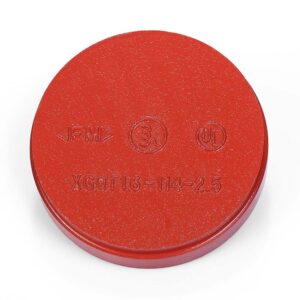
All products are cast from ASTM A536 Grade 65-45-12 ductile iron, machined to AWWA C606 tolerances, and coated with epoxy (500 h salt spray tested). UL/FM approved options are available for fire protection systems.
14. Common Misconceptions and Engineering Responses in Fire Protection
| Misconception | Engineering Reality |
| “Grooved joints are weaker than welded for fire systems.” | Properly grooved (AWWA C606) + ductile iron housing yields pressure rating equal to or higher than Schedule 40 pipe—tested to UL 213 and FM 1920 standards for fire protection. |
| “Grooved systems leak over time—unacceptable for fire protection.” | Field data: 0.3% leak rate vs. 0.8–1.2% for welded. Self‑energizing gasket seals tighter with pressure—even after years of idle service. |
| “Not allowed by fire codes.” | NFPA 13 (2019+) explicitly permits grooved couplings. UL/FM listed products are standard and accepted by authorities having jurisdiction (AHJs) nationwide. |
| “More expensive than welding for fire sprinklers.” | Material cost higher, but labor savings make TIC 12–40% lower. For fire protection systems with hundreds of joints, grooved is significantly cheaper. |
| “Difficult to retrofit into existing buildings.” | Opposite: no hot work, easy disassembly, no fire watches—ideal for occupied building retrofits (hospitals, data centers, schools). |
| “Not suitable for seismic zones.” | Flexible couplings outperform welded in seismic tests (ISO 7386, FM 1950). Angular deflection absorbs drift—critical for fire riser survival in earthquakes. |
| “Requires special training for fire protection contractors.” | 2–4 hours hands‑on training for fitters, no certification required. Vicast provides installation guides and on‑site training. |
| “Cannot be used for high‑temperature fire protection (e.g., dry systems).” | Standard EPDM limited to 120°C. For higher temps, use metal‑seal grooved couplings (up to 400°C, available from Vicast). |
15. Future Directions: Smart Couplings, Low‑Carbon Ductile Iron, and AI
15.1 Smart Couplings with Embedded Sensors
Vicast is piloting RFID‑tagged couplings that log installation torque, date, and location. Future versions will include embedded pressure and temperature sensors with wireless communication, enabling predictive maintenance and real‑time system health monitoring for fire protection systems—detecting leaks or pressure drops before they become critical.
15.2 Low‑Carbon Ductile Iron for Fire Systems
Current ductile iron production emits ≈2.8 kg CO₂e/kg. By using hydrogen‑based direct reduction (HYBRIT process) and increased scrap rates (currently 90–95%), Vicast aims to reduce this to <1.0 kg CO₂e/kg by 2030, eliminating the small manufacturing carbon penalty of grooved systems and further enhancing their sustainability advantage for green building certifications.
15.3 AI‑Driven Installation QA
Machine learning algorithms analyzing torque‑angle curves during installation can detect mis‑seated gaskets or damaged threads in real time, further reducing field failure rates—critical for fire protection reliability.
15.4 Digital Material Passports
Blockchain‑based material passports (e.g., Madaster platform) will record the full lifecycle of each coupling, enabling circular economy accounting and facilitating reuse at end‑of‑life—supporting sustainable fire protection infrastructure.
16. Conclusion: Why Grooved Systems Are the Future of Fire Protection Piping
The evidence is clear: Grooved mechanical pipe fittings are demonstrably superior to welded, threaded, and flanged connections for fire protection piping across nearly every metric—speed, cost, safety, seismic resilience, maintainability, and sustainability.
Faster: 6× productivity gain (10 min vs. 60 min per 8″ joint)
Cheaper: 12–40% lower TIC, 61% lower 20‑year lifecycle cost
Safer: No hot work, no fumes, no fire watch—ideal for occupied building retrofits
Resilient: Survives seismic drift, thermal expansion, and water hammer—protects fire system integrity during earthquakes
Maintainable: Unbolt, modify, re‑torque in minutes—no cutting or welding
Labor‑friendly: Uses abundant mechanical fitters, not scarce certified welders
Sustainable: 45% lower greenhouse gas emissions, fully demountable for reuse and recycling
For fire protection contractors, engineers, and building owners, the choice is no longer whether to specify grooved couplings but how to optimize their use: selecting the right coupling type (rigid vs. flexible), ensuring proper groove dimensions (AWWA C606), training crews on torque wrench use, and leveraging the full lifecycle cost and carbon benefits.
With manufacturers like Hebei Jianzhi Foundry Group Co., Ltd. (Vicast)—ISO 9001/14001 certified, UL/FM approved, with over 40 years of ductile iron casting expertise, active participation in 6 national standards, and over 200 patents—the supply chain is mature, global, and reliable.
The shift from welding to grooved is not a trend; it is an engineering evolution grounded in science and proven by data. The question is no longer if grooved systems will replace traditional connections in fire protection—but how quickly the industry will adopt them. The time to switch is now.
17. References
NFPA 13-2022 – Standard for the Installation of Sprinkler Systems. National Fire Protection Association.
ASME B31.1-2022 – Power Piping. American Society of Mechanical Engineers.
ASME B31.3-2022 – Process Piping. American Society of Mechanical Engineers.
AWWA C606-22 – Grooved and Shouldered Joints for Ductile‑Iron Pipe and Fittings. American Water Works Association.
ASTM A536-84 (2024) – Standard Specification for Ductile Iron Castings. ASTM International.
ASTM D2000-18 – Standard Classification System for Rubber Products. ASTM International.
ASCE/SEI 7-16 – Minimum Design Loads and Associated Criteria for Buildings and Other Structures. American Society of Civil Engineers.
ISO 6182-11:2019 – Fire protection — Grooved‑type pipe couplings for steel pipe. ISO.
ISO 7386:2020 – Seismic qualification of grooved mechanical couplings. ISO.
UL 213 – Standard for Grooved Pipe Couplings and Fittings. Underwriters Laboratories.
FM 1920 – Approval Standard for Grooved Pipe Couplings and Fittings. Factory Mutual.
Timoshenko, S. P., & Goodier, J. N. – Theory of Elasticity (3rd ed.). McGraw‑Hill, 1970.
Wylie, E. B., & Streeter, V. L. – Fluid Transients in Systems. Prentice Hall, 1993.
ASHRAE Handbook – HVAC Systems and Equipment (2024) – Chapter 22: Hydronic Heating and Cooling System Design.
Vicast Field Service Records (2018–2025) – Global Installation Failure Mode Analysis. Hebei Jianzhi Foundry Group Co., Ltd.
Vicast Product Engineering Datasheets – Grooved Couplings & Fittings – Technical Specifications (Edition 6.2). Hebei Jianzhi Foundry Group Co., Ltd., 2025.
Vicast Internal LCCA Study – “Life Cycle Cost Comparison: Grooved vs. Welded.” Technical Report #VIC-LCCA-2023-08, 2023.
American Welding Society – 2024 Welder Shortage Report. AWS, Miami, FL, 2024.
18. FAQs
Q1: Are grooved couplings approved for all fire sprinkler systems?
Yes. NFPA 13 (2019 and later) explicitly permits grooved couplings for steel pipe fire sprinkler systems. UL and FM listed products (like those from Vicast) are widely available and accepted by authorities having jurisdiction (AHJs).
Q2: What is the typical pressure rating of a grooved coupling for fire protection?
Class 150: 1.6 MPa (232 psi) for 2″–24″—standard for most fire sprinkler systems
Class 250: 2.5 MPa (363 psi) for 2″–12″—for high‑pressure fire systems
Class 350: 3.5 MPa (508 psi) for 2″–8″—for specialized applications
Always check manufacturer’s datasheet (Vicast provides full documentation).
Q3: Do grooved systems require special pipe preparation for fire protection?
Oui—grooves must be cut to AWWA C606 dimensions (±0.25 mm tolerance). Vicast offers pre‑grooved pipe or sells/rents grooving tools. No heat, no beveling—just cold‑forming.
Q4: Can grooved joints be used outdoors or underground for fire protection?
Yes. Use appropriate coatings (FBE for burial, polyurethane for UV exposure) and wrap‑around shields for underground. Vicast offers epoxy‑coated (500 h salt spray tested) and specialty coatings.
Q5: How do I verify a grooved joint is properly assembled in a fire sprinkler system?
Use a calibrated torque wrench to specified value (e.g., 120–140 N·m for 8″ couplings). Check housing gap uniformity (0.5–1.5 mm for flexible). Verify torque indicator paint (if supplied) is sheared. Record torque values in log per Vicast QA/QC protocol.
Q6: Are flexible couplings as strong as rigid for fire risers?
Oui—they have the same pressure rating but allow controlled movement. Use rigid near fire pumps and vertical riser anchors; use flexible for thermal expansion and seismic zones (per NFPA 13 seismic requirements).
Q7: Can I mix grooved fittings from different manufacturers in a fire system?
Only if groove dimensions (per AWWA C606) and gasket profiles are identical. Safer to stick with one certified brand like Vicast to ensure UL/FM compliance and avoid interface issues.
Q8: What training is required for fitters to install grooved joints in fire protection?
2–4 hours of hands‑on training (grooving, gasket seating, torque wrench use). No certification required. Vicast provides installation manuals and on‑site training.
Q9: What is the typical lead time for grooved fittings from Vicast?
For standard sizes (2″–12″) used in fire protection, stock is typically available for immediate shipment. Custom coatings or sizes may require 2–4 weeks.
Q10: Can grooved systems be used for steam or high‑temperature fire protection (>120°C)?
Standard EPDM gaskets are limited to 120°C. For steam or higher temperatures, use metal‑seal grooved couplings (available from Vicast, up to 400°C) or alternative joining methods.
Q11: How do grooved couplings perform under seismic conditions for fire risers?
Each flexible coupling provides ±1.0° angular deflection, translating to ≈70 mm lateral displacement per floor. This prevents buckling or tearing that would occur with welded rigid risers—critical for post‑earthquake fire protection.
Q12: Do grooved systems reduce water hammer in fire protection?
Yes. The flexible coupling reduces effective wave speed from ≈1,200 m/s (welded) to ≈850 m/s, cutting surge pressure by 30% per the Joukowsky equation—reducing stress on fire pumps, valves, and sprinkler heads.
Q13: What is the expected lifespan of a Vicast grooved coupling in a fire sprinkler system?
With proper installation and normal service conditions (clean water, <120°C, no aggressive chemicals), the ductile iron housing and EPDM gasket will last 25–50 years—meeting or exceeding the service life of the building.
Q14: Are Vicast products manufactured in ISO‑certified facilities?
Yes. Vicast operates under ISO 9001:2015 (quality) and ISO 14001:2015 (environmental) certified systems, with UL/FM approvals for fire protection products.
Q15: Where can I buy Vicast grooved fittings for fire protection projects?
Vicast distributors cover over 100 countries. Contact Hebei Jianzhi Foundry Group Co., Ltd. directly for distributor locations or to request a quote. Visit the official website for technical datasheets and certification documents.